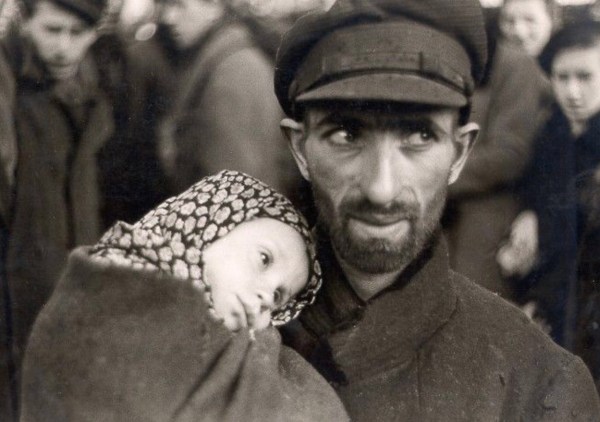
Chaim Kaplan, an unemployed former Jewish day school principal and resident of the Warsaw Ghetto, recorded the mood as the Jews received increasingly distressing news of German military victories on the western front in the summer of 1940:
All normal conduct of business has ceased. In place of business, peddling has come, and the place for all such vending is in the street. So the streets are filled with men, women, and little children, as in the good old days, even though all the stores are closed and the houses demolished. Mob upon mob fills the sidewalks until it is as crowded as a market day. And every crowd of vendors is also a crowd of politicians. Every oddity finds listening ears and spreads so fast that within an hour “all of Warsaw” is discussing it. There is no limit to the lies.
Our Jews don’t believe in the murderer’s victories in France. The newspapers announce victories which cannot be denied, whose truth is apparent — yet the Jews don’t admit them. They stick to their conviction: The Germans will end in destruction.
The Rebbe’s message for parashat Naso resonated with the themes of Shavuot and the receiving of the Torah. He exhorted his Hasidim to invest themselves in Torah study and Hasidic life with every fiber of their being, even under the pressurized environment of the Ghetto:
It is not sufficient for a person to merely perform a commandment to fulfill one’s duty as a Jew, rather one must transform one’s self into a Jew in the sense of and you will be a nation of priests unto Me, and a holy nation. This is the transformation represented by the phrase,and you will be. Consequently, the Jew must employ one’s entire character, nature, and inclinations for the purpose of holiness.
A parable is mentioned in the work Zot Zikaron by the righteous and holy Rabbi of Lublin in the name of the great and holy Maggid that when a person wishes to arouse love of God before prayer, one should contemplate one’s love for one’s children or even material possessions. Stirred by this love, the Jew should then recall that these blessings represent the greatness and kindness that God has bestowed, and this will inspire greater love of God. In other words, even one’s base love of material possessions are elevated into a love of God.
The Rebbe was cognizant, however, that many in his audience had lost all their possessions, and indeed many had lost children–the Rebbe himself lost his only son and daughter-in-law in the brutal Luftwaffe bombing during the initial invasion of Warsaw in the fall of 1939. He tempered his spiritual directives with an acknowledgment of the suffering of his Hasidim, yet stressed the importance of renewed spiritual effort in a new reading of Exodus 15:2, this is my God, Whom I will exalt; the God of my father, Whom I will glorify.
All this, however, is impossible when a person is immersed in suffering, Heaven forbid, and for this we pray that God save us with great acts of loving kindness, as my father of blessed memory wrote regarding the words and perform for us great acts of loving kindness. While everything that God does for us is an act of loving kindness, we pray that he should perform acts which also appear to us as good. For even if we perform commandments, if we do so while we are downtrodden, then we do not perform them with the depths of our being. Is it possible to immerse oneself in the study of Torah when one’s mind is ailing? Is it possible to experience fiery enthusiasm when one’s heart is sick, Heaven forbid? This is my God–this is my personal God, Whom I will serve with my innermost being, and also the God of my father, Whom I will glorify. I will not be satisfied with the sense of holiness and Divine Service which I inherited from my ancestors, rather Iwillalsoexalt God.
The Rebbe brought his drashah to a close with a prayer for concrete, material blessings of redemption for his Hasidim, alluded to in the Priestly blessing that appears in the Torah reading:
“Each generation according to its interpreters, its interpreters according to their generation.” An interpreter must be in touch with his generation, in order that he be closer to them and their inclinations so that he may train their distinctive natures to Divine Worship. Similarly, the salvation that God affords them should not remain beyond them, in some sort of metaphysical sense alone, rather the salvation should be drawn down them personally and for their practical benefit. As it is written in my holy father’s work, that Abraham our father should not say, “you fulfilled the prophecy of and they will will enslave and torture them, [but you have not fulfilled and I will take them out amidst great wealth],” for were it not for this claim, God could have fulfilled the prophecy and afterwards they will go out with great wealth, referring only to great spiritual wealth. In order that Abraham our father [should not make this claim], God fulfilled this prophecy in concrete terms, with silver and gold.
This is the sense of thus shall you bless the Jewish people…may God bless you. Granted, God will bless them, but they will place My name on the Jewish people, meaning literally upon them, and not remain merely above them, in a manner that will only benefit them in Heaven alone. They are, after all, human beings, and need even physical salvation, as Rashi comments on these [priestly] blessings, “with children” and “with possessions.”
Torah from the Years of Wrath, 1939-1943: The Historical Context of the Aish Kodesh