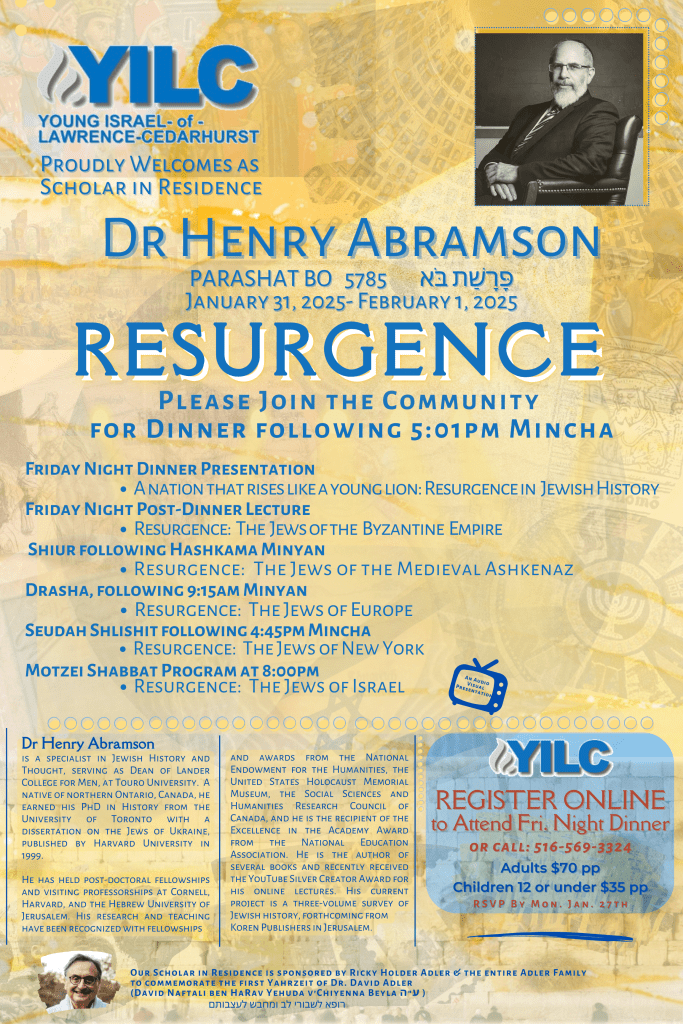
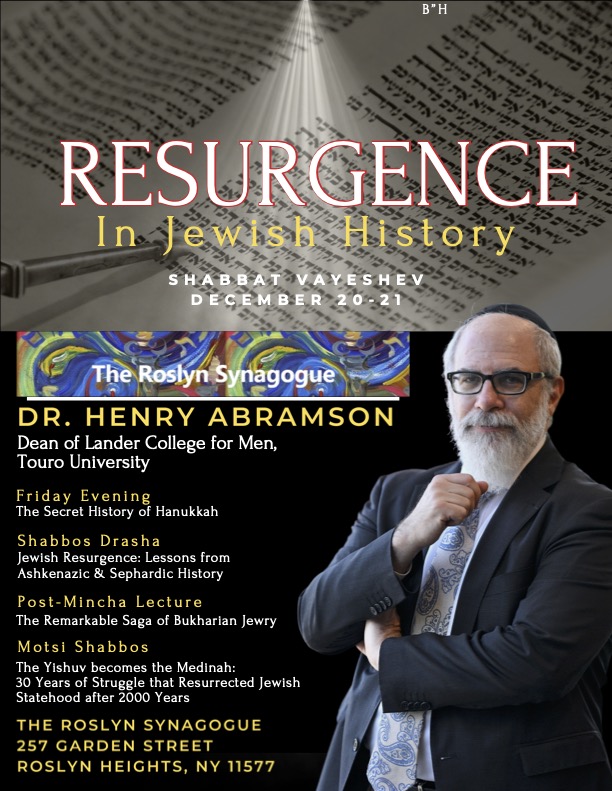
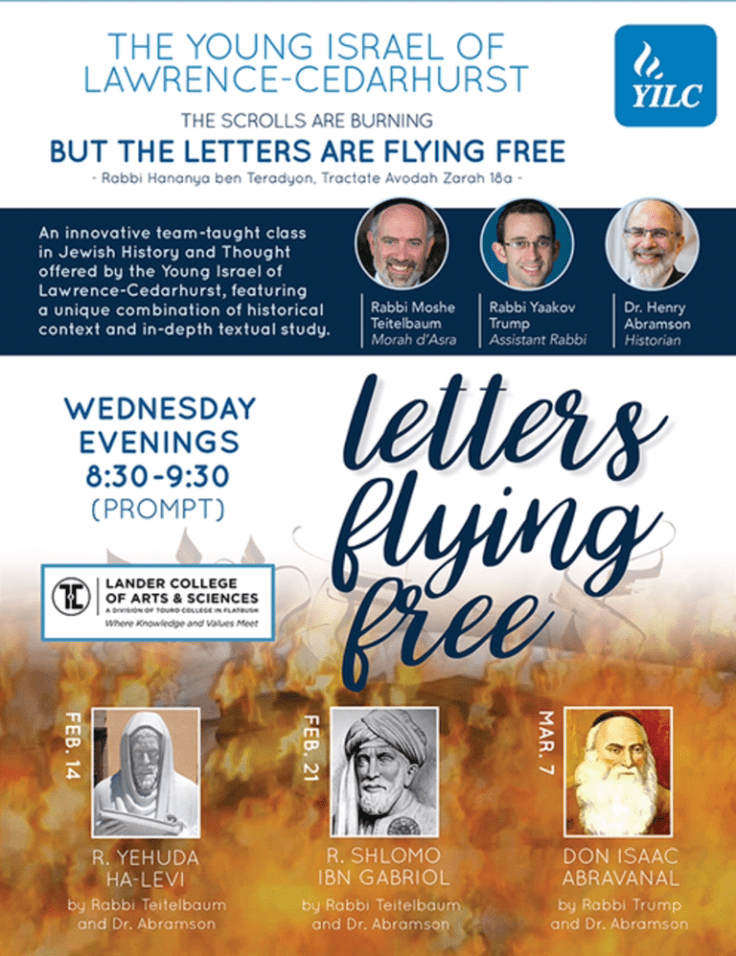
Really looking forward seeing my friends at YILC!

Lectures in Jewish History and Thought. No hard questions, please.


We’re starting on Monday! Please visit http://www.jewishhistorylectures.org for details on the schedule. Free and open to the community, Monday nights at 7:00 pm at the mighty Avenue J campus of Touro College, 1602 Avenue J, Brooklyn NY 11230. Call (718) 535-9333 or write to me at henry.abramson@touro.edu. Some sponsorships are still available ($250 per lecture),…

Searching for an escapee from the notorious Pawiak Prison, the Nazis arrested 255 Jewish leaders in the Warsaw Ghetto, holding them hostage and demanding that the community turn over the 21-year old resistance fighter Andrzej Kott. The rebel was not found. The Jewish hostages were eventually killed. The Rebbe was forced to spend that Sabbath…

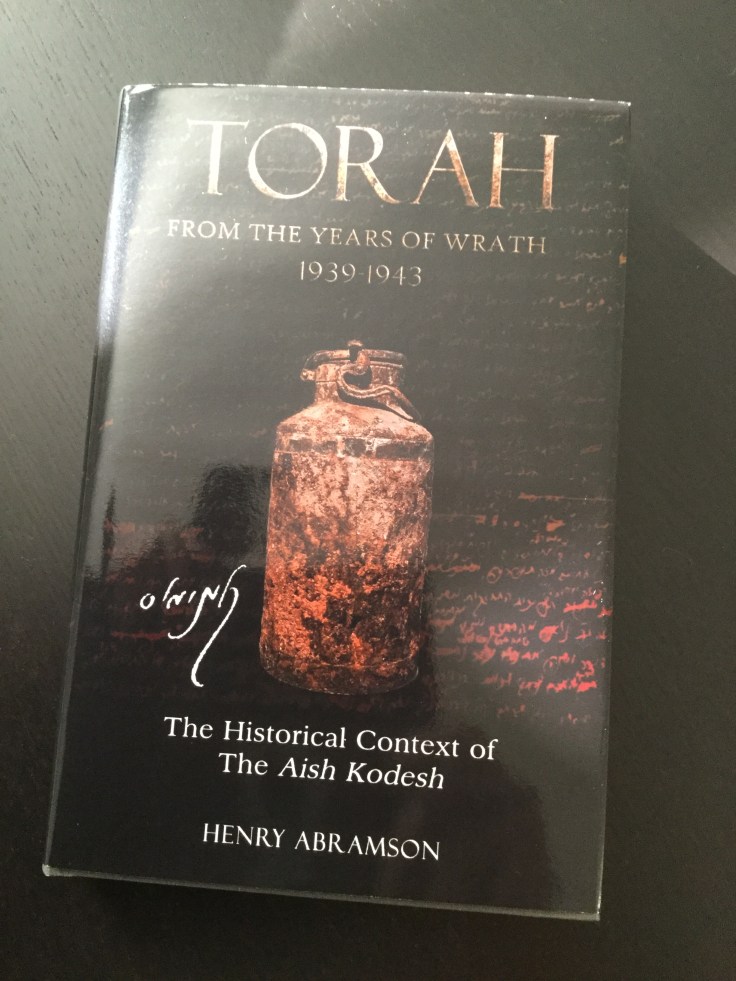
Just got my first copy of the hardcover edition of Torah from the Years of Wrath: The Historical Context of the Aish Kodesh. Special thanks to Mr. Sam Sapozhnik for making this possible! The hardcover edition hasn’t migrated yet to Amazon, but the good news is that I can offer my students, colleagues and friends 20%…

I’m really thrilled to be cruising the Douro River this summer with Kosher Riverboat Cruises, lecturing on the history of Spanish and Portuguese Jewry (my wife plans to come along, which means I really have to bring my A-game). I just learned that there’s only 18 cabins left, so if you’re interested, please click the…

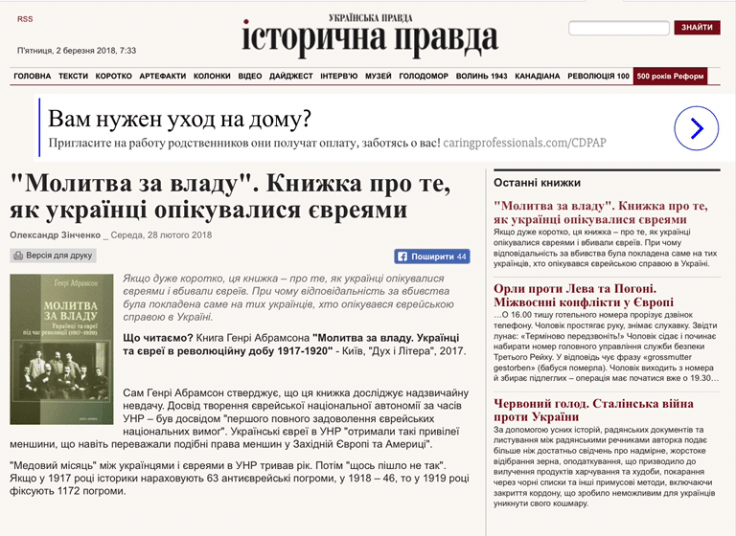
Conference presentation at the “The 100th Anniversary of the Ukrainian Revolution and the Proclamation of Ukraine’s Independence,” held at the Ukrainian Institute, New York, Sunday, January 21. My talk was inspired by a thought-provoking article in the Forward by Avital Chizik-Goldschmidt. A fascinating panel, which included Anna Procyk of CUNY, Serhy Yekelchyk of University of…

On Parashat Beshalah (January 20, 1940), a young rebel escaped from the notorious Pawiak Prison, located not far from the Piaseczno Bet Midrash. Andrzej Kott, the 21-year old leader of the military wing of a resistance movement called the Polish People’s Independence Action, was a child of assimilated Jewish parents who had converted to Christianity.…

The recent translation of the work of Rabbi Shimon Gershon Rosenberg (Rav Shagar, 1949-2007) promises to elevate his distinctive thought to a broader audience of readers (Faith Shattered and Restored: Judaism in the Postmodern Age), many of whom will resonate with Dr. Yitzchak Mandelbaum’s comment on his discovery of Rav Shagar: “I knew I had…

The Rebbe’s entry for Parashat Bo (January 13, 1940) is unusual. Recorded in the scribe’s careful hand, with minimal annotation, it has two bold diagonal lines drawn through the center of the text, indicating that the Rebbe rejected it altogether. A brief and uncharacteristic first-person comment is appended: “more of what we said I do…

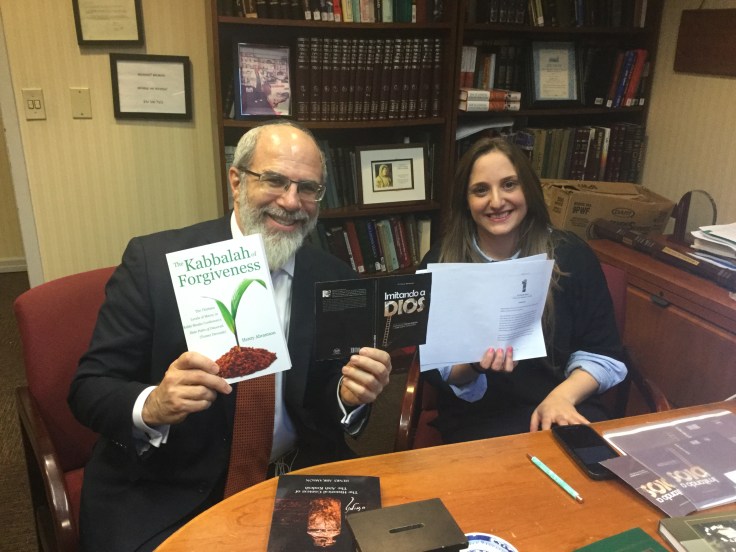
Really nice to meet with Jésica Neuah of Editorial Perspectivas to work on the tentative cover and book design of the Spanish edition of The Kabbalah of Forgiveness! Great to work with her and the whole team. G-d willing the book will be released in the summer of this year.

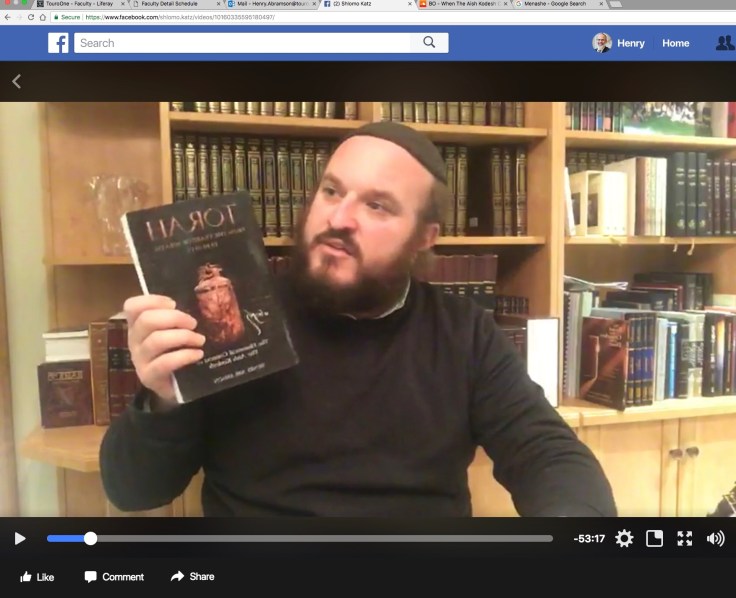
I had chills listening to Rabbi Shlomo Katz review the Rebbe’s words on this week’s parashah. I am grateful for his kind words of praise for my recent book on the historical context of the Aish Kodesh, but to tell the truth, I hardly recognized my own words from the masterful treatment they received from…

Chaim Kaplan recorded the mood in the Warsaw Ghetto in January 1942: The cold is so intense that my fingers are often too numb to hold a pen. There is no coal for heating and electricity is sporadic or nonexistent. In the oppressive dark and unbearable cold your mind stops functioning. Yet even in such…

Five months into the Nazi occupation, the Jews of Warsaw struggled to keep up with the barrage of administrative decrees inflicted upon them by the Germans. When the Rebbe spoke on Parashat Vaera, which fell on January 6, 1940, the worst was still far off. The Nazis had replaced the leadership of the Jewish Council…


Tonight at Machon Chana: part two of The History of Sephardic Jewry series. Last week we looked at the origins of Spanish Jewry and the Muslim period; tonight we will focus on the Reconquista up to the Expulsion of 1492.

Main Auditorium of the Mighty Avenue J campus of Touro College 1602 Avenue J, Brooklyn NY 11230 7pm Free and open to the community. No hard questions, please. For more information please click here.

My old friend Dr. Michael Chigel tagged me on Facebook this morning with his remarkably kind and generous unsolicited review of Torah from the Years of Wrath. I’m deeply moved and grateful to Mike for promoting the Torah of the Aish Kodesh, as well as for the undeserved praise he lavished on my small contribution, but also…

Very pleased to see this revised edition of my first book available. Includes a new foreword and afterword.

To the Hasidim steeped in the religious significance of the ritual calendar, the Sabbath known as Zakhor (March 23, 1940) must have seemed a cruel redundancy. Literally called “remember,” the Sabbath preceding the holiday of Purim is named for a few publicly read Torah verses (Deuteronomy 25:17-19) that memorialize the attack of Israel’s primordial enemy,…

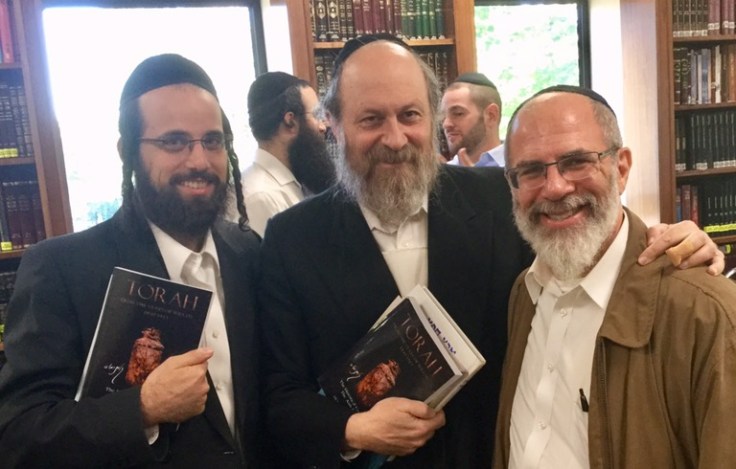
Hey friends in Crown Heights! Please drop by and say hello.

(Well, not Yehudah Ha-Levi, but a lecture about the great Spanish-Jewish poet-philosopher of the 12th century). With Rabbi Moshe Teitelbaum.

Sponsored by Brandon Sultan in honor of the Sultan and Benarroch Families, whose Sephardic roots are expressed in a desire to honor the Convivencia; and also in loving memory of Mrs. Jean Milstein, whose relentless optimism was an inspiration to all.
Just like that. Watch for our Shul President, Jeremy Chwat, and his wife–he apparently has an unusual motivation for coming to Shul three times a day, and she has a great, euphemistic comeback.

Someone told me that this was printed in The Vues. I’m not a Rabbi, but I’m kind of pleased that Ari Hirsch asked for my opinion anyway. Makes me feel like I actually belong in Brooklyn, somehow, if I’m included in this paper known as “the Heimishe Voice.”

The last weeks of winter 1942, ironically, represented a kind of plateau for the Jews of Warsaw. The typhus epidemic abated, and the Nazis had established some work facilities (“shops”) that led many to believe that through productive labor, the Jews would endure. The general feeling was, in the words of historians Barbara Engelking and…

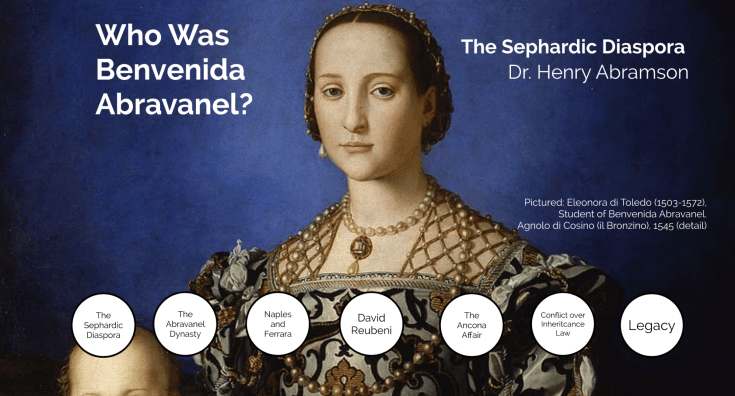
The life and times of an important woman of the early post-Expulsion generation of Sephardic Jews. Can’t see the video? Click here please.