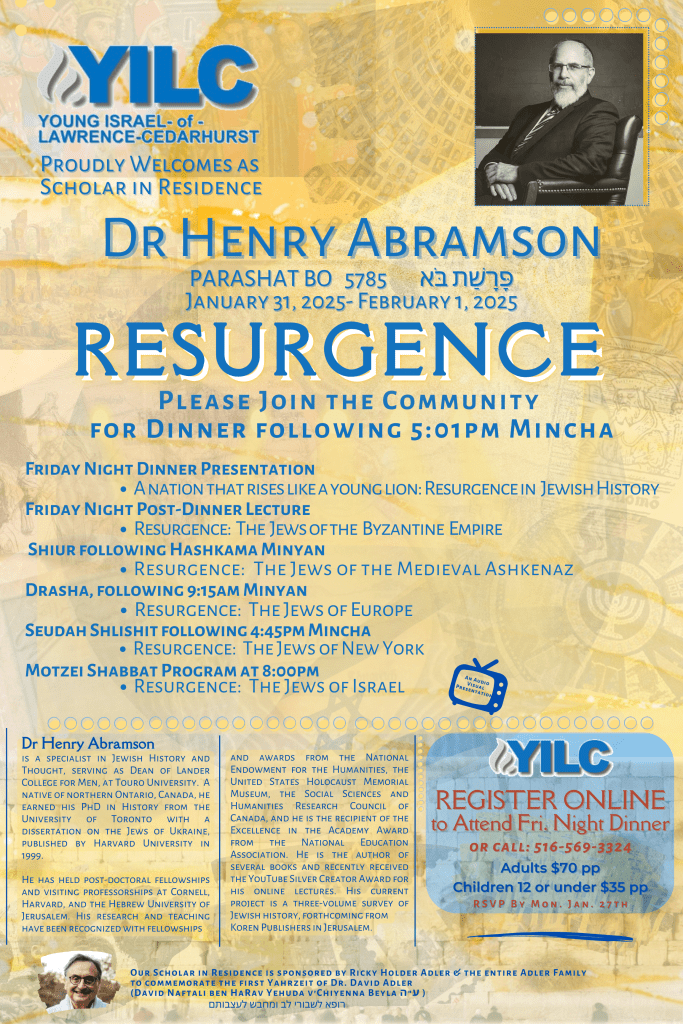
Really looking forward seeing my friends at YILC!

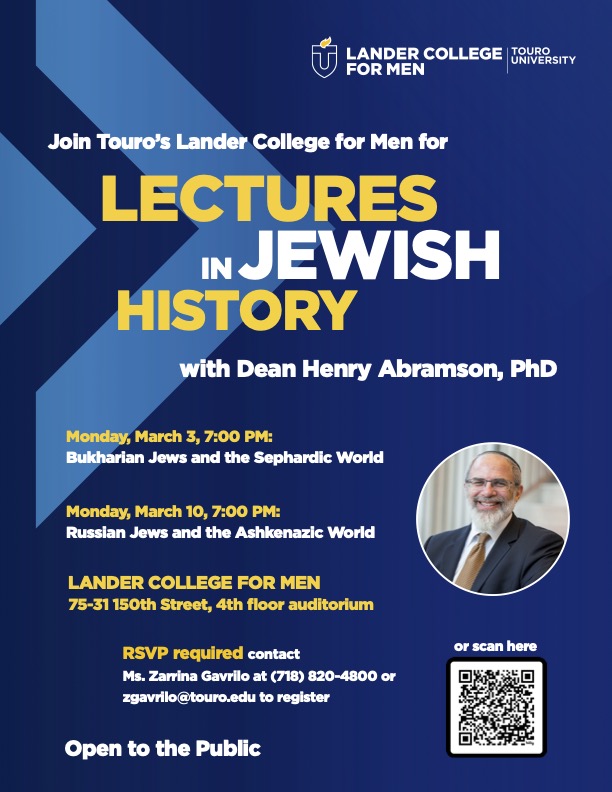
Lectures in Jewish History and Thought. No hard questions, please.


Tonight at Machon Chana: part two of The History of Sephardic Jewry series. Last week we looked at the origins of Spanish Jewry and the Muslim period; tonight we will focus on the Reconquista up to the Expulsion of 1492.

Main Auditorium of the Mighty Avenue J campus of Touro College 1602 Avenue J, Brooklyn NY 11230 7pm Free and open to the community. No hard questions, please. For more information please click here.

My old friend Dr. Michael Chigel tagged me on Facebook this morning with his remarkably kind and generous unsolicited review of Torah from the Years of Wrath. I’m deeply moved and grateful to Mike for promoting the Torah of the Aish Kodesh, as well as for the undeserved praise he lavished on my small contribution, but also…

Very pleased to see this revised edition of my first book available. Includes a new foreword and afterword.

To the Hasidim steeped in the religious significance of the ritual calendar, the Sabbath known as Zakhor (March 23, 1940) must have seemed a cruel redundancy. Literally called “remember,” the Sabbath preceding the holiday of Purim is named for a few publicly read Torah verses (Deuteronomy 25:17-19) that memorialize the attack of Israel’s primordial enemy,…

Hey friends in Crown Heights! Please drop by and say hello.

(Well, not Yehudah Ha-Levi, but a lecture about the great Spanish-Jewish poet-philosopher of the 12th century). With Rabbi Moshe Teitelbaum.

Sponsored by Brandon Sultan in honor of the Sultan and Benarroch Families, whose Sephardic roots are expressed in a desire to honor the Convivencia; and also in loving memory of Mrs. Jean Milstein, whose relentless optimism was an inspiration to all.
Just like that. Watch for our Shul President, Jeremy Chwat, and his wife–he apparently has an unusual motivation for coming to Shul three times a day, and she has a great, euphemistic comeback.

Someone told me that this was printed in The Vues. I’m not a Rabbi, but I’m kind of pleased that Ari Hirsch asked for my opinion anyway. Makes me feel like I actually belong in Brooklyn, somehow, if I’m included in this paper known as “the Heimishe Voice.”

The last weeks of winter 1942, ironically, represented a kind of plateau for the Jews of Warsaw. The typhus epidemic abated, and the Nazis had established some work facilities (“shops”) that led many to believe that through productive labor, the Jews would endure. The general feeling was, in the words of historians Barbara Engelking and…

The life and times of an important woman of the early post-Expulsion generation of Sephardic Jews. Can’t see the video? Click here please.


Dedicated to the memory of my father: A new translation and commentary of Moses Maimonides’ classic work on repentance. Softcover, 253 pages, illustrations. $18 after August 3, pre-order now for special price of $9 plus shipping. 5th edition (2017) Visit bit.ly/ordermot for more details.

Dedicated to the memory of my father: A new translation and commentary of Moses Maimonides’ classic work on repentance. Softcover, 253 pages, illustrations. $18. Click here to order.

All lectures will be held in the Main Auditorium of the mighty Avenue J Campus 7:00 PM Free and Open to the Community Touro College 1602 Avenue J Brooklyn, NY 11230 September 11 September 18 September 25 October 2 No Class October 9 October 16 October 23 October 30 November 6 November 13…

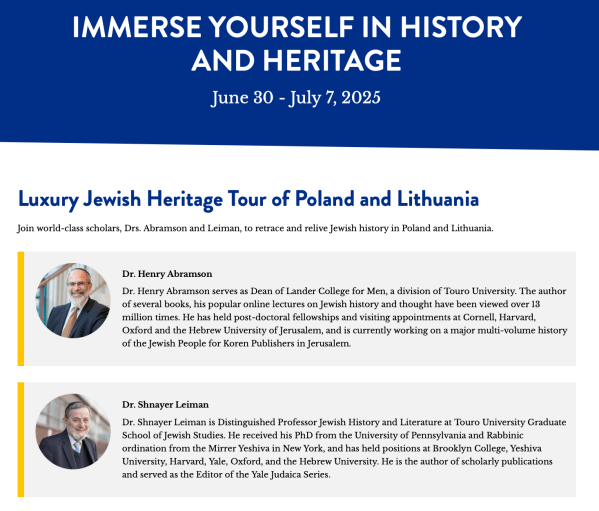
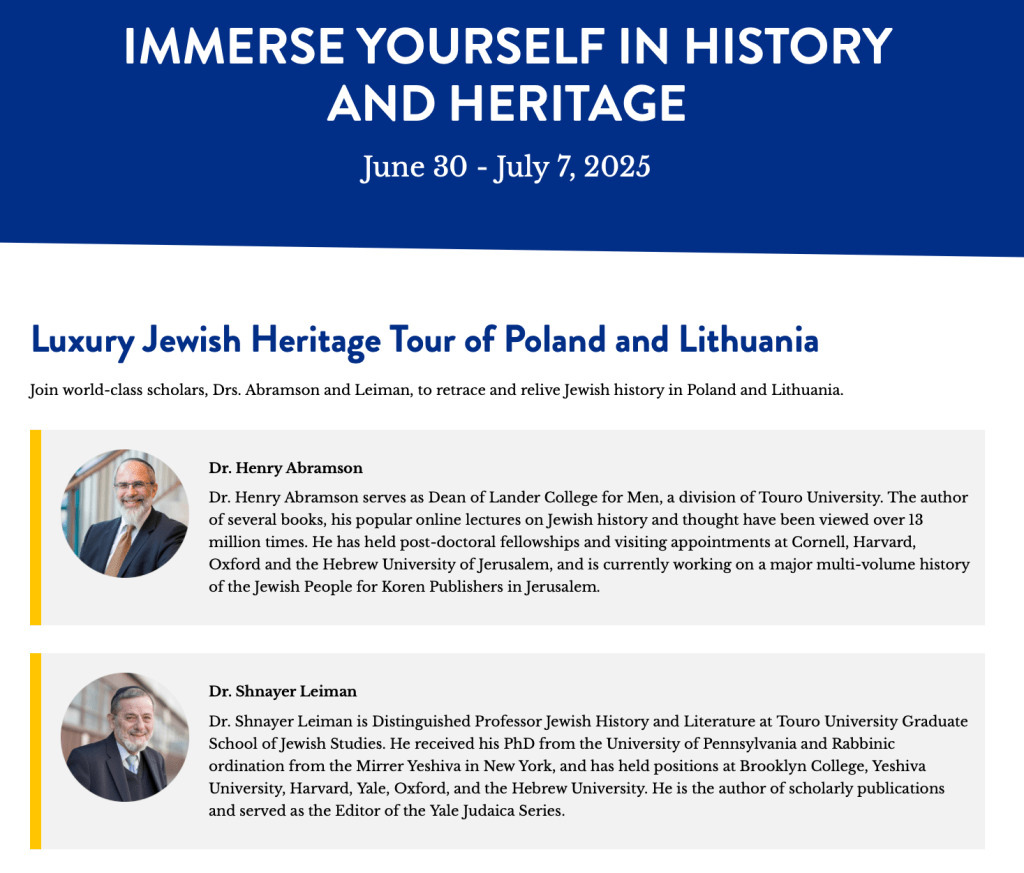
This amazing trip is now open to non-matriculated, visiting students! Join us–it promises to be a fantastic experience. Email me at abramson@touro.edu for more information.
The sixteenth century witnessed a phenomenal, short-lived explosion of Jewish spiritual creativity, centered in the sleepy Galilean town of Safed (Tsfat). Along with greats such as Rabbi Yosef Karo, Rabbi Moshe Cordovero was one of the founders of that unusual place, attracting still more Rabbis and especially Kabbalists to the mountaintop community, including Rabbi…
A brilliant 13th-century scholar of Rabbinic thought, Nahmanides’ defense of Judaism in a forced Church-sponsored debate earned him exile from his native Spain. An elderly sage, he emigrated to the Land of Israel, where he found a tiny Jewish community, desperately hanging onto the traditions of their ancestors. Summoning upon an immense reserve of energy,…
Brief survey of the major historical developments and themes affecting the land of Israel between the 2nd-century Bar Kochba rebellion and the Muslim conquest in the seventh century. Part of the Israel: The Land and its People series.
Certainly one of the greatest Rabbis of the entire Talmud, Akiva son of Joseph did not begin his study of Judaism before adulthood. His trajectory of incredible spiritual growth was punctuated by moments of great personal tragedy, and his martyrdom at the hands of the Romans after the failed second-century Bar-Kochba revolt has an enduring…
One of the greatest builders of ancient Israel, King Herod exploited his power as a Roman-sponsored ruler to develop the Temple, yet earned a reputation as a feared tyrant responsible for horrific massacres. HIs rule set the tone for the political climate in the Land of Israel during the tumultuous decades prior to the growth…
Born in the times of the Hasmonean rebellion celebrated with the holiday of Chanukah, Yohanan Cohen Gadol was one of the most prominent Jewish leaders during the brief period of Jewish freedom in the 2nd century BCE. Caught in the swirling controversy of internal religious debate, in his old age he abandoned his Pharisaic roots…
“Sweet singer of Israel,” David was the poet-warrior King who led the Jewish people to political and cultural prominence. Denied his most cherished goal of building the Temple, he lived a life of great personal challenge and heroic resurgence from tragedy, and his biography left an indelible mark on the Jewish understanding of leadership.