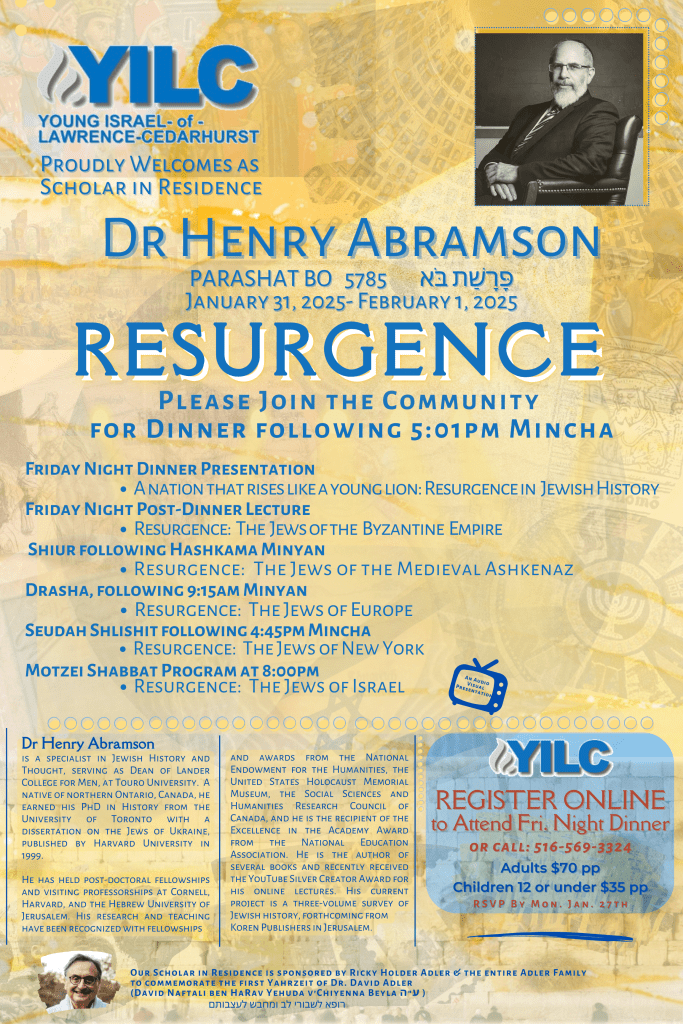
Really looking forward seeing my friends at YILC!

Lectures in Jewish History and Thought. No hard questions, please.


Compiled by Rabbi Yehuda Ha-Nasi in an exceptionally difficult time for the Jewish people, the Mishnah created the possibility of creating a “portable Judaism.” After the destruction of the Temple in 70 and the dramatic escalation of the diaspora, the Mishnah allowed Jews to define their religion within an intellectual and textual context, outside of…

Virtually ignored by Jewish philosophers, Philo of Alexandria represented the high point of synthesis between Greek and Jewish thought in the ancient world, and had a huge influence on early Christian thinkers. A prominent representative of the Egyptian Jewish community to the Roman Emperor, and well-respected in his day by his coreligionists, he nevertheless had…

Wrongly accused of espionage, Captain Alfred Dreyfus was sentenced to Devil’s Island on the basis of remarkably tenuous evidence. May critics, including the famous writer Emile Zola, argued that Dreyfus was unfairly charged simply because he was a Jew in the French army. As evidence mounted that another officer was guilty, the Dreyfus Affair exposed…

Captured by the Romans, Josephus was a Jewish general who ultimately served as a military advisor to General Titus. Josephus recorded his first-hand observations of the destruction of the Temple, and went on to a brilliant literary career in Rome, describing Jews and Judaism to a wider audience. Who was Josephus–traitor to his people or…
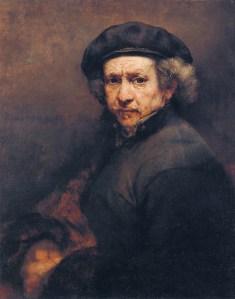
Rembrandt is well-known for his depictions of Jewish subjects, both as contemporary portraits and as models for Christian biblical characters.

Photo: Aryeh Abramson looks out over Iroquois Falls, Ontario, Canada, where he spent the Sukkot vacation visiting his grandparents. Captured by the Roman General (and later Emperor) Vespasian while defending the Galilee, Josephus ultimately turned against his coreligionists and served as an advisor to the forces besieging Jerusalem during the first Roman-Jewish War. His first-hand…

Moses Maimonides (1135-1204) was one of the greatest minds the Jewish people ever produced: philosopher, jurist, physician, and an extremely prolific writer who left us classics like The Guide for the Perplexed and the Mishneh Torah. For several years I have been in the habit of reviewing his Laws of Repentance in the weeks leading up to the…

Pope Gregory I (“the Great”) was one of the most influential Church leaders of the medieval period. His policy on the treatment of Jews in Christian Europe, known by the Latin phrase “Sicut Judaeis,” instituted an official if ambivalent position that lasted from the sixth century to the beginnings of the modern era.

Reeling from the humiliating defeat of the Crimean War, the Russian Empire decides its policy of forcibly conscripting Jewish boys into military service is counterproductive, and finally abandons the cruel decades-old policy of taking underage children into thirty-one years of military training and service.

To view the Prezi associated with this lecture, please click here. Excerpt from “The Jewish Diaspora: A Brief History” Henry Abramson 3. The Roman-Jewish Wars Our sources for the Roman-Jewish wars of the first and second centuries are more substantial than those of earlier periods, primarily because the importance of developments in this tiny…

Born in turbulent times, Christianity emerged from its intensely Jewish roots to become the official religion of the Roman Empire within a remarkably brief period of time. As a daughter religion to Judaism, however, dissent between the two faiths slowly dominated the discourse as Christianity became less of a Jewish movement, and more of a…


Wednesday Nights at 8:00 pm October 22: Rabbi Yohanan ben Zakkai October 29: Salome November 5: Bar Kokhba November 12: Shimon bar Yochai November 19: Abaye’s Mother November 26: Eldad the Danite December 3: Aaron of Lincoln December 10: Amnon of Mayence December 17: Abraham ibn Ezra December 24: Qasmunah All lectures…

Brief video highlighting the life and work of Rabbi Israel Meir Kagan (1838-1936), one of the most influential Rabbis of the 20th century. Better known as the Chofetz Chaim (*one who desires life,” taken from Psalm 34).

Conclusion “The Insulted King,” Illustration of Level 1 by Rebecca Odessa, Courtesy The Wisdom Daily Rabbi Cordovero’s Conclusion עַד כַּאן הִגִּיעַ שְׁלֹשׁ עֶשְׂרֵה מִדּוֹת שֶׁבָּהֶן יִהְיֶה הָאָדָם דּוֹמֶה אֶל קוֹנוֹ שֶׁהֵן מִדּוֹת שֶׁל רַחֲמִים עֶלְיוֹנוֹת וּסְגֻלָּתָן כי כְּמוֹ שֶׁיִּהְיֶה הָאָדָם מִתְנַהֵג לְמַטָּה כָּךְ יִּזְכֶּה לִפְתֹּחַ לוֹ מִדָּה עֶלְיוֹנָה מִלְמַעְלָה מַמָּשׁ כְּפִי מַה שֶּׁיִּתְנַהֵג כָּךְ מַשְׁפִּיעַ מִלְמַעְלָה…

The Thirteenth Level: The Moment of Innocence “The Moment of Innocence,” illustration of Level 13 by Rebecca Odessa, Courtesy The Wisdom Daily The Thirteenth Level: The Moment of Innocence Translator’s Introduction The Thirteenth and final Level of mercy carries an absolute guarantee: one who masters this level can forgive anyone. The Thirteenth Level renders all…

The Twelfth Level: Remember Where They Came From “Family Tree (Remember Where They Came From),” illustration of Level 12 by Rebecca Odessa, Courtesy The Wisdom Daily The Twelfth Level: Remember Where They Came From Translator’s Introduction The final element of the triad is Level Twelve. In Level Ten we…

The Eleventh Level: Do More for Those Who Do More “Serve and Protect (Do More for Those Who Do More),” illustration of Level 11 by Rebecca Odessa, Courtesy The Wisdom Daily The Eleventh Level: Do More for Those Who Do More Translator’s Introduction The second part of the triad of Levels Ten, Eleven and Twelve…

The Tenth Level: Do the Right Thing Anyway “The Hook (Do the Right Thing Anyway),” illustration of Level 10 by Rebecca Odessa, Courtesy The Wisdom Daily The Tenth Level: Do the Right Thing Anyway Translator’s Introduction The Tenth, Eleventh and Twelfth Levels together comprise a triad of strategies for forgiving others, particularly people with whom…

The Ninth Level: Bury the Past “The Scapegoat (Bury the Past),” illustration of Level 9 by Rebecca Odessa, Courtesy The Wisdom Daily The Ninth Level: Bury the Past Translator’s Introduction The Ninth Level of Mercy addresses a principal common to both Kabbalah and physics: energy never dissipates of its own accord; rather it is redirected…

The Eighth Level: Maintain a Core of Love “Maintain a Core of Love,” illustration of Level 8 by Rebecca Odessa, Courtesy The Wisdom Daily The Eighth Level: Maintain a Core of Love Rabbi Cordovero expands upon the metaphysics of forgiveness in the Eighth Level. God preserves a core region of positive regard for every human…

The Seventh Level: A Knot is Stronger “Building a Fence (A Knot is Stronger),” Illustration of Level 7 by Rebecca Odessa, Courtesy The Wisdom Daily The Seventh Level: A Knot is Stronger Translator’s Introduction Rabbi Cordovero begins the Seventh Level of Mercy with a well-known teaching from the Talmud (Berakhot 34b): “in a place where penitents…

The Sixth Level: Who Makes Your Lunch? “Who Makes Your Lunch?” illustration of Level 6 by Rebecca Odessa, Courtesy The Wisdom Daily The Sixth Level: Who Makes Your Lunch? Translator’s Introduction The Sixth Level begins with a deeply mystical passage in Ezekiel, set in the years immediately prior to the 6th century BCE destruction of…

The Fifth Level: Release the Anger “Release the Anger,” illustration of Level 5 by Rebecca Odessa, Courtesy The Wisdom Daily The Fifth Level: Release the Anger Translator’s Introduction The prophet Zechariah portrays God as a shepherd with two staffs: one is called “pleasantness” (נאם) and the other is called “woundings” (חובלים). In his commentary on Date…