Monday March 3: Please join me for this public lecture!
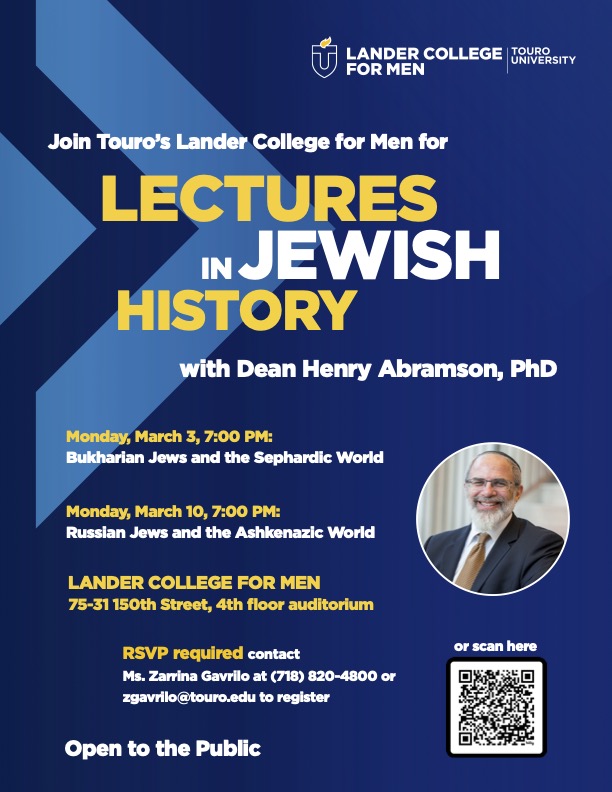
Lectures in Jewish History and Thought. No hard questions, please.

Contact their offices for details:


With Dr. Sharon Liberman Mintz, Judaica curator for Southeby’s, at a private viewing of this amazing 14th century Spanish Bible.






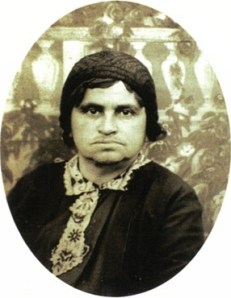

Sarah Schenirer (1883-1935) founded the Bais Yaakov (Bet Ya’akov) school system for women. One of the most visionary educators of the twentieth century, her movement had global impact. To view the Prezi associated with this lecture, please click here.

Baptized at age 12 as the result of his father’s dispute with a synagogue, Benjamin Disraeli (1804-1881) rose to prominence as a novelist and politician, serving several times as England’s Prime Minister. Colorful and flamboyant, Disraeli dismissed his antisemitic critics by emphasizing, rather than downplaying, his Jewish origins.

The discovery of the mutilated body of a young boy in Kiev led to the false arrest of a Jewish laborer named Mendel Beilis. Ignoring the argument of investigating officers, the Russian government under Tsar Nicholas II pressed ahead with the prosecution of Beilis, arguing that the boy was murdered as part of a Passover-related…
A thematic introduction to the topic of women in Jewish history, part of the Essential Lectures in Jewish History series by Dr. Henry Abramson. To view the Prezi associated with this lecture please click here.
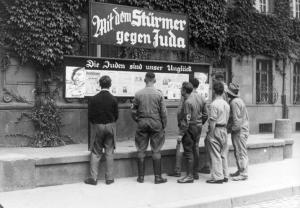
In October of 1946, ten Nazi defendants were hung on gallows erected by the International Military Tribunal. One of the most notorious, the propagandist Julius Streicher, uttered the phrase “Purimfest 1946” moments before his death, unconsciously echoing a mysterious passage in the Biblical book of Esther itself. Fascinating footnote in Jewish History!
Rabbi Yisrael Lipkin of Salant (Israel Salanter, 1810-1883) was the founder of the modern Mussar movement that revolutionized traditional Jewish education. Controversial during his lifetime, his ideas ultimately permeated the Yeshiva system as a whole. Part of the Jewish Biography as History series in Jewish History.
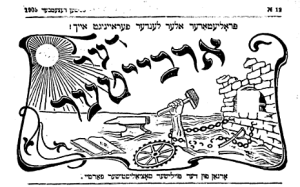
This lecture briefly covers the rise of mass Jewish politics at the turn of the 20th century, looking at the rise of Jewish Socialism, Zionism, and other movements. Part of the Essential Lectures in Jewish History series available at http://www.jewishhistorylectures.org. To view the Prezi associated with this lecture, please click here.

Blessed with a fine mind but an obstreperous personality, Salomon Maimon was one of the most erudite rebels against Judaism in the 18th century, leaving a powerful memoir that betrayed some of the stress points in traditional society.

Murder on Purim? That’s the charge of Socrates Scholasticus, whose lone account of an alleged Purim celebration that got out of hand in the year 415 has become part of the historical record, for good or ill. Although the validity of the accusation is highly questionable, the incident at Inmestar had a larger impact centuries…

The Haskalah was a major intellectual-political movement of the 18th and 19th centuries. Seeking political emancipation and intellectual freedom, it challenged the hegemony of the traditionalist authorities, leading to widespread assimilation on one hand but exceptionally creative solutions to modernity on the other. Part of the Essential Lectures in Jewish History series. To view the…
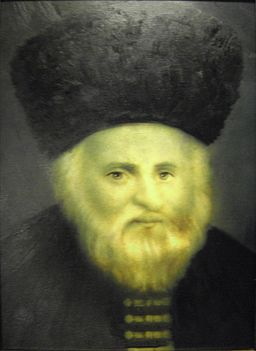
Rabbi Eliyahu ben Shlomo, the 18th century Talmudic scholar better known as The Vilna Gaon, is revered as the father of traditional Lithuanian Judaism. Part of the Jewish Biography as History series by Dr. Henry Abramson.

Dr. Bernard Lander (1915-2010) was one of the most influential Jewish educators of the 20th and 21st century. Scholar and social activist, he founded Touro College in 1971, which now serves almost 19,000 students world wide. This short video was prepared to commemorate the recent anniversary of his passing.
 Henry Abramson