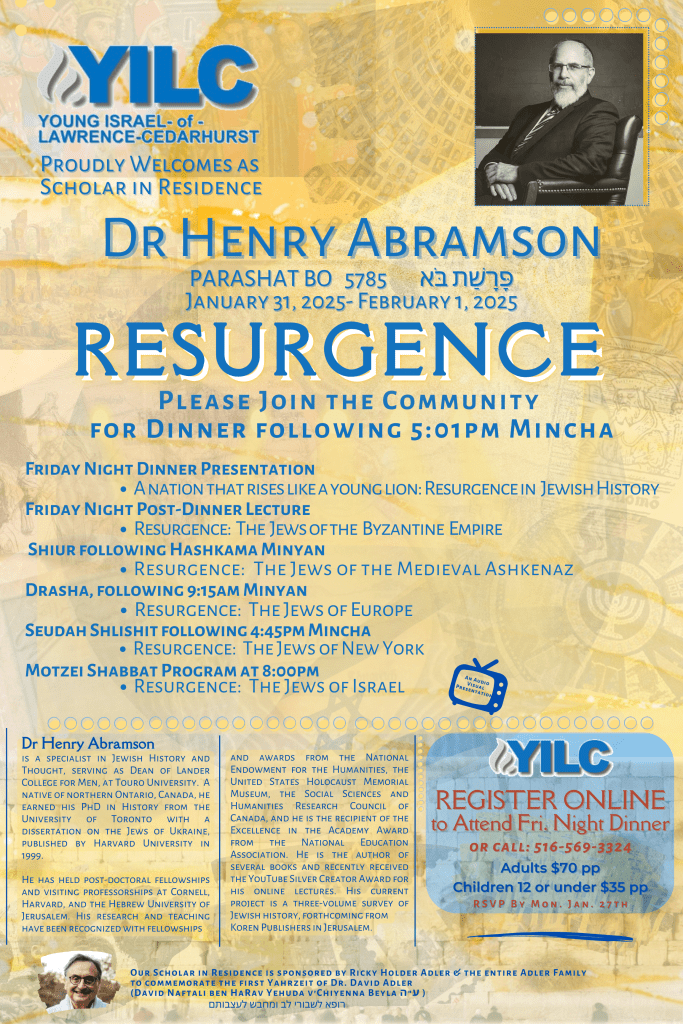
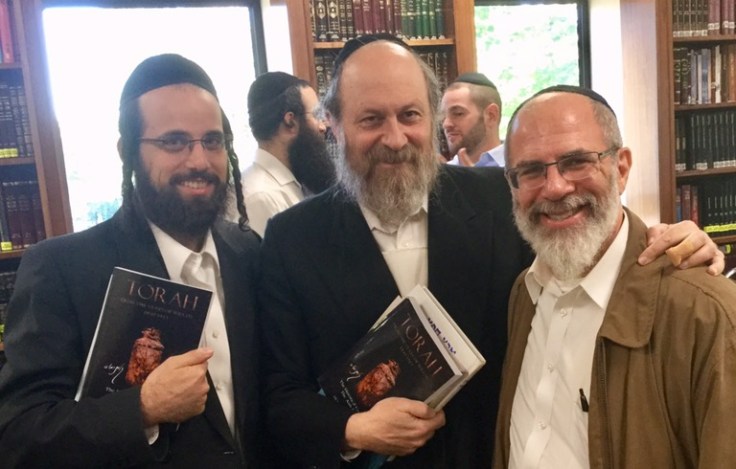
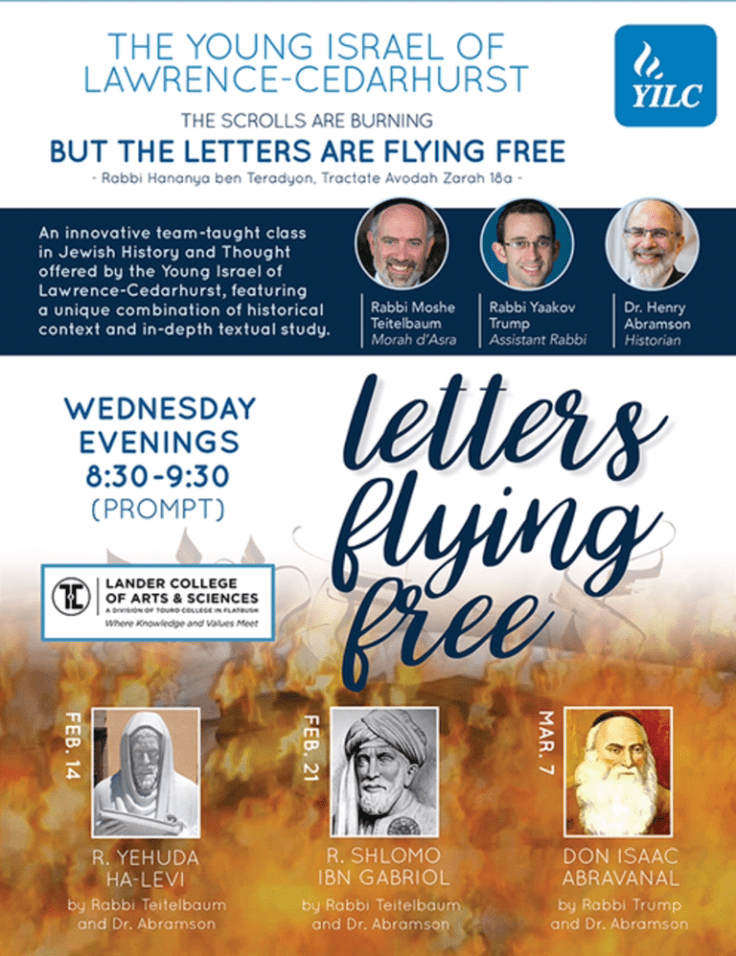
Really looking forward seeing my friends at YILC!

Lectures in Jewish History and Thought. No hard questions, please.


Tonight at Machon Chana: part two of The History of Sephardic Jewry series. Last week we looked at the origins of Spanish Jewry and the Muslim period; tonight we will focus on the Reconquista up to the Expulsion of 1492.

Main Auditorium of the Mighty Avenue J campus of Touro College 1602 Avenue J, Brooklyn NY 11230 7pm Free and open to the community. No hard questions, please. For more information please click here.

My old friend Dr. Michael Chigel tagged me on Facebook this morning with his remarkably kind and generous unsolicited review of Torah from the Years of Wrath. I’m deeply moved and grateful to Mike for promoting the Torah of the Aish Kodesh, as well as for the undeserved praise he lavished on my small contribution, but also…

Very pleased to see this revised edition of my first book available. Includes a new foreword and afterword.

To the Hasidim steeped in the religious significance of the ritual calendar, the Sabbath known as Zakhor (March 23, 1940) must have seemed a cruel redundancy. Literally called “remember,” the Sabbath preceding the holiday of Purim is named for a few publicly read Torah verses (Deuteronomy 25:17-19) that memorialize the attack of Israel’s primordial enemy,…

Hey friends in Crown Heights! Please drop by and say hello.

(Well, not Yehudah Ha-Levi, but a lecture about the great Spanish-Jewish poet-philosopher of the 12th century). With Rabbi Moshe Teitelbaum.

Sponsored by Brandon Sultan in honor of the Sultan and Benarroch Families, whose Sephardic roots are expressed in a desire to honor the Convivencia; and also in loving memory of Mrs. Jean Milstein, whose relentless optimism was an inspiration to all.
Just like that. Watch for our Shul President, Jeremy Chwat, and his wife–he apparently has an unusual motivation for coming to Shul three times a day, and she has a great, euphemistic comeback.

Someone told me that this was printed in The Vues. I’m not a Rabbi, but I’m kind of pleased that Ari Hirsch asked for my opinion anyway. Makes me feel like I actually belong in Brooklyn, somehow, if I’m included in this paper known as “the Heimishe Voice.”

The last weeks of winter 1942, ironically, represented a kind of plateau for the Jews of Warsaw. The typhus epidemic abated, and the Nazis had established some work facilities (“shops”) that led many to believe that through productive labor, the Jews would endure. The general feeling was, in the words of historians Barbara Engelking and…

The life and times of an important woman of the early post-Expulsion generation of Sephardic Jews. Can’t see the video? Click here please.


Nicholas Donin was an erstwhile Talmudic scholar who converted to Christianity and made a career of denouncing the Talmud. His charges, brought before the Pope, resulted in a massive destruction of priceless Jewish manuscripts in Paris, 1242. Part of the Jewish Biography as History lecture series by Dr. Henry Abramson.

Rabenu Gershom, Me’or Ha-Golah (Our Teacher Gershom, Light of the Exile) was one of the most influential Jewish legislators of the High Middle Ages, affecting a wide variety of Jewish practices including monogamy, divorce law, and the right to privacy. Part of the Jewish Biography as History lecture series by Dr. Henry Abramson.

Yocheved was the daughter of one of Judaism’s greatest scholars: Rabbi Shlomo Yitzhaki, better known as Rashi. A fascinating woman in her own right, this lecture will survey some of the references to Yocheved (and her illustrious sisters) and what light this sheds on the history of medieval Jewish women.

To view the Prezi associated with this lecture, please click here. http://www.youtube.com/watch?v=1OnArXdHQdc

L.L. Zamenhof (1859-1917) was a Polish Jew who invented the world’s most successful artificial language, Esperanto. Conceived as a vehicle for world peace, Esperanto is even regarded by the Oomoto religion of Japan as the “language of heaven.”

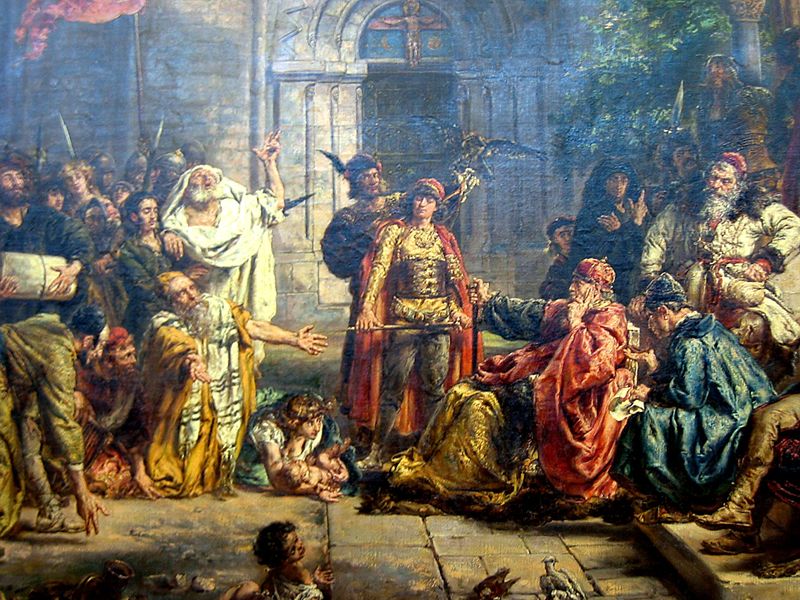
This week marks the death anniversary of King Boleslaw V (The Chaste) in 1279. Boleslaw followed the tradition of his predecessors in Poland by creating incentives for Jewish settlement in Poland, including the establishment of Magdeburg Recht. Ultimately, these policies proved extremely attractive to Ashkenazi Jews from the Rhineland, making Poland a great center of…

To view the Prezi associated with this lecture, please click here.

To view the Prezi associated with this lecture, please click here.

The Fourth Lateran Council, which met in 1215 at the behest of Pope Innocent III, issued several pieces of Church legislation with dire implications for Jews. The doctrine of transubstantiation was confirmed, leading to a new element in antisemitic canards: accusations that Jews “desecrated the host.”

Poet, politician and philosopher, Shmuel ha-Nagid was an exemplar of the Golden Age of Spanish Jewry.

In November of 1977, Egyptian President Anwar Sadat flew to Israel to address the Knesset. His meeting with his former enemy Prime Minister Menachem Begin ultimately resulted in the sometimes strained but nevertheless enduring Israel-Egypt peace accord, but his unpopularity with hardline Egyptians, opposed to making peace with Israel, resulted in his assassination in 1981.

To view the Prezi associated with this lecture, please click here. Excerpts from The Sea of Talmud: A Brief and Personal History Henry Abramson (2012) The Yeshiva administration must have put considerable thought into the wording of the hand-lettered sign posted outside the cafeteria. Many young men studying Talmud at this Jerusalem institution were taking…