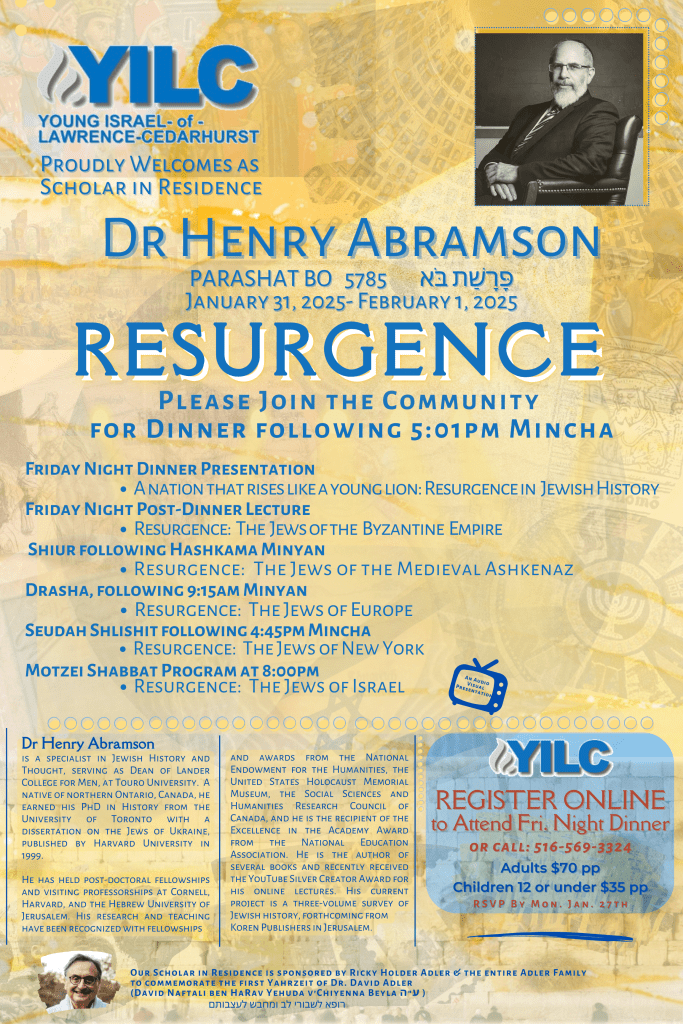
Really looking forward seeing my friends at YILC!

Lectures in Jewish History and Thought. No hard questions, please.


Nicholas Donin was an erstwhile Talmudic scholar who converted to Christianity and made a career of denouncing the Talmud. His charges, brought before the Pope, resulted in a massive destruction of priceless Jewish manuscripts in Paris, 1242. Part of the Jewish Biography as History lecture series by Dr. Henry Abramson.

Rabenu Gershom, Me’or Ha-Golah (Our Teacher Gershom, Light of the Exile) was one of the most influential Jewish legislators of the High Middle Ages, affecting a wide variety of Jewish practices including monogamy, divorce law, and the right to privacy. Part of the Jewish Biography as History lecture series by Dr. Henry Abramson.

Yocheved was the daughter of one of Judaism’s greatest scholars: Rabbi Shlomo Yitzhaki, better known as Rashi. A fascinating woman in her own right, this lecture will survey some of the references to Yocheved (and her illustrious sisters) and what light this sheds on the history of medieval Jewish women.

To view the Prezi associated with this lecture, please click here. http://www.youtube.com/watch?v=1OnArXdHQdc

L.L. Zamenhof (1859-1917) was a Polish Jew who invented the world’s most successful artificial language, Esperanto. Conceived as a vehicle for world peace, Esperanto is even regarded by the Oomoto religion of Japan as the “language of heaven.”

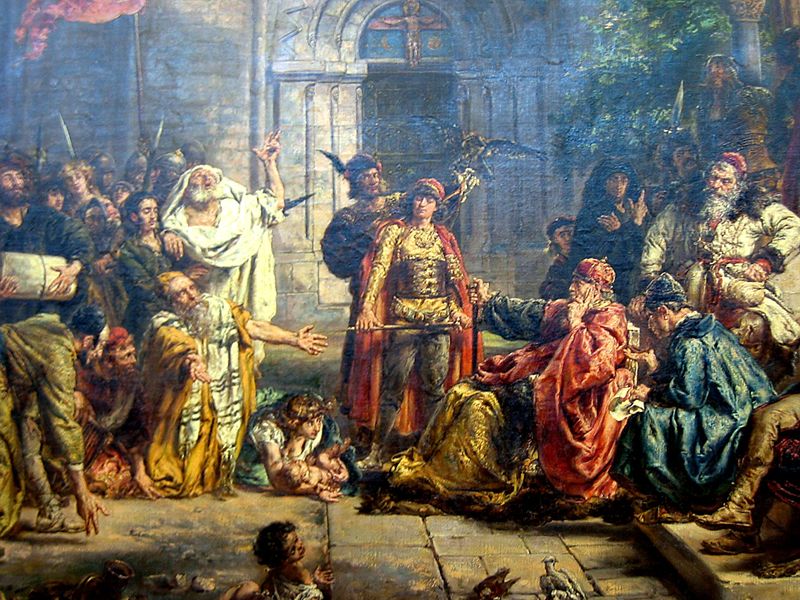
This week marks the death anniversary of King Boleslaw V (The Chaste) in 1279. Boleslaw followed the tradition of his predecessors in Poland by creating incentives for Jewish settlement in Poland, including the establishment of Magdeburg Recht. Ultimately, these policies proved extremely attractive to Ashkenazi Jews from the Rhineland, making Poland a great center of…

To view the Prezi associated with this lecture, please click here.

To view the Prezi associated with this lecture, please click here.

The Fourth Lateran Council, which met in 1215 at the behest of Pope Innocent III, issued several pieces of Church legislation with dire implications for Jews. The doctrine of transubstantiation was confirmed, leading to a new element in antisemitic canards: accusations that Jews “desecrated the host.”

Poet, politician and philosopher, Shmuel ha-Nagid was an exemplar of the Golden Age of Spanish Jewry.

In November of 1977, Egyptian President Anwar Sadat flew to Israel to address the Knesset. His meeting with his former enemy Prime Minister Menachem Begin ultimately resulted in the sometimes strained but nevertheless enduring Israel-Egypt peace accord, but his unpopularity with hardline Egyptians, opposed to making peace with Israel, resulted in his assassination in 1981.

To view the Prezi associated with this lecture, please click here. Excerpts from The Sea of Talmud: A Brief and Personal History Henry Abramson (2012) The Yeshiva administration must have put considerable thought into the wording of the hand-lettered sign posted outside the cafeteria. Many young men studying Talmud at this Jerusalem institution were taking…


Rabbi Moshe ben Maimon (1135-1204) was a towering figure in medieval Jewish history, and continues to cast a long shadow into the Jewish present. Nevertheless, the work of the philosopher-physician endured significant controversy, including an especially sad episode in which Jews actually consigned his works to the flames.

To view the Prezi associated with this lecture, please click here.

One of the more colorful false messiahs in Jewish history, Jacob Frank made a career of conversion–first to Islam, then to Christianity, all the while leading a neo-Sabbatean movement that emphasized antinomian “purification through transgression.” His appeal to the Church in 1757 resulted in a modern-day disputation over the Talmud, and ultimately the burning of…

In one of the most bizarre episodes in Jewish history, the Central Asian kingdom of Khazaria converted to Judaism in the eighth century. Multiple sources confirm the conversion, yet the entire story remains a mystery. What was the nature of their Judaism? More importantly, what happened to them?

Sa’adia Gaon was an important Jewish philosopher and communal leader of the 9th and 10th centuries, famous in particular for his massive Book of Beliefs and Opinions. A child prodigy to rose to the highest ranks of Jewish scholarship, his thought left an indelible imprint on the Jewish spiritual tradition.

Wondering how to harness the power of the Internet for effective teaching? Confused and maybe alarmed by all the talk about using social media as a pedagogic tool? Sign up for these three workshops for teachers by visiting http://www.miamijewisheducators.org! A project of Touro College South and The Shul.

Pakistani terrorists attacked the Chabad House in Mumbai, India, on Wednesday, 29th of Heshvan, 5769 (26 November 2008). Part of a concerted attack that killed 179 and wounded hundreds, they murdered the young Chabad emissaries running the house, Rabbi Gavriel and Mrs. Rivky Holtzberg. Their infant son, who turned two the day after his parents…

Who, exactly, wrote down the foundational texts of the Oral Torah? Who is responsible for the compiling of the Talmud? These were some of the questions addressed to Sherira Gaon, the Rosh Yeshiva of the great city of Pumbedita in Babylon in 987 by a young Rabbi in Tunisia. His famous response, preserved for over…

Hannah Szenes was a young Hungarian Jewish woman who joined the resistance in 1943, parachuting into Nazi-occupied territories with British support. She was captured and tortured, but did not divulge secret information on her colleagues. Her poetry, including the classic “Blessed is the Match,” survive and add to her legacy.

Credited with the popularization of Christianity, Saul (later Paul) of Tarsus was influential in mediating Jewish ideas to an increasingly Gentile audience. Combining appealing concepts such as life after death and a personal Deity with a relaxed approach to the requirements of Rabbinic Judaism, the former Pharisee succeeded in spreading Christianity well beyond its narrow…

Vladimir Ze’ev Jabotinsky (1880-1940) was one of the most influential political thinkers in the first half of the twentieth century, founder of the Revisionist movement.