Two brief thoughts on the momentous occasion of the beginning of the new Academic Year.
Learning Should Be Free! Henry Abramson on Teaching Jewish History to the Global Classroom
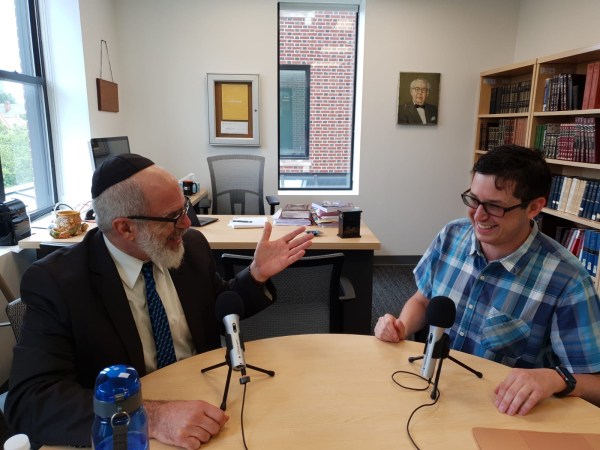
Wow, had a great time talking with Max Sklar on his The Local Maximum Podcast. He’s super smart, and was kind enough to only ask a few hard questions. Visit https://www.localmaxradio.com/episode/82 or download it from your podcast supplier. I think it turned out nicely.
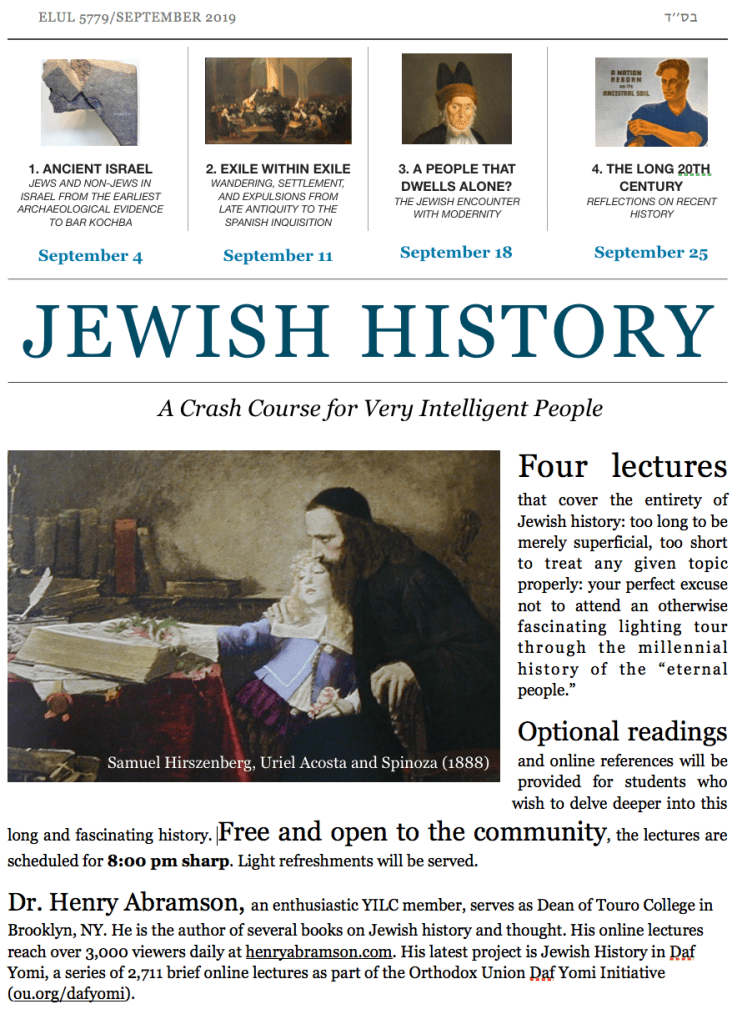
Wednesday Night: Crash Course in Jewish History

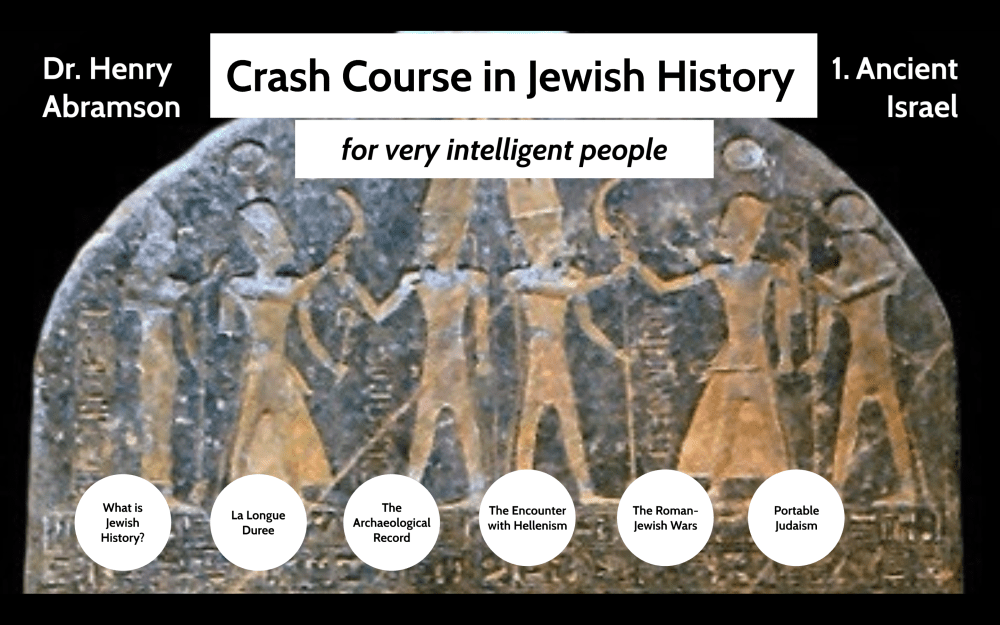
Okay, this is going to be something different: four concentrated lectures on absolutely all of Jewish history, skipping the boring parts so we can cover it all. Free and open to the community; might be recorded for the Internet but depends on if anyone asks hard questions. Join us!
Wednesdays in September 2019, 7:30-8:30 pm
Young Israel of Lawrence-Cedarhurst
Global Maimonides on Teshuvah Project Begins!
There are forty days from Rosh Hodesh Elul (today) to Yom Kippur. Please join hundreds (maybe thousands?) of students sharing in my yearly review of the classic work of Moses Maimonides on Teshuvah. Free texts and videos offered in a variety of platforms on social media. May you all have a transformative season of self-improvement, and enter the year 5780 with strength and renewed purpose!
Please visit www.bit.ly/globalrambam2019 for lots more information and resources.
Dr. Daniel Reiser to Speak at Touro College
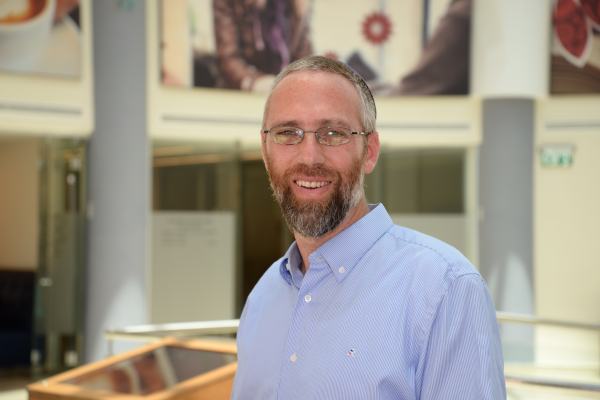
Touro College is deeply honored to host this remarkable world-class scholar, whose pioneering efforts working through the difficult manuscripts of the Aish Kodesh have made the Warsaw Ghetto writings of this important Hasidic Rabbi accessible to a new generation of scholars and disciples. This is a rare opportunity–please join me in welcoming Dr. Reiser to Brooklyn, and hear his moving presentation.
Holy Fire: The Life of R. Kalonymus Kalmish Shapira of Piaseczno (the “Aish Kodesh”)
Monday, September 9, 7PM
Main Auditorium
Touro College
1602 Avenue J, Brooklyn NY 11230
Free and Open to the Community

Secret Torah NY Discount for Jewish History Students!

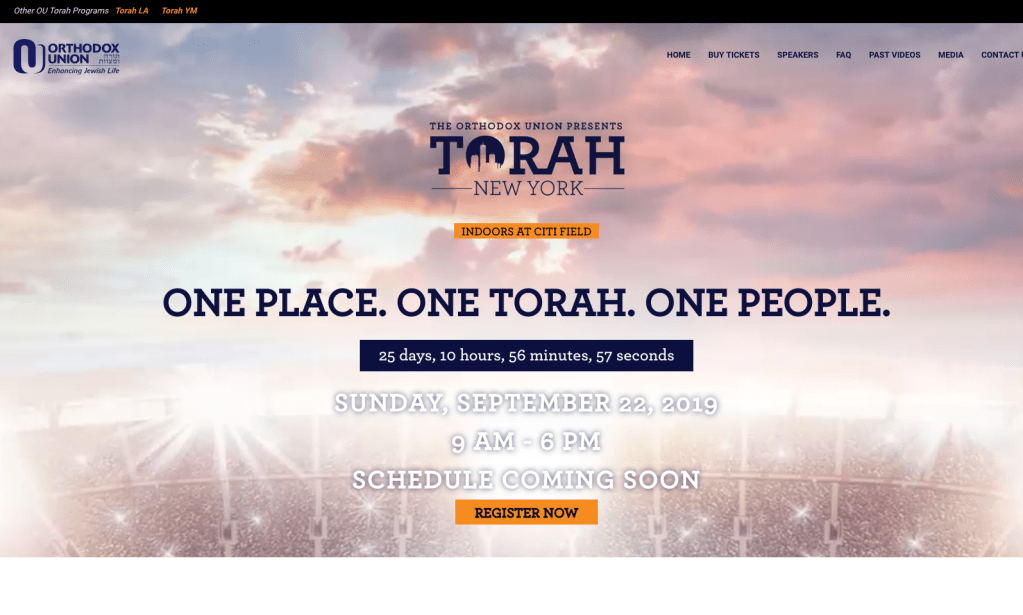
I’m really looking forward to lecturing at Citi Field next month as part of the incredible Torah NY gathering. There are going to be some absolutely phenomenal speakers there, including Rabbis Moshe Elefant, Moshe Schwed, Ya’akov Trump, Stephen Weil.
They have also let me know that there’s a secret 10% discount for all registrations that use this secret code: TNY19NOHARDQS.
I think TNY19 must stand for “Torah New York 2019.” Still working on the acronym NOHARDQS.
Please join us! It’s going to be an amazing day of learning and inspiration. Come by and say hello!
Crash Course in Jewish History

Please join us at Young Israel of Lawrence-Cedarhurst for four lectures in Jewish History! Details below.

What’s with all the interviews this week?

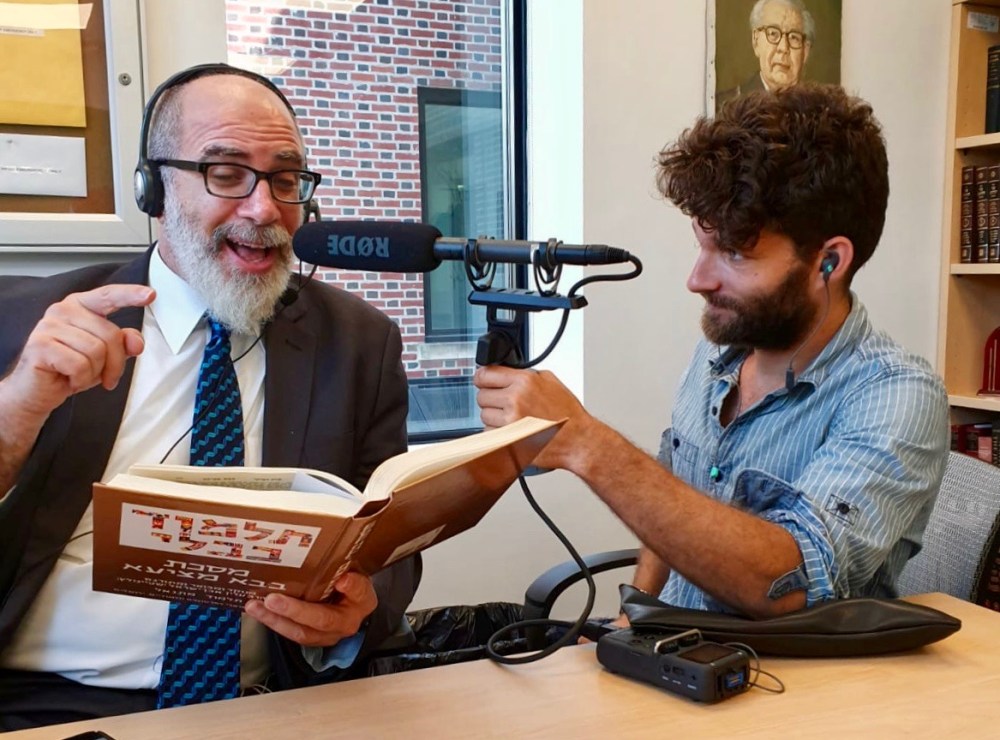
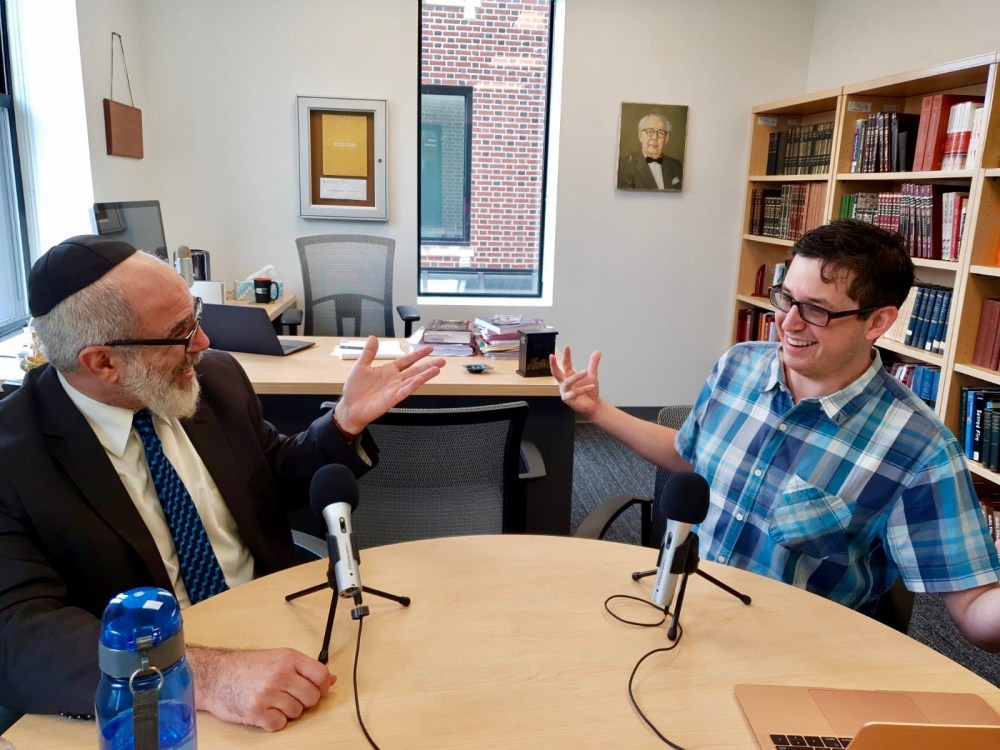

This week was unusually busy for interviews! Kind of surprised that people want to talk to me about this stuff, but really glad there are others who find this research FASCINATING.
Yesterday I had a great convo with Rabbi Sholom Licht for a print article in Jewish Action. Our discussion began with the Jewish History in Daf Yomi project, rapidly went way off the rails with larger discussions on traditional vs. academic study of the Talmud, so many other things.
Then this morning Max Sklar came by to do a recording for his very cool podcast, Local Maximum, that looks at issues of media and education. We discussed the Jewish History series in particular, got into the weeds with analytics and what they say about free adult education on the internet.
Finally, Max Miller came by for a recording with Peter Gwin of National Geographic on the line in DC, talking about the tsunami of 115 and a key passage in the Talmud. A marine archaeologist at the University of Haifa has connected the dots, and they wanted my take on her research for their fascinating and edgy podcast, Overheard at National Geographic.
Exhausted and exhilarated! I hope to send links to the finished products when they are available later this Fall.
Crash Course in Jewish History

Siyum Ha-Shas in the Displaced Persons Camp, 1945


“We were only a few broken Jews with two books, but…the day of the Siyum HaShas was my day of victory, the day of victory for all survivors, and the day of victory for every ‘Talmud Jew.’”
The brick crematoria of Dachau had barely cooled when the surviving remnants of European Jewry were called upon to mark the third Siyum HaShas in November, 1945. For most, it seemed unthinkable—in the wake of the most horrific genocide in human history, could the emaciated, traumatized survivors turn their attention to celebrating the third completion of the seven-year Daf Yomi cycle of Talmud study?
Outside the continent-sized graveyard that was Europe, subdued gatherings of Jews marked the occasion. In New York, where the black boots of the SS had never ground Jewish ashes into the soil, and of course in Jerusalem, students who cherished their daily study regimen came together to mark the transition from the end of the final tractate Nidah to the first page of the initial tractate Berakhot. In the Holy Land, British Mandate authorities were able to interfere with the Siyum HaShas by temporarily blocking one celebration in Tel Aviv, citing the potential for anti-British activity. If commemorations in lands that had not experienced the Holocaust firsthand were strained or cancelled—how would it be possible to hold the celebration in Germany, with ragged survivors whose daily existence during the war was more concerned with desperate survival than the intricacies of Talmudic law?
And yet it happened. In the words of a self-described “graduate of Auschwitz,” Joseph Friedenson, the Siyum HaShas in the Feldafing Displaced Person camp represented “the greatest rejuvenation in modern history to happen before our eyes.”
Please click here to read the full article in the OU Torah blog.
 Henry Abramson