Thank you for your consistent support and enthusiasm. I am delighted that so many people share my passion for Jewish history and thought, and consider it a rare privilege to share my research with you online and in person. I wish you all a blessed New Year of spiritual and material prosperity.
As I’m sure you’re aware, at this time of year it is a custom to increase our charitable giving so as to accumulate merit before Yom Kippur. There are thousands of worthy causes, and I do not wish to detract from any of them (nor clog your inbox with unsolicited requests). At the same time, I feel it is incumbent upon me to do whatever I can to support my undergraduate students, many of whom are the first in their family to attend college, many of whom are forced to work full-time to support themselves (and their families!) while studying.
So here’s the thing: I would like to raise enough money to pay for ten gifted, motivated students to earn a bachelor’s degree in Jewish history with me. I figure it will cost about $100,000, and we have raised about $15,000 so far. Please partner with me in this worthy endeavor, so we can raise a new generation of historians who will continue research into the amazing, surprising, and inspiring history of the Jewish people.
Online tax-deductible donations to Touro College may be made at the Friends of Jewish History crowdfunding website (https://www.crowdrise.com/the-friends-of-jewish-history/fundraiser/avenuej). If you prefer to send a check, please make it out to Touro College, with Friends of Jewish History in the memo line, and send it to me at the address below.
We have a great year of Jewish history lectures planned, with a series on the Jews of the Danube River valley scheduled for the Fall and a new series on the Jews of Italy in the Spring.
Please visit this site for my translation of Rabbi Moshe Cordovero’s classic Tomer Devorah (The Kabbalah of Forgiveness), a text often studied at precisely this time of year as we strive to improve our relationships with each other, with G-d, and with ourselves. The site also features a series of brief videos on each of the 13 strategies of forgiveness.
I’m also proud to offer a series of 40 brief online lectures (!) covering the entirety of Maimonides’ Laws of Repentance, in memory of my father, Jack David Abramson of blessed memory. More information on the translation and links to the free videos are available here.
Wishing you all a successful completion of the High Holy Days–may 5779 be a year that initiates a period of spiritual and material prosperity for you, your families, and all those around you.
With gratitude for your interest in our shared research,
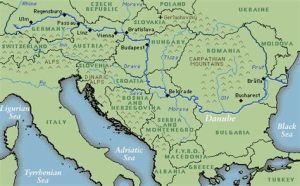
From its headwaters in Germany’s Black Forest to its final destination in the Black Sea, the Danube River flows through ten countries and over ten centuries of Jewish history. Great cities like Vienna and Budapest punctuate its course through East-Central Europe, the cradle of much of Ashkenazic civilization. This fall we will explore the history of the great Jews and Jewish communities of the region, celebrating the magnificent cultural achievements of Danubian Jewry, commemorating its tragic destruction in the twentieth century—and examining signs of incipient rebirth as the irrepressible, exuberant spirit of Jewish creativity expresses itself along the shoreline in the 21st century.
Following our remarkable exploration of the Douro River, looking for ethnographic remnants of Crypto-Jewish culture in Spain and Portugal, our Fall 2018 excursion into Jewish history will begin with a voyage along the Danube itself with Kosher Riverboat Cruises. Led by Sayeret Matkal veteran David Lawrence and fed by Master Kosher Chef Malcolm Green, we will team with Prague Jewish historian David Kraus to learn more about the unique experience of Hapsburg Jewry. I am honored in particular to join Rabbis Marvin Hier, Abraham Cooper and Meyer May of the Simon Wiesenthal Center in a commemoration of the life and work of Simon Wiesenthal, culminating in a visit to Mauthausen and Linz.
Returning to the Mighty Avenue J campus of Touro College at the end of October, we plan to continue the discussion in our regular Monday Night Jewish History @ J series, incorporating the intensity and immediacy of local research into the larger perspective of Danubian Jewish History.
The haunting memorial to the Jews of Budapest murdered in the Holocaust by drowning in the Danube River. Conceived by Can Togay and created by Gyula Pauer (2005).
Schedule of Lectures
Part One: Europe
1. The Saga of Danubian Jewry (scheduled for Budapest, Hungary)
2. “Every Sofa Covered in Plastic:” The Glory of Hungarian Jewry (scheduled for Budapest, Hungary)
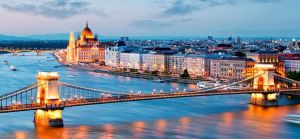
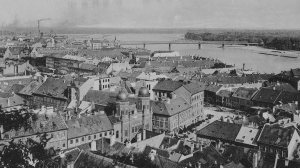
Budapest on the Danube
3. What is New, is Forbidden:” Bratislava Jewry Responds to Modernity (scheduled for Bratislava, Slovakia)
Historic Bratislava (a.k.a. Pressburg)
4. Vienna and the Creation of a Modern Jewish Identity (scheduled for Vienna, Austria)
From Emil Mayer’s photographs of Jewish Vienna.
5. A Vanished World: Shtetl Culture in the Wachau Valley (scheduled for Wachau Valley, Austria)
The gorgeous Wachau valley.
6. Social Change in Danubian Responsa Literature (scheduled for Wachau Valley, Austria)
7. The Eternity of Israel is Not a Lie:” Danubian Jewry, the Holocaust, and the 21st Century (Mauthausen & Linz, Austria)
Lecture Sponsored by
Christopher and Ann Marie Bray
in honor of (dedicated to) Eretz Israel
Part Two: Brooklyn
All lectures scheduled for Monday nights, beginning promptly at 7:00 pm in the Main Auditorium of the Mighty Avenue J campus of Touro College, 1602 Avenue J, Brooklyn NY 11230. Lectures are free and open to the public; we encourage support of our brilliant students by offering sponsorships ($500) online at the Friends of Jewish History Scholarship Fund.
Monday, November 5
“Light is Sown:” Rabbi Isaac Ben Moses (the “Or Zarua”) and the Medieval origins of Danubian Jewry
Monday, November 12
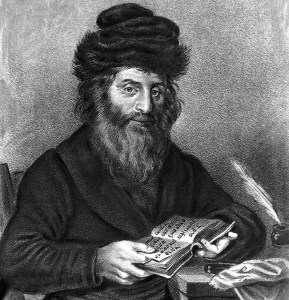
“What is New, is Forbidden:” Rabbi Moses Sofer (the “Chatam Sofer”) and the Challenges of Modernity
Monday, November 19
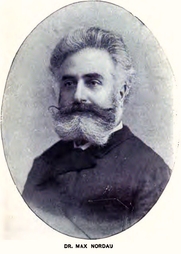
The Other Zionist: Max Nordau and the Vision of a Modern Israel
Monday, November 26
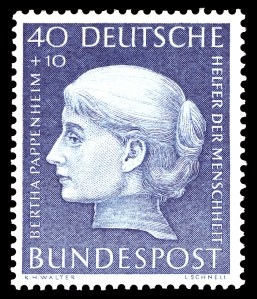
The Untold History of Bertha Pappenheim and the Modernization of Social Activism
For more information write Henry.Abramson@touro.edu or call (718) 535-9333. No hard questions, please.
Exploring the Lost Jewish History of the Douro River Valley
Henry Abramson, PhD
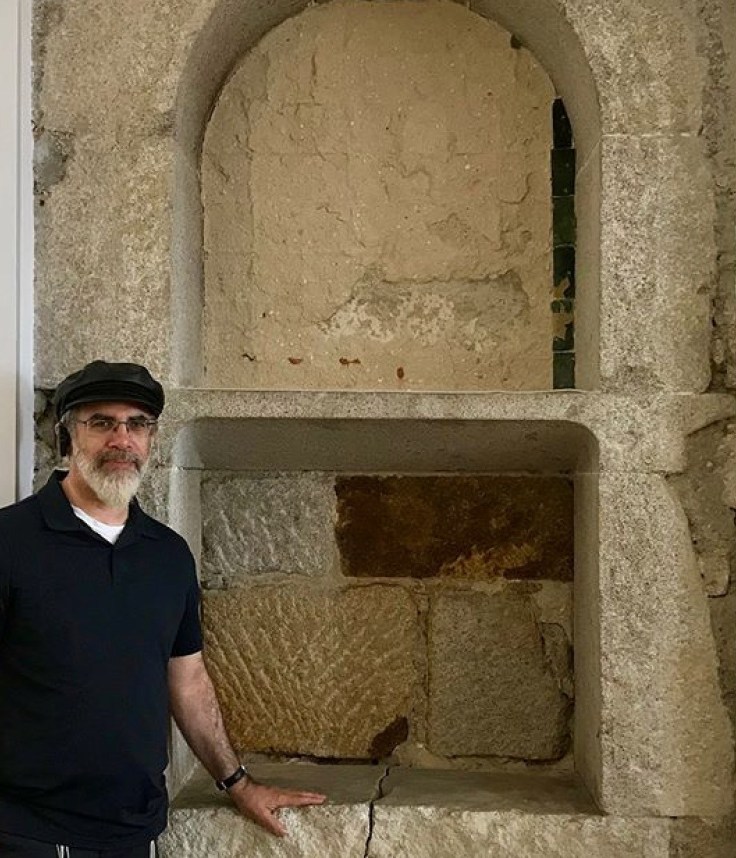
An Aron Kodesh discovered in 2013 behind a hidden wall in the Jewish Quarter of Porto.
“Portugal,” explained Filipa Carretas, our local guide, “is about three things: fado, Fátima, and futebol.” Fado is the profoundly melancholy Portuguese national music, Fátima refers to a 1917 sighting of the Virgin Mary (in a town ironically named for the daughter of Muhammad), and futebol is, well, soccer. Portugal is also about a fourth, unstated element: the pervasive presence of a submerged Jewish population, vanished in the flames of the Inquisition five hundred years ago. With DNA studies indicating that 20 percent of Portuguese citizens have Jewish roots, it is not at all unusual to meet a local who did the family research and became a “Jew by surprise.” This is also Portugal.
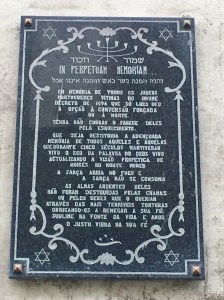
Plaque in the old Jewish Quarter of Porto, commemorating the Portuguese Jews who were forcibly baptized in 1496.
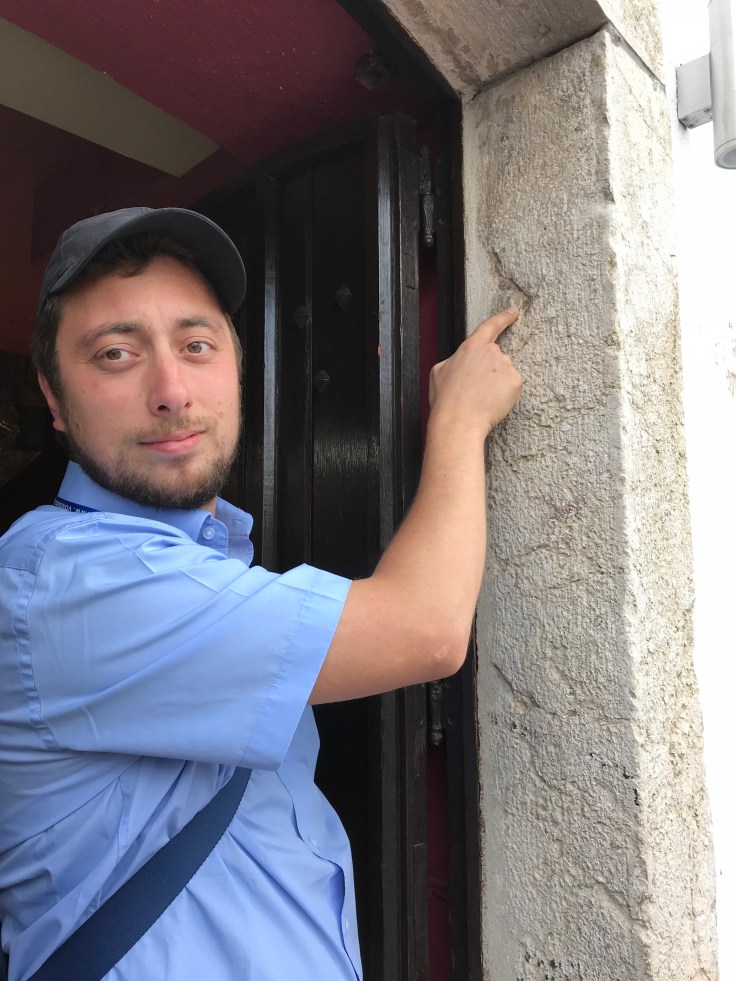
The invisible yet palpable echo of the crypto-Jewish tradition resonates through Portugal like the far side of a conversation faintly overheard in another person’s cell phone. A rush of sibilants or an exclamation of laughter confirms the reality of the distant interlocutor, even though we do not see her before us. The history of Portugal’s crypto-Jewish community is similarly measured by absences—a mezuzah scar on a doorway, a bolt-hole for a Torah scroll hidden behind a false wall, a disappeared Juderia marked, if at all, by a 21st century plaque.
This summer I had the wonderful opportunity ofjoining a group of Jewish history enthusiasts in a rather luxurious exploration of the Douro River valley as a scholar-in-residencewith Kosher Riverboat Cruises. Nestled between lush mountain terraces, the Douro flows from the interior of the Iberian peninsula through Spain and traverses northern Portugal before emptying into the Atlantic Ocean. Sun-kissed, the river is especially famous for its vineyards, which produce the famous Port wine (named for Porto, Portugal’s second city and home to one of its oldest Jewish communities). Well-read in the general history of the Jews but fairly ignorant of the specifics on the ground—this was my first trip to Portugal—I assumed that my role would be toprovide nightly lectures on the general history of the Jews of Spain and Portugal, leaving the more granular analysis of local sites to the competent Portuguese historians contracted to tour us on the land excursions. It soon became apparent, however, that the highly educated, academically curious passengers as well as our new Portuguese friends turned to me for responses to difficult questions of identity, belonging, and memory—subjects that stretched far beyond my training as a historian.
How, for example, does one remark on the Jewishness of a given site when nothing remains? Our guides were sympathetic and forthright about the darker aspects of Portuguese-Jewish history, but were sometimes not well-equipped to navigate the emotional minefields surrounding a synagogue that was confiscated as part of the purges of theInquisition and transformed into a church. At moments like this, David Lawrence, a Sayeret Matkal veteran who transformed his Israeli logistical skills to Kosher Riverboat Cruises, would nudge me and say, “get in there and say something Jewy.”
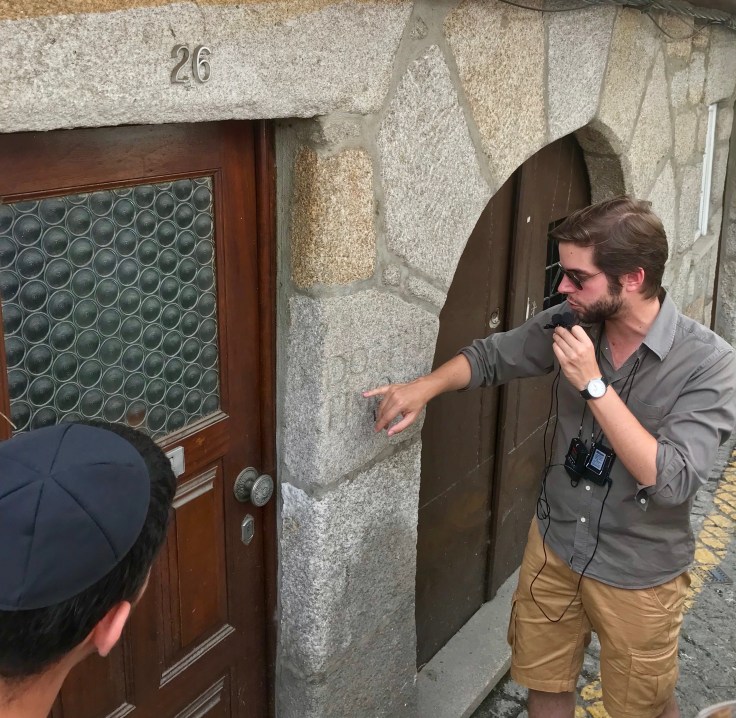
Prague Jewish historian David Kraus indicates one of the hundreds (thousands?) of “mezuzah scars” visible throughout Portugal. Was this home once inhabited by a Jewish family 500 years ago, or is this just a coincidental blemish?
So by night we retired to the luxurious accommodations abroad the Douro Serenity and enjoyed the incredible kosher cuisine of Master Chef Malcolm Green and the informative musical programs of “Entertainer in Residence” Howie Kahn, but by day we embarked on an ethnographic expedition reminiscent of the 20th-century explorations of Eastern Europe by Sh. An-Ski.
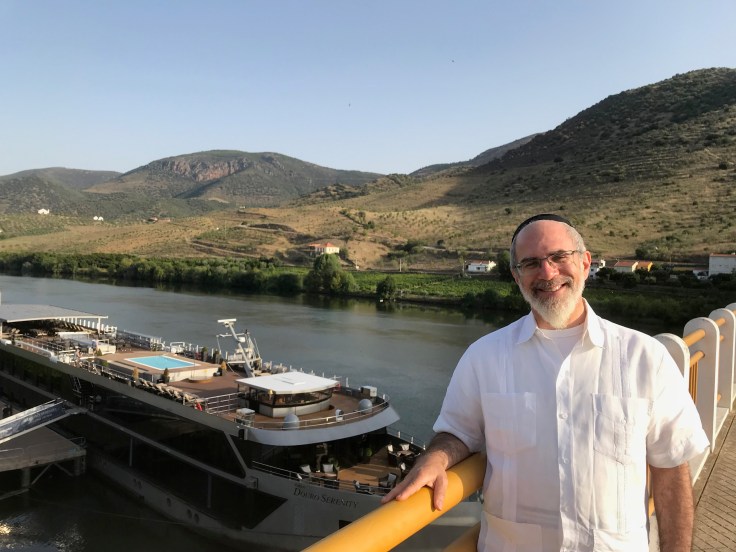
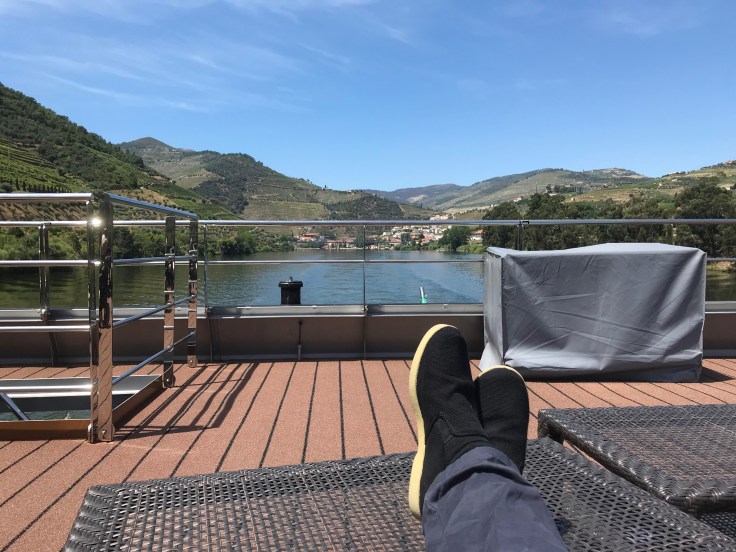
With the Douro Serenity in the background.Chillin’ on the Douro Serenity as we cruise upriver. Graduate school didn’t prepare me for these hardships.
Neutral third-person descriptions morphed into more intimate, first-person accounts as confirmed Ashkenazim began to say “when we were expelled from Spain” and our Portuguese hosts spoke apologetically of “when we persecuted you.” This was, to paraphrase the Skipper, no longer just a “three-hour cruise.”
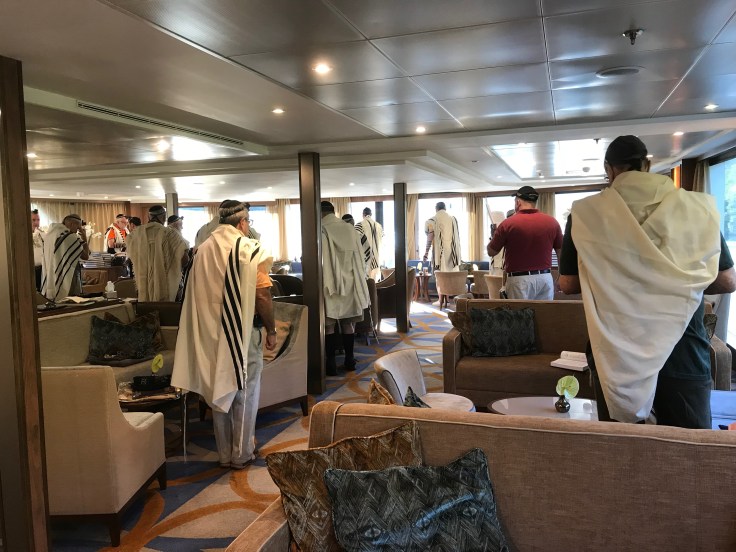
Shacharis on board. Really hard to concentrate with the beautiful Douro passing by on board. The tribulations of travel.Our stateroom. Yes, it was tough, but somehow we survived.
Salamanca
Portugal boasts an ancient Jewish settlement that reached a population of some 30,000 by the end of the fifteenth century. Perched on the edge of the Iberian peninsula, Portugal earned a reputation for tolerance that had long attracted Jews fleeing Spanish oppression, including Don Isaac Abravanel’s grandfather Shmuel, who fled the 1391 riots and forced baptism to reclaim his Jewish faith in Portugal. It is fitting, therefore, that the first major stop of our river cruise began in Salamanca, a University town whose Jewish population was obliterated by the Spanish Inquisition and the 1492 Edict of Expulsion.
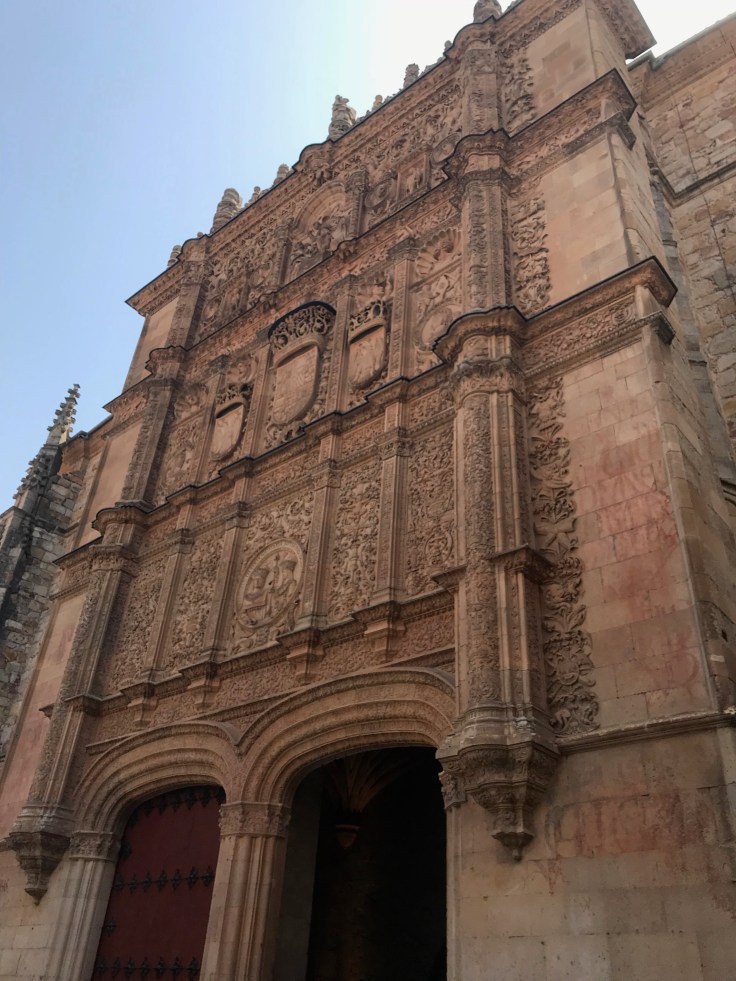
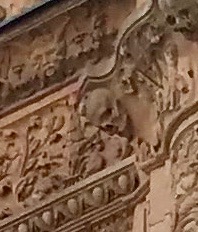
The glorious sandstone facade of the University of Salamanca. Student lore maintains that gazing on the tiny frog that sits atop the left-hand skull on the right-hand column (see detail) will help students pass final examinations. That, and studying.Detail. Don’t you feel smarter already?
The Jewish presence in Salamanca is well-documented in ecclesiastical and municipal records from the 12th century on—first as a series of privileges conferred upon them by rulers seeking the economic advantage of Jewish merchants, later as their rights were eroded and properties were confiscated, including King Juan II’s 1413 dedication of Salamanca’s Beit Midrash and its surrounding courtyards as dormitories for students of the University. Traces of the community remain, sometimes as echoes or mirror images of their disappearance—a quiet street called Vera Cruz, for example, marks the street near a synagogue where Jews once prayed. In 1411 the fiery Dominican Vincente Ferrer (“the Angel of Judgement”), fueled by religious zeal, burst into the synagogue to proselytize the terrified minyan. In the midst of his impromptu sermon, Ferrer claimed to have a vision of crosses magically appearing on the prayer shawls of the Jews, which he interpreted as their secret desire to convert to the faith of the “true cross”—hence Vera Cruz. A mass baptism followed, as it did wherever Ferrer roused the population with zealous, sometimes violent, religious fervor. Ferrer eventually received sainthood from the grateful Church.
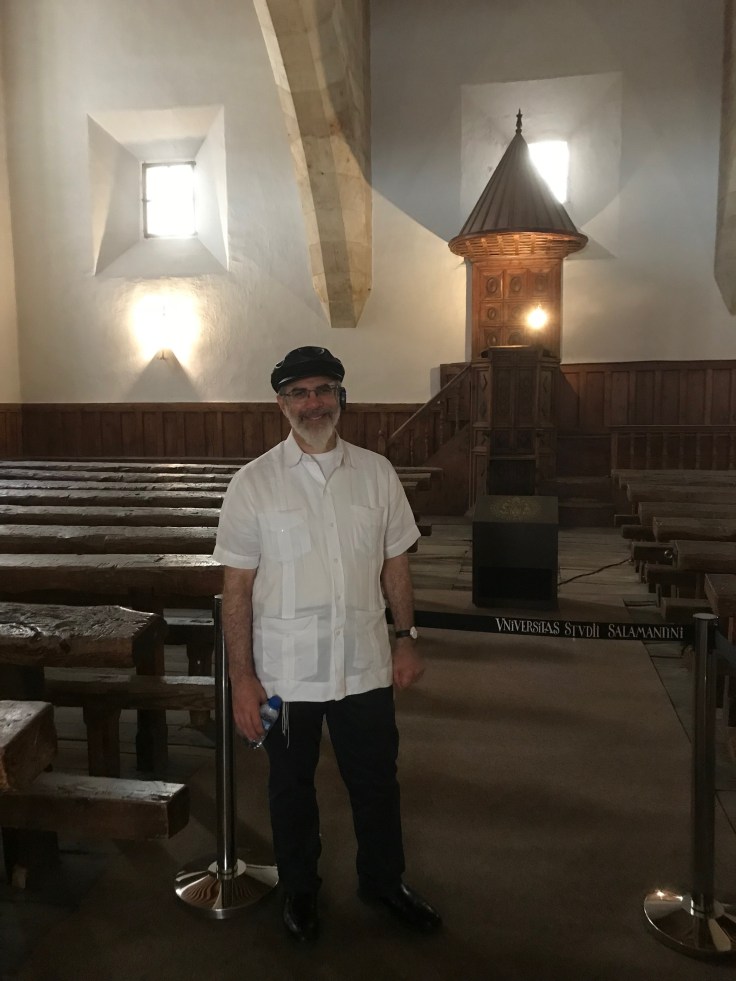
In Luis de Leon’s 16th century classroom. Unadorned wooden benches seem about right for keeping undergraduate students focused.
The forcibly baptized Spanish Jews (designated “New Christians,” “conversos,” or thederogatory “Marranos”), maintained their connections with the traditional Jewish community throughout the fifteenth century. Living openly as Christians yet secretly as Jews (hence the term “crypto-Jews,” meaning “hidden Jews”), many continued to attend religious classes and services in the Jewish community, observed the dietary laws and the Sabbath, and married into other crypto-Jewish families. In 1478 the Spanish Inquisition was therefore instituted to root out Judaizing tendencies in this New Christian population. Led by the sadistic Tomas de Torquemada, the Inquisition used torture to exact “confessions” from conversos, describing their secret Jewish activities and, more significantly, naming other New Christianswhose faith was less than genuine.
The purge-like atmosphere engulfed all Spanish territories under Ferdinand and Isabella, a terror that continued for generations until it was finally abolished in the early nineteenth century. Swept up in its clutches were many prominent theologians and scholars, including the beloved lecturer Luis de Leon of University of Salamanca (1527-1591), whose credentials as an Augustinian Friar did not expunge the taint of his Jewish ancestry—that, and the fact that he dared to study Hebrew Scriptures in the original. Denounced as a crypto-Jew, he was imprisoned and interrogated. Returning to his classroom after four years of rough treatment, he famously began his class with the words, “as we were saying.”
Although initially concentrating on crypto-Jews, the Inquisition eventually directed its attention to the unbaptized Jewish community as well. Torquemada argued before the royal court that the stubborn persistence of Jewish practice was a consequence of the continued fraternization between conversos and the Jewish community. Historians argue about why Ferdinand and Isabella ultimately agreed to Torquemada’s plan to expel the Jews in 1492–was it religious zeal or greed?—but nothing could stop the throne from forcing its remaining Jews to choose conversion or exile in the Hebrew month of Av of that fateful year. Thousands of Salamancan Jews were forced from their homes and, like the first of Genie Milgrom’s fifteen crypto-Jewishgrandmothers, followed the Douro River westward as it flowed to the Portuguese border and beyond. We followed their trail.
Belmonte
In a break with Portugal’s history of relative religious tolerance, King João II initially refused to admit the estimated 100,000 Jewish refugees massing at his borders. Intensive petitioning finally moved the King to grant a six-month transit visa to 600 prominent families, at the usurious cost of six cruzados per person (approximately $20,000 US in contemporary currency). Despairing, many Jews chose to turn back, accept Christianity, and risk the depredations of the Inquisition. Others entered Portugal illegally, hoping to blend into the local population. Both João and his successor Manuel I imposed harsh antisemitic decrees aimed at forcing the Jews to accept baptism, including the kidnapping of Jewish children and exiling them to São Tomé, a recently acquired island off the coast of west Africa—according to the historian Samuel Usque, himself a Jewish refugee from Portuguese persecution, nearly 2,000 of the 2,500 children abandoned on São Tomé died there, perhaps eaten by huge indigenous lizards. By 1497, however, the Portuguese persecution reached its nadir with the mass conversion of all remaining Jews, both Portuguese and Spanish refugees, such that the entire Iberian peninsula was rendered Judenrein: free of Jews.
Belmonte
Amazingly, they persisted. Traces of crypto-Jewish activity over the following centuries arerecorded in Inquisition trial records and memoirs of those who managed to emigrate to safe havens like Amsterdam. It is difficult to comprehend the incredible stamina of these crypto-Jews, many of whom only learned their secret Jewish backgrounds upon reaching adulthood. Nevertheless, secret traditions continued through the centuries, right up to the 20th century, when a Polish Jewish civil engineer named Samuel Schwarz working in the Douro region heard rumors of a Portuguese community that practiced Judaism in a tiny village called Belmonte (the birthplace, incidentally, of Luis de Leon). Like the proverbial Japanese soldier stranded on a tropical island who was unaware that the war had ended, Schwarz reported that the Belmonteconversos were skeptical that he was even Jewish. Only when he recited the familiar words of the Sh’ma prayer did they accept the fact that the Inquisition had not reached every living Jew.
Samuel Schwarz (1880-1953), discoverer of the crypto-Jewish community of Belmonte. Were their first words to him, “funny, you don’t look Jewish?”
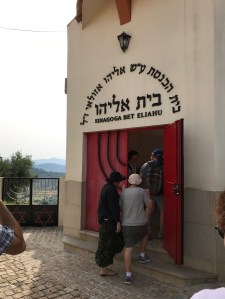
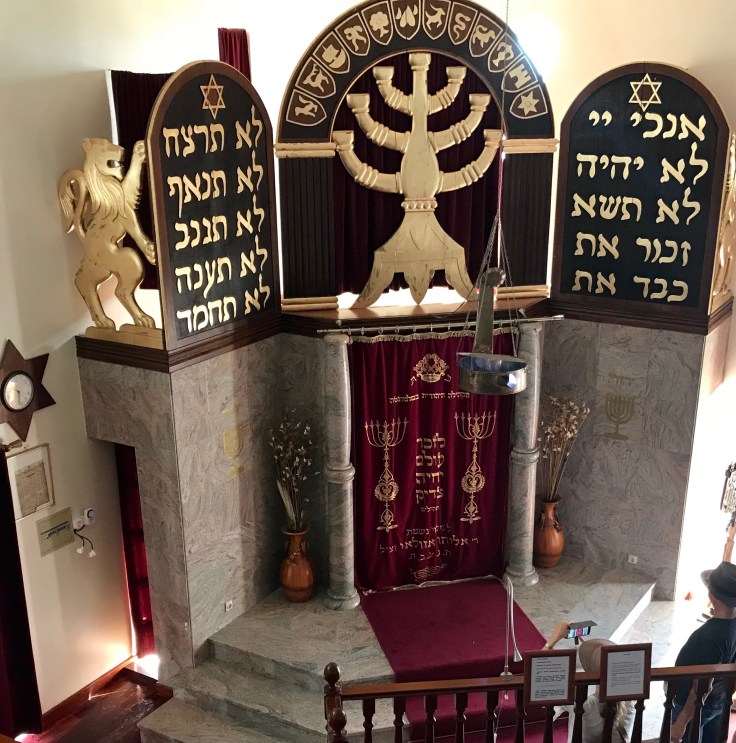
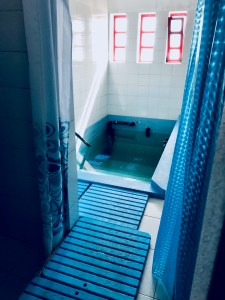
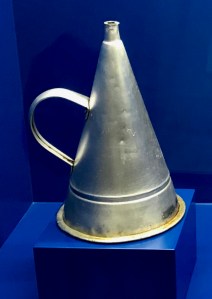
Belmonte became a destination for ethnographers and historians seeking to document thehistory of a secret community of crypto-Jews who risked their lives to continuously maintain their identity for half a millennium. A synagogue was dedicated in 1997, complete with a modern mikvah, and the crypto-Jews of Belmonte slowly began to integrate themselves back into the world Jewish community, with a large number of the youth emigrating to Israel. Their heroic tenacity was commemorated with a modernmuseum that told their story, largely through ritual artifacts borrowed from countries where Judaism was freely practiced (possession of ordinary objects like Jewish books, kiddush cups or Chanukah candelabras were absolute contraband under the Portuguese Inquisition). Nevertheless, even these markers of identity tell the story well—skeleton keys representing the Spanish-Jewish custom of cherishing the possibility of an eventual return to their homeland, and covered lanterns that obscured the glow of Sabbath candles from inquisitive passers-by.
The Synagogue of BelmonteThe Aron Kodesh of the Belmonte SynagogueThe Mikveh of Belmonte
I was especially moved by the description of a local women’s ritual—indeed, much of the faith of Belmonte’s Jews was preserved specifically bywomen—that I recognized from studies of 17th and 18th century Eastern European Jewish women. The crypto-Jewish women of Belmonte would utter special prayers over the preparation of wicks, calling them “prayer braids” before dipping them in wax to make homemade Sabbath candles. Dr. ChavaWeissler has discovered a similar practice in the shtetls of Eastern Europe, where Jewish women would visit thegraves of ancestors in the month of Elul and measure their perimeters with cotton that would be used to make the wicks for Sabbath candles throughout the year. Thisbeautiful custom, lost to modern Jewish women, not only united the living and the dead—it also united the Sephardic diaspora with Ashkenazic practice. Is itpossible that Tevye’s daughters received this ritual from Sephardic refugees?
Lantern used for secret lighting of Shabbat candles
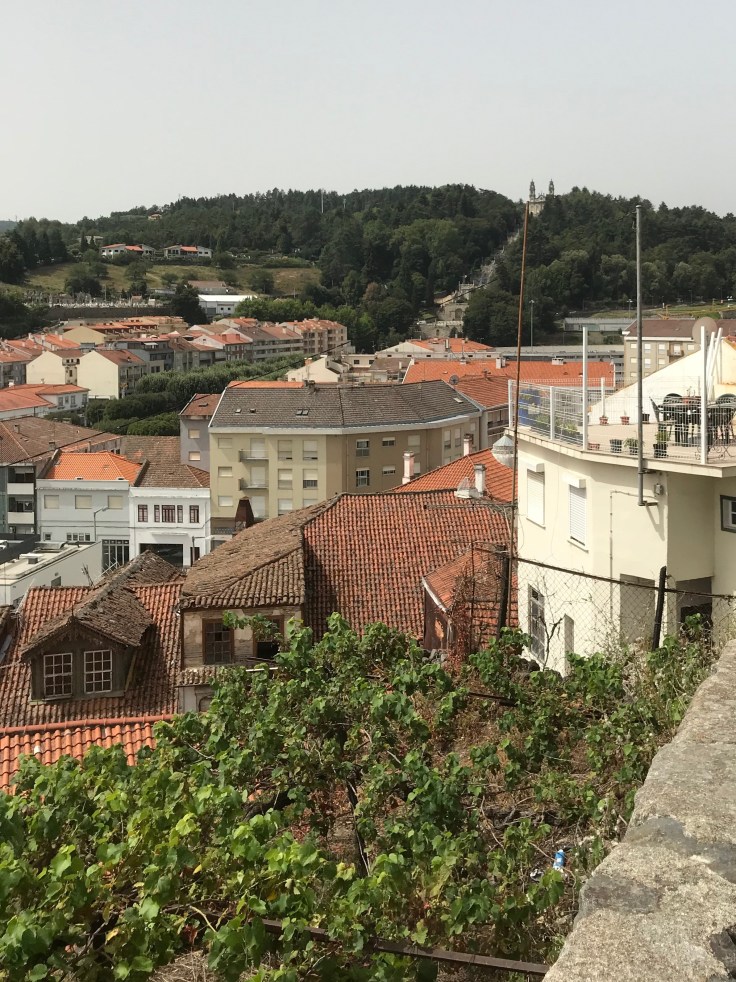
Lamego
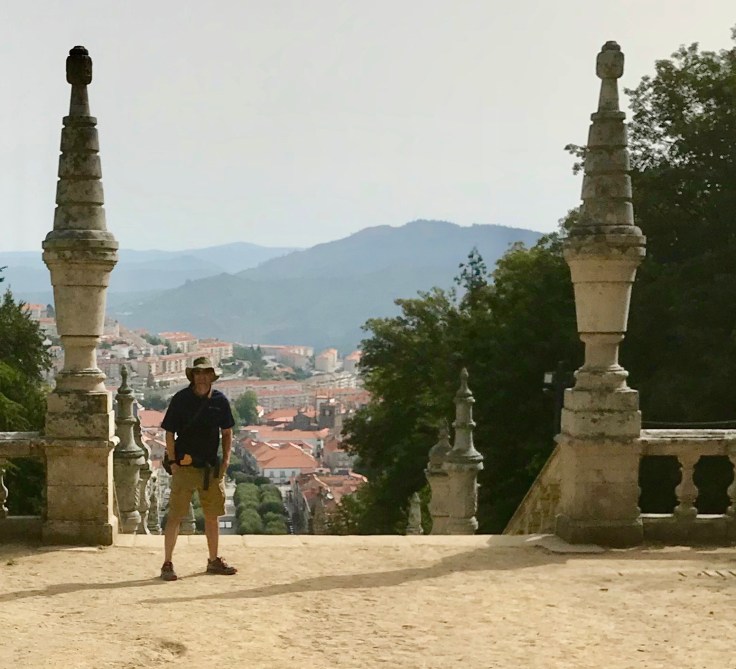
The Cathedral of Lamego above its magnificent 686-step stone staircase.
In an environment where every trace of Jewish civilization was intentionally wiped out and covered over—both by the Inquisitionand later by the crypto-Jews themselves, fearingdiscovery—it was sometimes challenging to describe the civilization that once flourished in the Iberian peninsula without physical artifacts like synagogues, Torah scrolls and the like. Evidence of Jewish settlement was often occulted, attenuated, and disguised, as if reserved for initiates only. Lamego was a perfect case in point.
David “Say Something Jewy” Lawrence midway up the Lamego staircase.
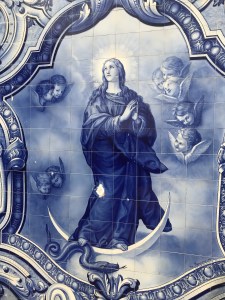
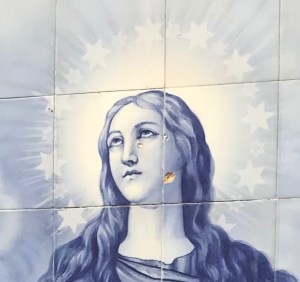
Graced by a 12th-century cathedral crowning a magnificent stone staircase (we watched two local penitents painfully climb the 686 steps on their knees, a feat that makes me grateful for fasting on Yom Kippur), the Baroque era renovations feature statues of Jewish heroes from the Hebrew scriptures and classically Portuguese blue ceramic outdoor tiles with subtle nods to Mary’s yiddishe mishpoche.
Classic Portuguese blue & white tile work adorning a landing of the Lamego staircase. Check out the detail of Mary’s halo, eh?Detail.
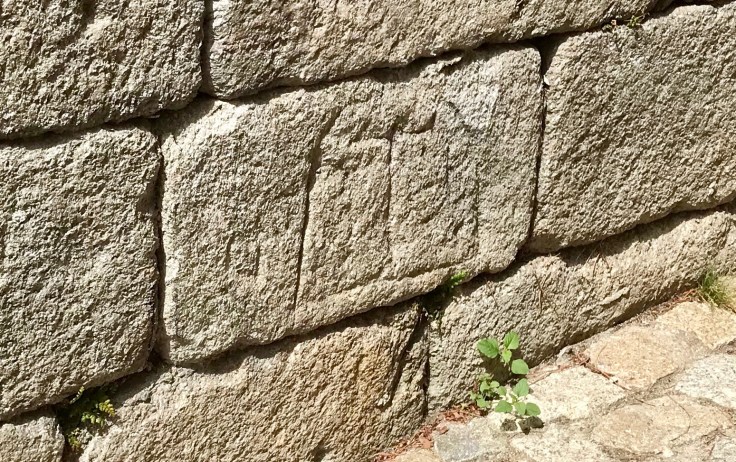
Even after five hundred years’ absence, traces of Jewish life in Portugal were everywhere. That church in the old Jewish neighborhood with a strange separate entrance to a second floor gallery—could that have once been a synagogue with a women’s balcony? The tablet-shaped mason’s marks on the medieval public cistern—a sign of a Jewish or crypto-Jewish stone worker? Amazingly, much of the local research is in its preliminary stages.
Historian Manuel Rezende points out a partially obscured latin dedication indicating that this confiscated building in the Jewish quarter was dedicated for public use.Curious tablet-shaped stonemason’s mark on the medieval cistern of Lamego.
Porto
After Lisbon, Porto is Portugal’s second city, home to one of the oldest Jewish communities in the country—so much so that the common name Rappoport is derived from the phrase “Rabbi of Porto” (although this could be a reference to an Italian city of the same name). Jews favored this northern city at the mouth of the Douro River because of its easy access to Atlantic markets, especially England.
The mouth of the Douro River, with Porto on the left and Gaia on the right. In the background is the Dom Luis I bridge, created by Théophile Seyrig, who defeated his mentor Gustav Eiffel to with the international 1880 design competition.
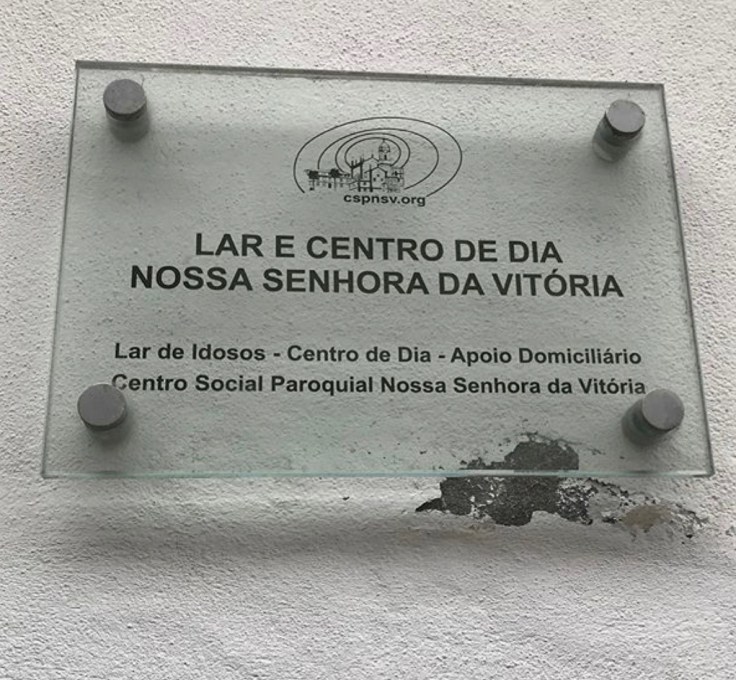
On an architectural level, the Juderia of Porto is well-preserved, albeit rededicated to Christian purposes with the installation of monasteries and other ecclesiastical and secular facilities. One site in particular stands out—a nondescript white building houses a seniors center named, entirely without irony, in honor of “Our Lady of Victory.” Passing through a narrow corridor to the back of the building, one enters a pleasant airy space, used as a dining room with about ten small tables set for four seniors each. A modern rendition of the Last Supper decorates the southern wall, where a door leads onto a quiet patio overrun with gorgeous purple flowers and a steep staircase leading to an alley below.
Renovations to the dining room in 2013 revealed that hidden behind the eastern wall was an Aron Kodesh, carved directly into the stonework separating the building from its neighbor. Two compartments, a square space topped by a slightly larger arched tablet-shaped opening, with space for approximately six small Torah scrolls. Combined with sixteenth century testimony from Immanuel Aboab, a native of Porto, we know that this building once operated as a secret synagogue for crypto-Jews hiding from the Portuguese Inquisition. Placing my hand on the cool stonework of the Aron Kodesh—a gesture I have repeated many times in synagogue services—I felt a frisson of connection with my Sephardic brethren, an electric sense of solidarity across the centuries and an abiding sense of the eternity of the Jewish people. I was reminded ofthe anonymous carving found in the barracks of a Nazi concentration camp, actually a verse from Samuel: netsah Yisrael lo ye-shaker, which in this context is best translated as “the survival of the Jewish people will not be denied.”
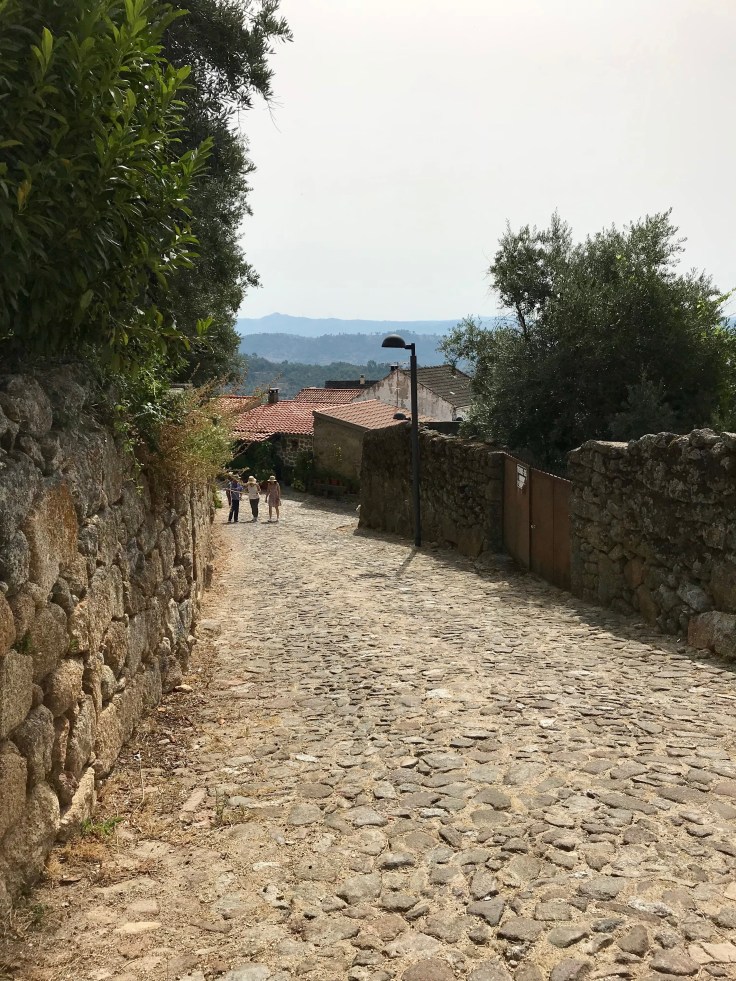
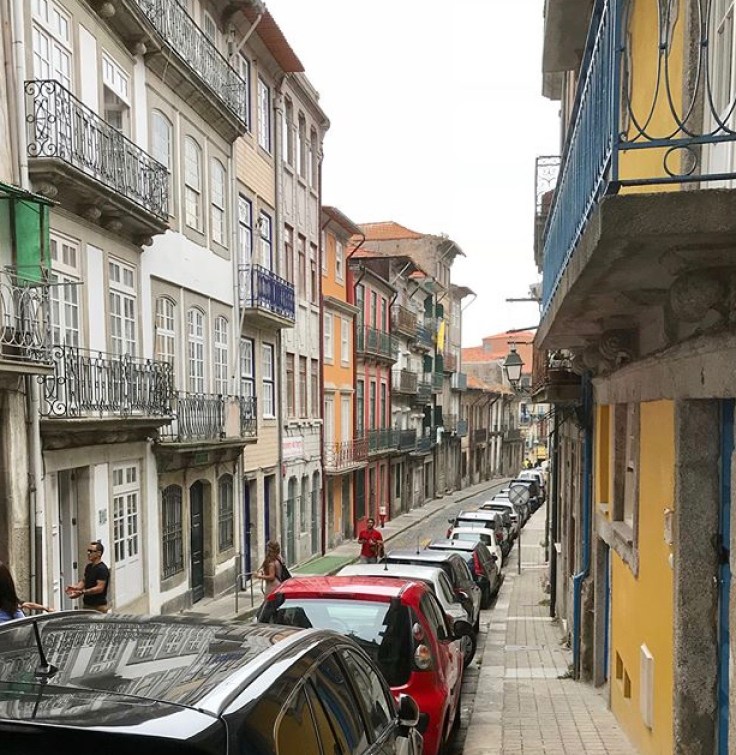
Street in the old Jewish quarter in Porto. The white building on the left was once used as a secret synagogue by crypto-Jews hiding from the Inquisition.David Kraus describes the 2013 discovery of the Aron Kodesh in the room now used as a dining hall.Current occupant of the building: a day care facility for seniors, named in honor of “Our Lady of Victory.”
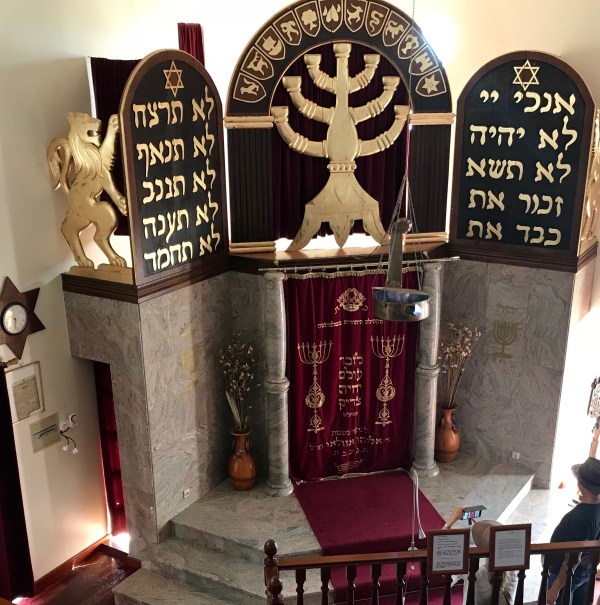
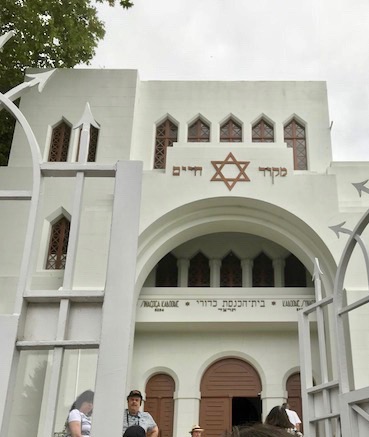
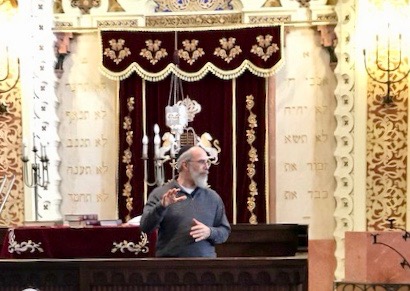
Indeed, the proof of Jewish survival in Portugal finds expression in the Mekor Hayim-Kadoorie synagogue. The congregation, which is heavily dependent on Israeli business people and travelers, serves as a gathering point for descendants of crypto-Jews, slowly discovering their Jewish origins and looking for a place to reconnect to their past. The interior of the synagogue, built in the mid-20th century with strong Art Deco influence, features well-chosen scriptural verses that seem ideally suited for this unique gathering of Jews. How would a young man, raised as a Catholic like his fathers yet contemplating a return to his pre-Expulsion roots, react to the verse surrounding the women’s balcony (Psalms 145:18) “God is close to all who call out to Him, to all who call out to God in truth”? Or for those who despaired that Jews and Judaism were completely destroyed in Portugal, would they read the verse that arches over the Aron Kodesh (Isaiah 43:11) as a subtle dig at their erstwhile Catholic faith: “I, only I, am God, and apart from me there is no savior.”
The Kadoorie-Mekor Hayyim Synagogue.I was honored to provide a few impromptu historical reflections from the Bimah.
Coimbra
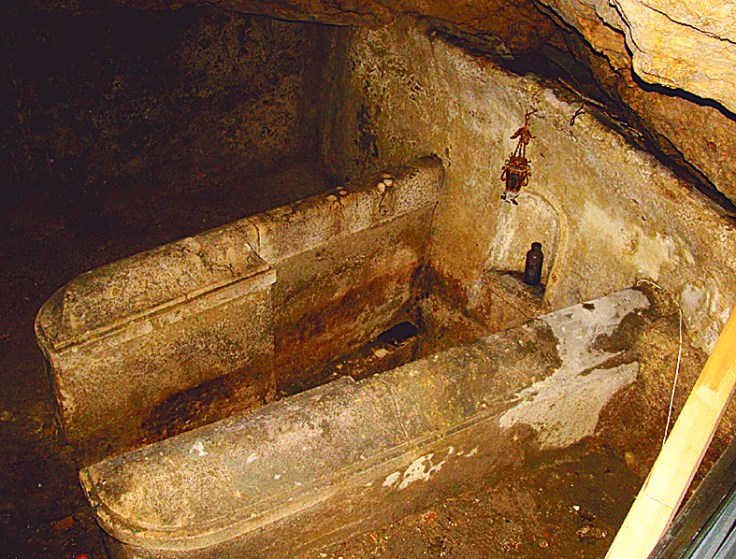
Leaving the Douro River valley, we headed south to the medieval town of Coimbra, home toone of Europe’s oldest Universities, established in 1290. The extent of Jewish settlement in Coimbra is increasingly evident—the city was possibly home to Jewish refugees who suffered expulsion from England in the same year of the University’s founding, as the city’s academic and mercantile foundations would have been an attractive destination. Indeed, repairs to the sewage system in the main shopping district—a section of the city that once housed the Jewish quarter—revealed a network of underground mikvaot that stretched back some seven hundred years (ironically, this discovery was made in 2013, the same year of the discovery of the hidden Aron Kodesh in Porto).
700-hundred year old Mikveh discovered underneath the main shopping district of Coimbra.
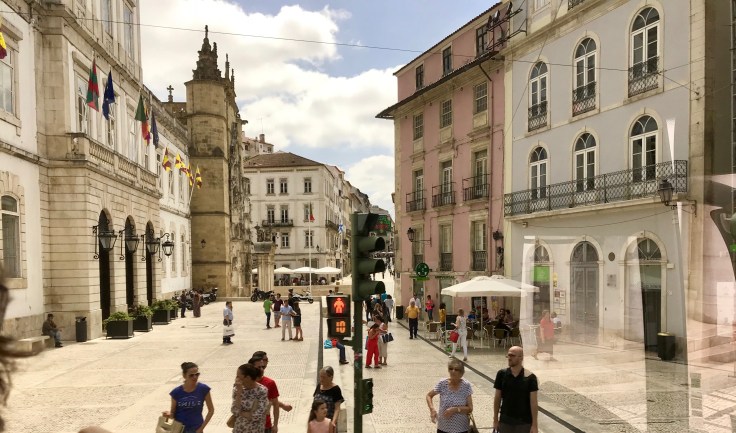
Unfortunately, the presence of a large number of theologians associated with one of the initialfaculties of the University meant that Coimbra served as one of the four seats of the Inquisition in Portugal. An estimated 11,000 suspected crypto-Jews were tried in Coimbra, many of them sentenced to public burnings in the town square. Like many sites in Portugal, the cheerful, well-organized square gleams with enthusiasm under the sunny blue skies, as if todeny the horrors that were once perpetrated there.
Cheerful main square of Coimbra, site of Inquisition public burnings.
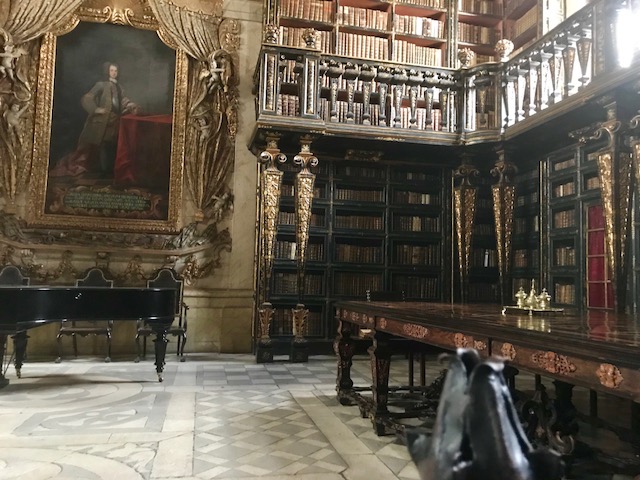
The sense of incongruity is preserved in the beautiful library, called “the Jewel of theUniversity,” in whichrare books are exposed to and unfiltered sunlight and remain unprotected by modern climate control—yet the regular parade of visitors are admonished not to take photographs on their smart phones for fear of damaging the priceless manuscripts (including, for example, original commentaries on the Bible by Don Isaac Abravanel, a native of Portugal).
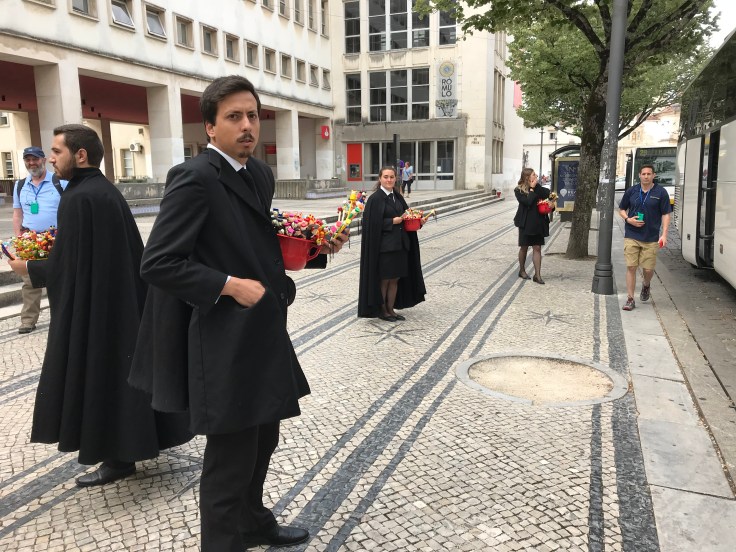
Coimbra students in academic robes flog tchotchkes to tourists.Inside the beautiful Coimbra library. Note the direct sunlight, no a/c protecting the rare books.
Óbidos
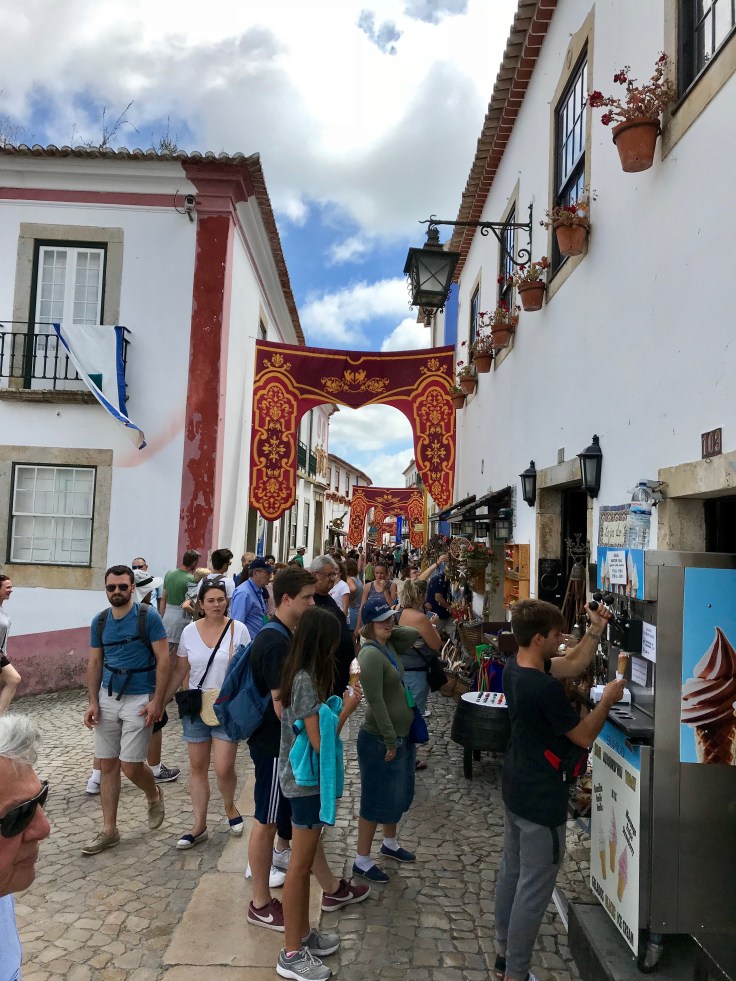
A priceless Portuguese gem is the remarkably well-preserved market town of Óbidos, home to an annual festival medieval culture.
Active market in well-preserved medieval Óbidos.
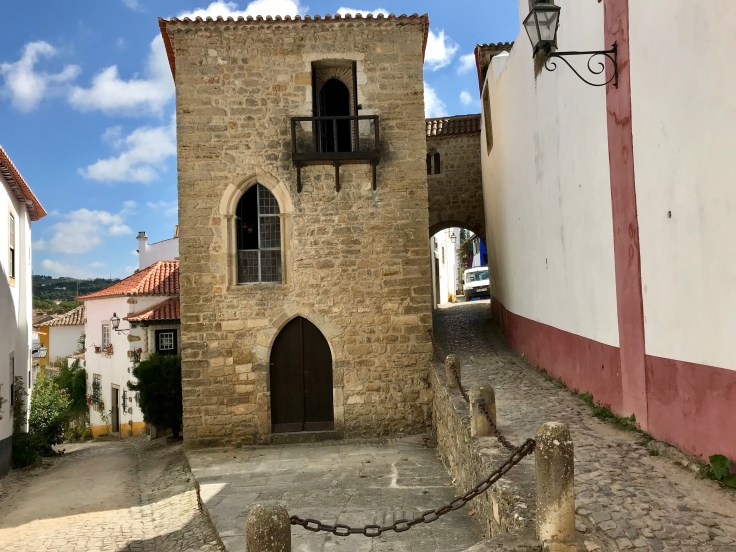
Like most economic centers, it possessed a Jewish quarter, ironically located close to the modest cathedral. Our local guides pointed us to a building that stood on the site of a pre-Inquisition synagogue. Renovated in the 18th century after an earthquake damaged major structures (including the defensive wall that encircles Óbidos), the guides made the rather amazing claim that the otherwise unremarkable building dated from the seventh century, a holdover from the pre-Muslim Visigothic era in Portugal.
The old synagogue at Óbidos. Does it really date from the Visigothic era, i.e. early 8th century?
Is this possible? If the building really does date from the seventh century, it would be among the oldest synagogues in the world, certainly in Europe. Thehistorical record does preserve notation of an synagoguein Obidos, already old by the Christian Reconquista, but is this the building?Myesteemed colleague Steven Fine of Yeshiva University—a specialist of Roman Jewish architecture who recently reconstructed the bas-relief scene of the sacking of the Temple on the Arch of Titus in it original color (!) version—is skeptical. I would love to take the local guide’s version of Jewish history over Dr. Fine, but I’m hard pressed to do so.
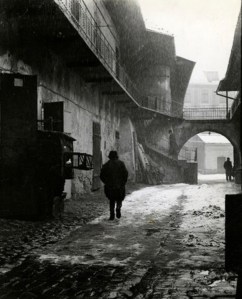
But something about the vision of the building—perhaps the covered arch on the right, or the gothic peaks over the doorways—evoked another image in my mind, the iconic Roman Vishniac photograph of theJewish quarter of Cracow (1937). Hard to reconcile the cheerful, eccentric yet pleasing proportions of the Portuguese structure basking in the Portuguese sun with the dreary, cramped and chaotic Polish street scene, but they both depict a single theme: the vanished world of Jewish history, one lost to the centuries-long persecution of the Inquisition, the other to the devastating ferocity of the Holocaust. I felt a strange kinship with my Sephardic siblings in Obidos.
Roman Vishniac’s photograph of the Jewish quarter in Cracow.
Lisbon
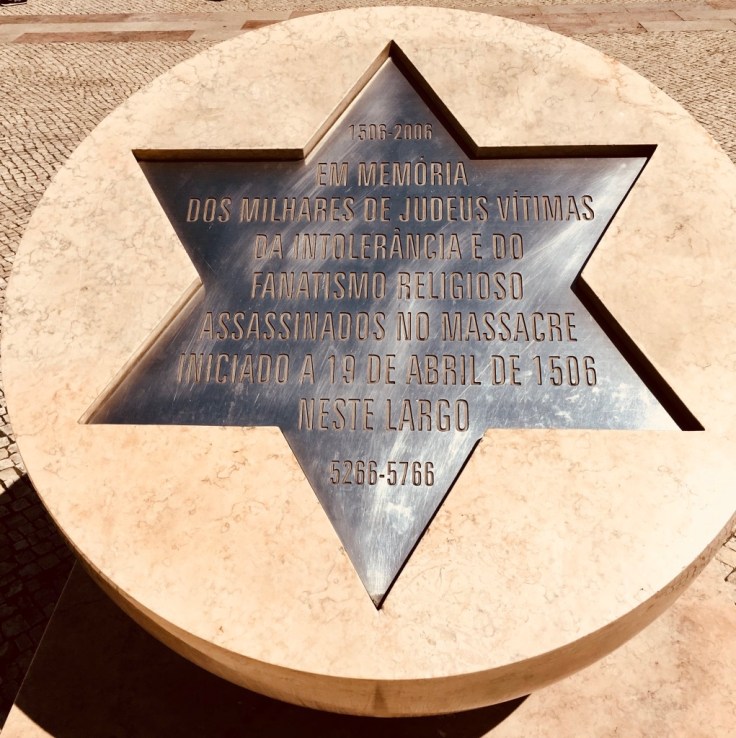
After the pastoral serenity of the Douro River valley and the pristine medieval idyll of central Portugal, arriving in the modern metropolis of Lisbon felt like a 500-year acceleration to the present day, or at least the 1970s, judging by the wood-paneled decor of the hotel room we occupied on our last night before returning to New York. Like the rest of Portugal, signs of incipient revival of Jewish life are evident, but they are like bright green shoots of new grass in aonce-mighty pine forest ravaged by fire. Sometimes, however, the shoots are themselves indicative of both the future and the past simultaneously, like the 2006 monument to the horrific 1506 pogrom that occurred in the capital city. Years after the forcible conversion, but before Manuel I’s promise of exemption from Inquisitorial investigation expired, Portugal was experiencing a drought-related economic crisis. A few churchgoers claimed to see an unusual halo surrounding an icon of the virgin Mary—remember Fatima?—and many flocked to witness the miracle.
Plaque commemorating the 1506 pogrom in Lisbon.
As the story goes, a number of those Catholics in attendance were, of course, erstwhile Jews who were swept up in the forced conversion of 1497. They apparently could not contain their disdain for the credulity of their neighbors, and they were overheard as they expressed their skepticism, claiming that it was merely a trick of the light. As news of the remarks of these New Christians spread, a rage took hold of the population, and converso-Jewish blood flowed in the streets for days until order could be restored.
This too is Portugal.
And, of course, it is marked with a plaque.
Conclusion
What an amazing experience this was! I had no idea that exploring the Douro River valley with Kosher Riverboat Cruises would be so fascinating from a historical perspective. I’m completely psyched for our next cruise: the Danube in October.
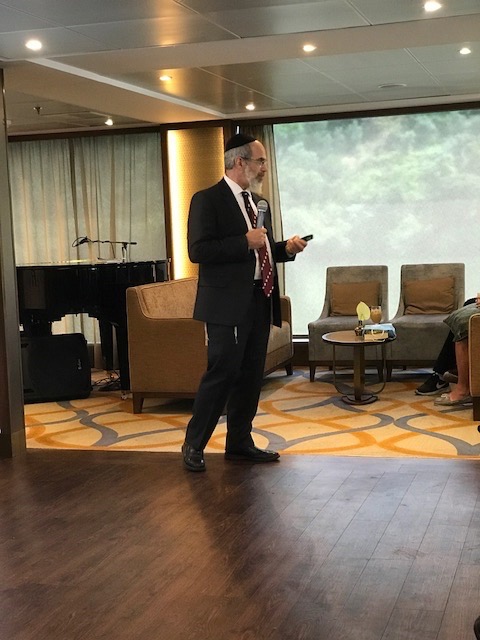
Me doing the lecture thing aboard the Douro Serenity.
Please accept my invitation to participate in a Global Study of Maimonides project, in memory of my father Jack Abramson a”h. It’s totally free and painless (insofar as teshuvah is ever painless). Here’s the next steps:
I’m uploading them as fast as I can, and whenever possible I’m scheduling them to appear at 6:00 am every day (videos will not appear on Shabbat or Yom Tov, but will be scheduled for the day before).
3. Stay Tuned for Livecasts
I haven’t quite figured this out yet, but I was thinking of holding some live online sessions.
4. Optional: Read the Book
The book version is, I think, kind of cool. Lots more commentary and some tools on practical teshuvah. Optional, but I think you will like it–let me know either way! It’s available in hardcover, paper and ebook here.
Looking forward to learning with you! Here’s an introductory videos.
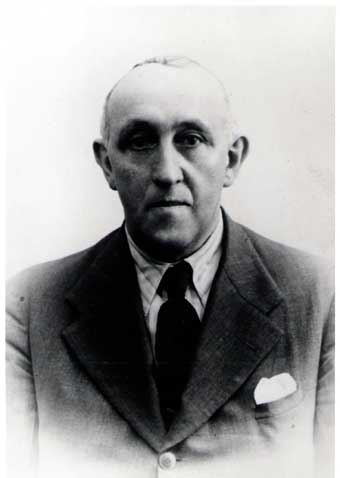
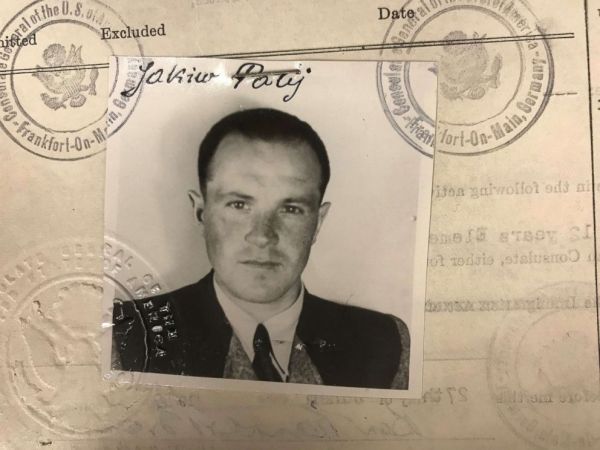
Hasidim of the Aish Kodesh should take note: this is likely the face of one of the murderers of Rabbi Kalonymus Kalmish Shapira hy”d. Jakiw Palij, a longtime resident of Queens, New York, was recently extradited to Germany for filing false information while immigrating to the United States after World War II.
Palij served as a guard in Trawniki, the labor camp where the Rebbe was imprisoned after his deportation from Warsaw. Beginning November 3, 1943, the Nazis instituted Aktion Erntefest (“Operation Harvest Festival”) as retaliation for the Jewish uprisings that were spreading throughout several concentration camps, including Sobibor and Treblinka. In a coordinated effort that spanned several labor camps, guards shot over 42,000 in the space of two days. The Rebbe was among the martyrs.
We still have a few hours before the onset of Shabbat and the possible arrival of Mashiach, but if we have to make it through another Tisha B’Av–
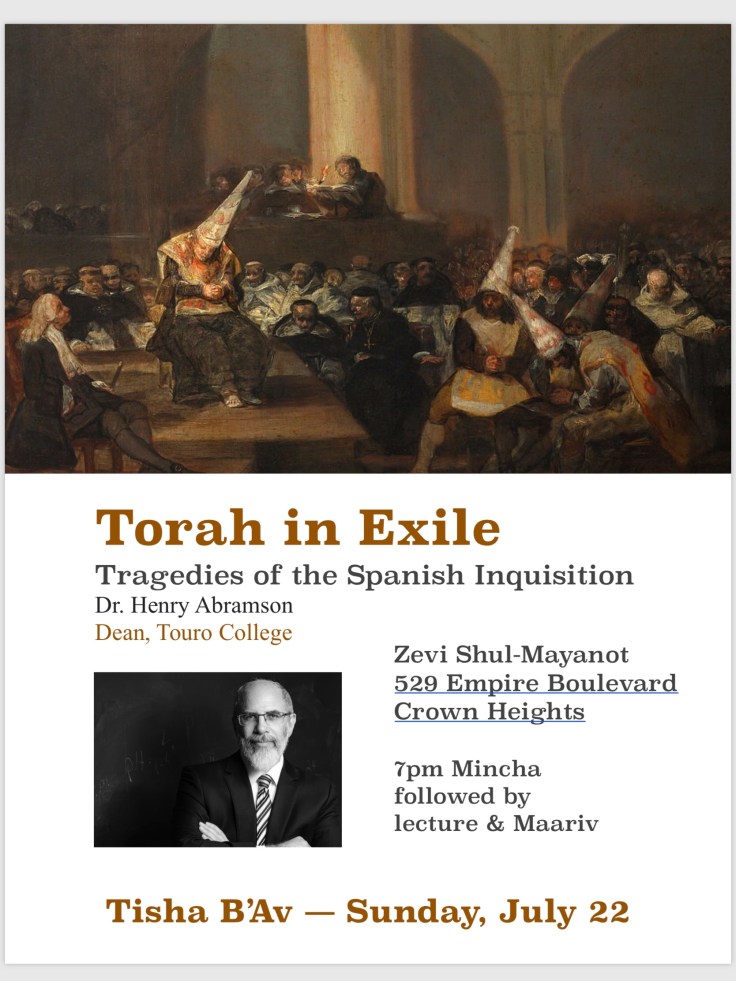
If you are in Fort Lee, NJ Sunday morning or Crown Heights, Brooklyn Sunday afternoon, please join me for presentations on the implications of the Spanish Inquisition and Expulsion on our understanding of the meaning of Exile in our times.
Wishing you all an excellent Shabbat and a speedy consolation,
Thanks to Ben Rothke for this kind review of Torah from the Years of Wrath in this week’s Jewish Link of New Jersey. I am very grateful to be a part of the community that values and spreads the teachings of the Piaseczno Rebbe; nice to see positive reviews!
Keeping the Faith
By Ben Rothke | July 19, 2018
It’s a story that if it were not true, one couldn’t believe it. One of the greatest Jewish thinkers of the past century is martyred in the Holocaust, but leaves his treasured writings in a milk can buried in a devastated city. The can contains a plea to send the manuscripts to the author’s brother in Israel. After the war, the milk can is wondrously discovered in the rubble of the Warsaw Ghetto and makes its way back to the author’s brother.
In “Torah From the Years of Wrath 1939-1943: The Historical Context of the Aish Kodesh,” author Henry Abramson, dean of the Lander College of Arts and Sciences, takes the texts of the Piasetzna rebbe, Rabbi Kalonymus Kalmish Shapira, and maps the text to the historical context in which they were written during the war years.
Keeping one’s faith today is for the most part not a trial given the favorable living conditions most people find themselves in. But with starvation, war, the death of some of his family members, Rabbi Shapira still held onto his faith. Even as the darkness was increasing, and any possibility of survival was vanishing, the rebbe was still able to provide his followers with some semblance of hope, and more than that, deep meaning to what was going on.
What Abramson does in this fascinating book is to match the writing and sermons to what the Jews in the Warsaw Ghetto were experiencing. Rabbi Shapira had to deal not just with his own trauma and suffering, but that of thousands of his followers.
Much of Rabbi Shapira’s writings during those war years were cryptic. Abramson is able to deftly peel the layers off that and give the reader an explanation to the deepness of the messages. He is able to capture the depth of the Rebbe’s emunah at a time of unimaginable suffering.
It’s not clear if the Book of Job is a work of fiction or non-fiction. Job, whether real or imagined, dealt with questions of theodicy. Rabbi Shapira’s writing are perhaps the ultimate work in dealing with theodicy written since the Book of Job, from one who was suffering from the utter depths of destruction and devastation.
By Ben Rothke
Ben Rothke lives in New Jersey and works in the information security field. He reviews books on religion, technology and science.
My father’s yortsayt is coming up next week, and as in previous years I hope to begin another cycle of study of Maimonides on Teshuvah. Please visit the Maimonides on Teshuvah page page to learn more about how to participate in this free, Global Study of Maimonides program. Posts will also appear on Facebook at
We hope to cover the entire Laws of Repentance in the forty days between Rosh Hodesh Elul (this year, the first post is scheduled for August 10) and Yom Kippur. Join me!














 Henry Abramson