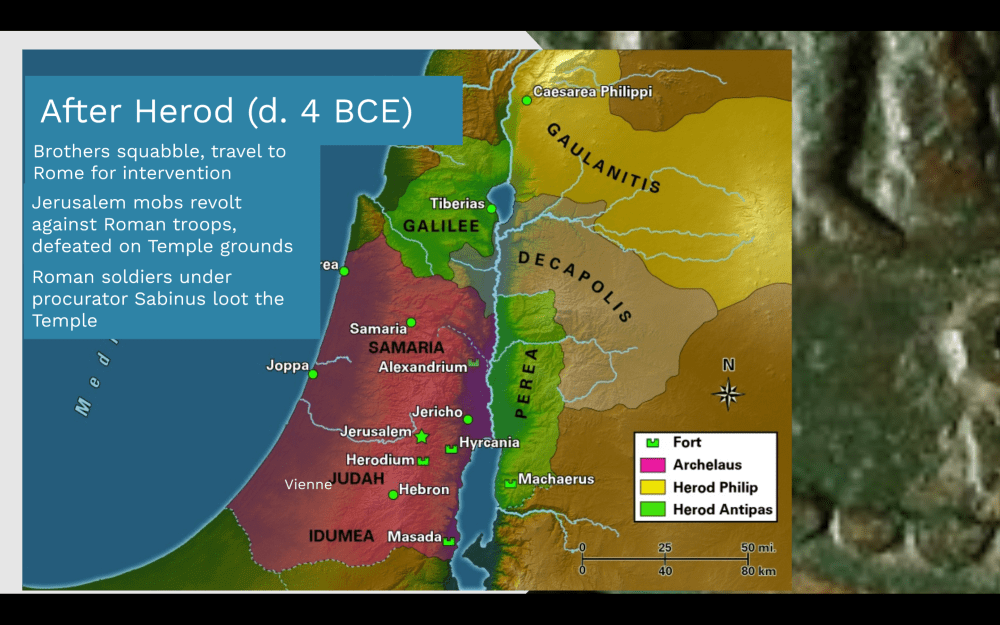
Good morning students of Jewish history! Here’s a planning note for your Presidents’ Day. Join me tonight for a lecture and live chat online at 9:00 pm EST. We will be discussing the Roman-Jewish Wars of the 1st and 2nd centuries: the initial rise of the rebellion against Rome, the intervention of Vespasian and the destruction of the Temple under Titus, the Kitos “war,” and the Bar Kochba Rebellion.
I’ll be online simultaneously to live chat with you (no hard questions, please). Even better: from his college dorm, my son will be acting as moderator to remove any unwanted intellectual vandals from hijacking the conversation with antisemitic or proselytizing viewers (a few dicey moments in the last two premieres, but he managed to keep us on track). With his help, I anticipate a productive conversation.
Here’s the link to the lecture and chat. There’s a little bell where you can set a reminder for yourself. Looking forward to studying this fascinating period of Jewish history with you tonight!
Premieres tonight at 9:00 pm EST
PS: Shout-out to my undergraduates in HISN 256: you are welcome to join us! This lecture isn’t part of your coursework but is absolutely relevant to your overall study of Jewish history. Optional but recommended.
PPS: To my students who attend the lectures in person: remember that we are not meeting this Wednesday (February 19), but will return on February 26.
Hello students of Jewish history! I’m really looking forward to this event next week. Please join me! I’m working on the lecture now. Register by clicking here.
“Origins of the Jewish People to the Maccabean Revolt,” part I of the new I SURVIVED JEWISH HISTORY series, goes live tonight at 9:00 PM EST! Join me for a live chat! Here’s the link to the video: https://youtu.be/Vr9r0RgllWQ
Part I of the “I Survived Jewish History” lecture series is scheduled to premiere on YouTube this coming Monday, February 3 at 9:00 PM EST. Join me in a live chat! Just no hard questions, please. Here’s the link: https://youtu.be/Vr9r0RgllWQ.
I am really enthusiastic about the Spring 2020 series of lectures in Jewish history, beginning Wednesday evening at 7:30 prompt at Young Israel of Lawrence-Cedarhurst. Our plan is to cover the entire, amazing story of the Jewish people from the earliest time to the present day in twelve lectures (click here for calendar and topics). As always, these lectures are free and open to the community!
Egyptian Execration Doll, 18th c. BCE.
For those of you who can’t make it in person, we are trying something new on YouTube. I hope to upload an advance copy video of the lecture for students, researchers and colleagues the day following the Wednesday night lecture (click here for more information on how to get early access to the “director’s cut” version), and then open it up for the wider public (free of charge as always) in a Premiere showing on Mondays at 9:00 pm EST. The cool thing about the new Premiere feature is that I plan to be online at the same time, engaging in a live chat with Jewish history enthusiasts! I tried it out recently with my slightly absurd “All Jewish History in under 18 minutes” video, and it was a lot of fun. BTW that 18 minute video enjoys a ridiculous amount of popularity–it’s been viewed over 26,000 times in the past three weeks–and my favorite comments are the ones that say I left out this topic, or that period, etc.).
Wednesday’s lecture, covering the Origins of the Jewish People to the Maccabean Revolt, was particularly difficult to prepare because it reaches back into the murkiest past, and I had to do a lot of reading in archaeology (fascinating stuff, though).
I’m really excited about the I SURVIVED JEWISH HISTORY Spring Semester of Jewish History Lectures beginning later this month. Please check the flyer for the live lectures with our New York audience (please join us if you’re in town!). Here’s a tentative syllabus of the online dates and times for the release of those lectures.
The Live Lectures are free and open to the public. YouTube Members (Students, Researchers, and Colleagues) will receive Advance Viewing privileges of the rough cut (their comments will help me edit out the bad jokes). The Online Premiere (something new for me) will be open to the broader community, and I plan to participate in the real-time chat session with viewers during the Premieres.
Please save these dates! HMA
I SURVIVED JEWISH HISTORY
Seminar I 1. Origins to the Maccabees
Live Lecture: January 29, 7:30 PM @ YILC
Advance Viewing for Members: upload scheduled for January 30
Online Premiere: 8:00 PM EST, Monday, February 3
2. Rome and Early Christianity
Live Lecture: February 5, 7:30 PM @ YILC
Advance Viewing for Members: upload scheduled for February 6
Online Premiere: 8:00 PM EST, Monday, February 10
3. Revolt and Exile
Live Lecture: February 12, 7:30 PM @ YILC
Advance Viewing for Members: upload scheduled for February 12
Online Premiere: 8:00 PM EST, Monday, February 17
Seminar II
1. Sassanian Persia and the Talmud
Live Lecture: February 26, 7:30 PM @ YILC
Advance Viewing for Members: upload scheduled for February 27Online Premiere: 8:00 PM EST, Monday, March 2
2. Under Crescent and Cross
Live Lecture: March 4, 7:30 PM @ YILC
Advance Viewing for Members: upload scheduled for March 5
Online Premiere: 8:00 PM EST, SUNDAY, MARCH 8 (note change of day)
3. The Glory of Spain
Live Lecture: March 11, 7:30 PM @ YILC
Advance Viewing for Members: upload scheduled for March 12
Online Premiere: 8:00 PM EST, Monday, March 16
Seminar III
1. The Scientific Revolution, Popular Uprisings, and the Jews
Live Lecture: March 18, 7:30 PM @ YILC
Advance Viewing for Members: upload scheduled for March 19
Online Premiere: 8:00 PM EST, Monday, March 23
2. Hasidim, Mitnagdim, and Maskilim
Live Lecture: March 25, 7:30 PM @ YILC
Advance Viewing for Members: upload scheduled for March 26
Online Premiere: 8:00 PM EST, Monday, March 30
3. The New World
Live Lecture: April 1, 7:30 PM @ YILC
Advance Viewing for Members: upload scheduled for April 2
Online Premiere: 8:00 PM EST, Monday, April 6
Seminar IV
1. The Holocaust
Live Lecture: April 22, 7:30 PM @ YILC
Advance Viewing for Members: upload scheduled for April 23
Online Premiere: 8:00 PM EST, Monday, February 17
2. The State of Israel
Live Lecture: April 29, 7:30 PM @ YILC
Advance Viewing for Members: upload scheduled for April 30
Online Premiere: 8:00 PM EST, Monday, April 27
3. The 21st Century
Live Lecture: May 6, 7:30 PM @ YILC
Advance Viewing for Members: upload scheduled for May 7
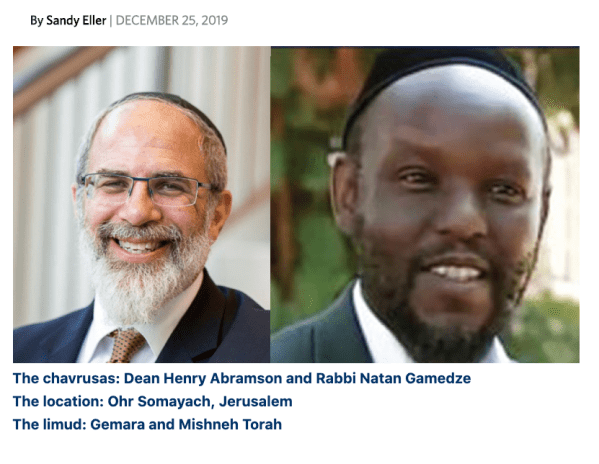
Thanks to Sandy Eller of Mishpacha Magazine for writing this piece about one of my best chevrusas ever, Rabbi Nati Gamedze. Here’s the link to thefull piece, pasted in below.
It was the unlikeliest of pairings: a Swazi prince and a Toronto PhD candidate. But as they squared off over their open gemaras at Yeshiva Ohr Somayach in Yerushalayim, each found depth, meaning, and connection.
The year was 1992. Henry Abramson remembers his younger self as an overly confident intellectual enjoying a year-long sabbatical in Israel. He used that opportunity to immerse himself in his first yeshivah experience as a baal teshuvah, but faced a significant obstacle finding a chavrusa whose learning style dovetailed with his own. He shared his frustrations with his maggid shiur, who turned to the rosh yeshivah, Rav Mendel Weinbach, for help.
“They unleashed a secret weapon on me — Nati Gamedze,” recalls Abramson, now an academic dean at Touro College and a highly respected lecturer who has authored six books and numerous scholarly articles.
Like Abramson, Gamedze was anything but typical. A relatively recent convert to Judaism who hailed from Swaziland’s royal family, Gamedze had graduated Oxford University with honors and was fluent in 14 languages. His journey to Judaism was equally unconventional — after getting closed out of a course in Russian at South Africa’s University of Witwatersrand, Gamedze noticed someone reading a book in an unfamiliar script that ran from right to left. Looking to add another language to his already impressive repertoire, he decided to register for a class in Hebrew and the rest, as they say, was history. Gamedze found himself inexplicably drawn to Judaism.
Now the two unusually cerebral academics were learning in Ohr Somayach, and Rav Weinbach paired them up as chavrusas.
Abramson was blown away by his new study partner, who ultimately earned his semichah after learning for several years at Brisk.
“We were certainly a match, although I was definitely, without question, the junior chavrusa,” says Abramson. “We would walk into the beis medrash and take our seats, with me facing the aron kodesh and Nati facing the bimah. He would lean way back, with his hat perched on his head and he would say to me, ‘So, Hillel, what language should we learn in today?’ ”
The two typically delved into their studies in either English, Hebrew, French, or German, with much of their discussion on the Gemara framed in the contemporary thoughts of 19th and 20th century thinkers. As the arguments got heated, the conversation usually reverted back to Abramson’s native tongue.
“He would be in low gear and I would be trying so hard,” shares Abramson. “He would ask delicate questions that would make me realize I was going the wrong way. I think I won maybe one argument out of every 20. Then again, Abaye and Rava had thousands of arguments and Abaye won only six, so it was a pretty good rate.”
In the course of their chavrusashaft, the unusual pair learned Bava Metzia and Kiddushin, with special emphasis on the Rambam’s commentary. On Fridays they would meet with Rav Weinbach to review the material they had covered, sharing discussions that Abramson recalls even today as particularly humbling.
“The Rambam’s Mishneh Torah is written in fairly straightforward Hebrew and any 14-year-old with reasonable skills can learn it,” recalls Abramson. “Nati and I would learn the Rambam together and possibly have some disputes, but we were sure we had gotten it and that it was no big deal. Then we’d walk in on Friday and Rav Weinbach would destroy us both, showing us how we had missed everything. It was like a massive freight train had passed us by and we just missed it week after week after week.”
Their shared time in the beis medrash often led to long walks through Maalot Dafna as they talked out their learning, a process that laid the groundwork for a solid friendship. While Abramson was already married with children, Gamedze was faced with the daunting challenge of finding a shidduch and was a frequent Shabbos guest at the Abramsons’ Shabbos table, regaling the family with his inimitable ability to throw his voice across the room or discussing his 32 surnames, each of which corresponded to an ancestral achievement but was kept secret in an effort to avoid being cursed by Swazi witchdoctors.
From his earliest exposure to Yiddishkeit, Gamedze found himself mesmerized by the story of Akeidas Yitzchak. Abramson, in turn, was fascinated by the notion that someone who was completely conversant with the latest philosophical trends and thoughts could be so deeply moved by the Torah.
“My time spent studying with him deepened my connection to Judaism profoundly,” notes Abramson. “He understood that the Torah was not a cold, intellectual body of knowledge, but a living, breathing tradition and he became a role model for me of someone who saw a kaleidoscope of color where I had only seen a small spectrum.”
Equally inspiring was appreciating Gamedze as a modern-day Onkelos, someone who gave up everything after coming to appreciate the Torah’s beauty and brilliance.
“It was a humbling experience, both intellectually and spiritually, to see someone with a phenomenal brain that was so much more powerful than mine, who saw the awesomeness of a connection to Judaism, something that inspired me in my own personal journey,” says Abramson.
More than a quarter of a century later, the memories of his chavrusashaft with the man now known to the world as Rabbi Natan Gamedze remain fresh in Abramson’s head, particularly as the Siyum HaShas draws near. Preparing for the upcoming daf yomi cycle, Abramson has been collaborating with the Orthodox Union on its All Daf program since April, creating short videos drawing on a single element of each day’s daf yomi. Ever a high achiever, Abramson hopes to record the final video in 2024, shaving three years off the daf yomi’s seven-and-a-half-year-long cycle.
“One of my rabbis told me once that I should be doing seven daf a day,” muses Abramson. “I’m pretty sure he was joking, though.”
Asked if he thought Rabbi Gamedze was doing daf yomi, Abramson pauses for a moment before answering.
“Nati doing daf yomi?” he says, the smile evident in his voice. “Now that would be interesting.”
(Originally featured in ‘One Day Closer’, Special Supplement, Chanuka/Siyum HaShas 5780)








 Henry Abramson