Really looking forward to meeting this community!

Lectures in Jewish History and Thought. No hard questions, please.


The Seven Jewish Survival Skills HISN 155: Survive Jewish History I Divine Providence Two things: first of all, this isn’t a “skill” per se, since it is not directly dependent on human choice, and second, it’s very difficult to discern exactly when and how it operates. This is an academic course, as therefore we tend……

Hello Jewish History fans– Here’s a new project you might find interesting. A few months ago I came across the work of Ken Bain (What the Best College Teachers Do), which inspired me to take a dramatic new look at the way I’ve been teaching a bread-and-butter course for a long time: History of the……

“It is not sufficient for a person to merely perform a commandment to fulfill one’s duty as a Jew, rather one must transform one’s self into a Jew in the sense of and you will be a nation of priests unto Me, and a holy nation.”

Shimon Huberband was a student of the Rebbe and an amateur historian working for Emanuel Ringelblum’s underground Oneg Shabbat archive (Rabbi Huberband, who was killed along with Ringelblum and most of the archivists, was probably instrumental in convincing the Rebbe to entrust his manuscript to Ringelblum for burial). Rabbi Huberband visited the court of Piaseczno……

Brief overview of the life and work of Hakham Ovadia Yosef, prominent Chief Sephardic Rabbi of Israel. Final installment in the Spring 2018 Lecture Series: The Sephardic Diaspora. Sponsored by Katie and Vick Crespin of Miami Beach, FL In honor of the Six Million and all who were killed just for being Jewish.

Hello everyone– Had a great time here at the “Touro of Cambridge.” Great colleagues, great students, but looking forward to returning to the Mighty Avenue J for tomorrow’s lecture on Hakham Ovadya Yosef, last of the Spring 2018 series). Here’s a couple photos my wife took of me at my old hangouts: Widener Library and……

Brief lecture on the Crypto-Jews. Part 9 of The Sephardic Diaspora series. If you have difficulty seeing the video please click here.

The brief sense of relief felt by Warsaw Jews at the beginning of Passover 1941 did not last. Decrees expelling Jews from several towns were scheduled for the intermediate days of the holiday, and pressures upon the Jewish community increased dramatically. Diarists of the Ghetto record widespread confusion among the population over new Nazi policies……

Good morning students of Jewish History! Just a reminder that we will not be meeting tonight; classes will resume on Monday May 7. You can always use the extra time to catch up on some reading! Click here for a few suggestions. Looking forward to learning with you next week, the penultimate lecture in the……

Good morning– Just a quick note to those who attend in person at the Mighty Avenue J campus: we will not be meeting this Monday, April 30. Planning to reconvene on Monday, May 7 with the penultimate lecture of the season–the history of the Crypto-Jews. Fascinating stuff, I think. H P.S. Seeking sponsors for the……


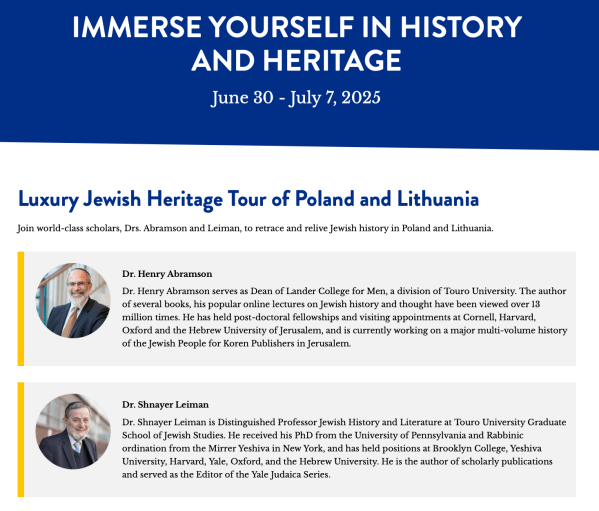
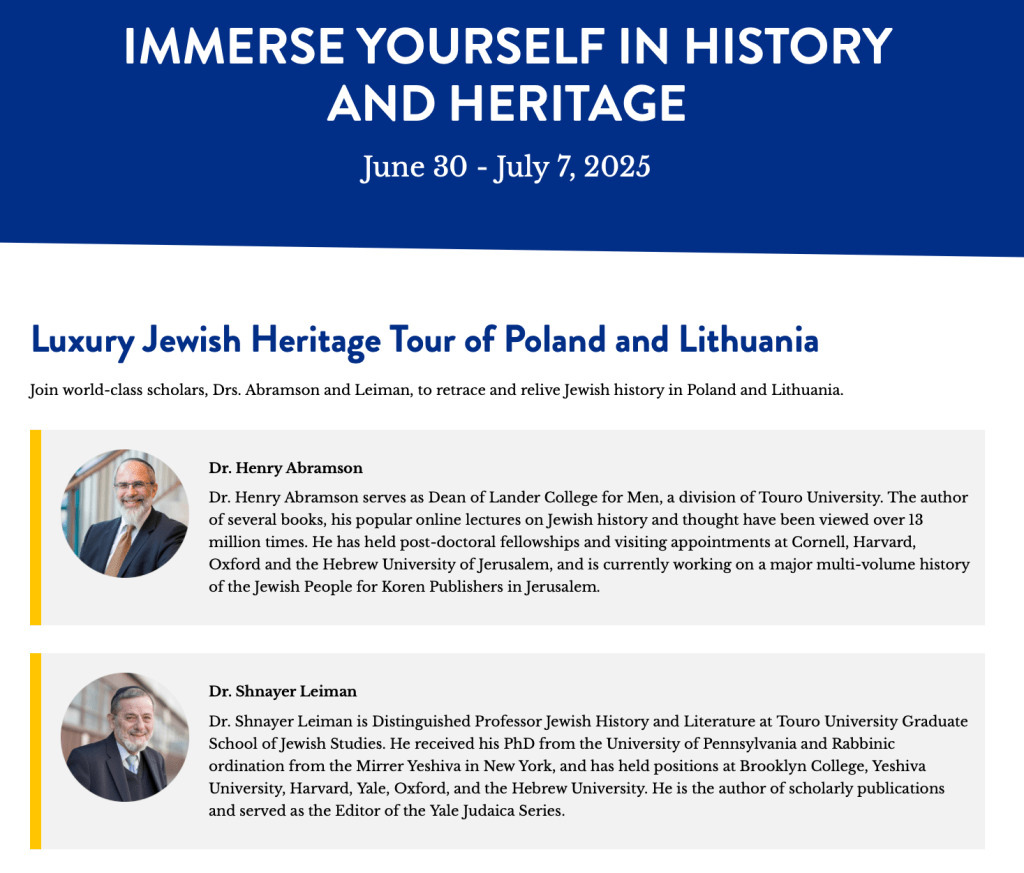
This amazing trip is now open to non-matriculated, visiting students! Join us–it promises to be a fantastic experience. Email me at abramson@touro.edu for more information.
The sixteenth century witnessed a phenomenal, short-lived explosion of Jewish spiritual creativity, centered in the sleepy Galilean town of Safed (Tsfat). Along with greats such as Rabbi Yosef Karo, Rabbi Moshe Cordovero was one of the founders of that unusual place, attracting still more Rabbis and especially Kabbalists to the mountaintop community, including Rabbi……
A brilliant 13th-century scholar of Rabbinic thought, Nahmanides’ defense of Judaism in a forced Church-sponsored debate earned him exile from his native Spain. An elderly sage, he emigrated to the Land of Israel, where he found a tiny Jewish community, desperately hanging onto the traditions of their ancestors. Summoning upon an immense reserve of energy,……
Brief survey of the major historical developments and themes affecting the land of Israel between the 2nd-century Bar Kochba rebellion and the Muslim conquest in the seventh century. Part of the Israel: The Land and its People series.
Certainly one of the greatest Rabbis of the entire Talmud, Akiva son of Joseph did not begin his study of Judaism before adulthood. His trajectory of incredible spiritual growth was punctuated by moments of great personal tragedy, and his martyrdom at the hands of the Romans after the failed second-century Bar-Kochba revolt has an enduring……
One of the greatest builders of ancient Israel, King Herod exploited his power as a Roman-sponsored ruler to develop the Temple, yet earned a reputation as a feared tyrant responsible for horrific massacres. HIs rule set the tone for the political climate in the Land of Israel during the tumultuous decades prior to the growth……
Born in the times of the Hasmonean rebellion celebrated with the holiday of Chanukah, Yohanan Cohen Gadol was one of the most prominent Jewish leaders during the brief period of Jewish freedom in the 2nd century BCE. Caught in the swirling controversy of internal religious debate, in his old age he abandoned his Pharisaic roots……
“Sweet singer of Israel,” David was the poet-warrior King who led the Jewish people to political and cultural prominence. Denied his most cherished goal of building the Temple, he lived a life of great personal challenge and heroic resurgence from tragedy, and his biography left an indelible mark on the Jewish understanding of leadership.
The Bible describes how the Jewish people, emerging from Egyptian servitude and decades of wandering in the Sinai desert, followed Joshua’s military leadership to conquer the Land of Israel and establish the ancient foundations of their Torah-centered society. This lecture will survey the archeological and historical record to understand the larger context of the Biblical……

Join me for a live webinar on the complex topic of Judaism in the first century on Monday, March 13 at 6:00 pm EST. We will look at several of the most important themes of this century: the conflict with the Romans that ended in the destruction of the Temple, the sectarian movements including the……