
Main Auditorium of the Mighty Avenue J campus of Touro College
1602 Avenue J, Brooklyn NY 11230
7pm
Free and open to the community. No hard questions, please.
Lectures in Jewish History and Thought. No hard questions, please.
Main Auditorium of the Mighty Avenue J campus of Touro College
1602 Avenue J, Brooklyn NY 11230
7pm
Free and open to the community. No hard questions, please.


This is the first time I’ve ever had occasion to be a bit sad to be Henry Abramson‘s friend because I’m afraid you might think I am exaggerating when I tell you how extraordinarily beautiful I find his new book to be, I mean, “Torah from the Years of Wrath.” It’s an historically-charged analysis of the Warsaw ghetto sermons of the Aish Kodesh. I picked it up at the bookstore on Friday and couldn’t put it down all Shabbos until I read it to the end.
I do think you are exaggerating, but I am flattered nonetheless, and would like to share your review with AS MANY PEOPLE AS POSSIBLE.
More than one person has told me that they read the book over Shabbos, and I feel a bit queasy about that. The first chapter, which outlines the Rebbe’s life and work before the war, is certainly valuable and appropriate, but I’m not sure how to react to the idea of reading chapters two, three and four, which deal with the war years 5700, 5701 and 5702 (1939-1943). One the one hand, the Aish Kodesh delivered these sermons on Shabbos, so his Torah–no matter how difficult–must be acceptable on the seventh day. On the other hand, my historical contextualization of the sermons are pretty disturbing, and I avoided researching them on Shabbos and Yom Tov. Many people have told me that they found the book uplifting, though, so perhaps there is room to be lenient. Seems like a question for LOR.
That the style is eloquent and as compelling as a novel, that the scholarship is impressive, that the voice manages to remain the voice of a pious hosid even amid an elegant English style and a scholarly sobriety — all this may go without saying. What makes the book extraordinary is the way it manages to do what very few biographies (if that’s the right word in this case) manage to do, namely to present the life and thought of a single individual in such a way that the entire epoch is put in focus through this one small lens. Henry will no doubt attribute this optic phenomenon to the Aish Kodesh himself, Rabbi Kalonymus Kalmish Shapira zt”l. But I don’t see how anyone who has read these 1939-1943 Warsaw ghetto sermons of the without Henry’s aspeklaria-type commentary would be able to see the actual epoch in question.
Rabbi Moshe Weinberger shlita mentioned similar thoughts in a private conversation, captured partially in his haskamah to the book: Aish Kodesh was composed with a distinct social purpose, and it is impossible to understand it fully without a grasp of the immediate historical circumstances. Most Hasidic works are less rooted in the specific circumstances of the events of the previous week–in the Warsaw Ghetto, however, the Rebbe’s Hasidim were desperate for a Torah perspective on how to understand the unfolding Holocaust, and his words were carefully crafted to meet their immediate, pressing needs. My role was very simple: I just studied the events of the week, as recorded in voluminous documentation, and then turned to the Aish Kodesh to learn his reaction. The hardest part was envisioning myself as a simple Hasid (or even freethinker) sitting in the Piaseczno Beis Medrash, seeking the Rebbe’s wisdom after suffering the devastating onslaught of Nazi persecution.
Although I’ve read a good number of books on the Holocaust, and more specifically on the philosophical question of “faith after the Holocaust,” this is the first text I have ever read that shows faith itself, emunah itself, in the fray, not as a philosophical problem found among the debris of Auschwitz but as a living torment and spiritual labour. Almost a terrifying vivisection of emunah.
A classic understatement. Mike, you’ve read more than a “good number” of books on this topic. I agree, however–the Aish Kodesh is not a work written in some quiet sanctum, composed with the sounds of a violin floating in the window with spring breezes. “Vivsection” is an interesting choice of vocabulary–not only does Aish Kodesh demonstrate faith in action, almost painfully slow-motion since we know the outcome–it remains alive even today, in the hearts of Piaseczno Hasidim and other students of the Rebbe around the world.
More. It’s perhaps the most terrifying and challenging example of the famous dictum of Rabbi Shneur Zalman: men bedarf lebn mit der tzayt, “We must live with a times,” a dictum that refers in paradoxical language to “time” as defined by the Hebrew calendar and the weekly sedras. The greatest Jewish souls, we know, have always lived inside the text of the Torah with more vitality than they lived inside their own livingrooms. What most people know as “time,” time as defined by the news or by history, is for them dreams and distractions; the only real “time” is that of the weekly parsha, textual time as defined by the Torah. But how many great Jewish souls have shown us what it means to continue living within this order of time, tenaciously, passionately, at all costs, even as the world of things — food, weather, bricks, health, human dignity — crumbles and putrifies all around them?
Powerful words, Mike, and absolutely on point. I wish I had thought to cite this passage in my book! Maybe in a future edition.
For those readers who are less familiar with Chabad chassidus, here’s the passage in full from Hayom yom, 2 Cheshvan: “From a sicha of my father, after the conclusion of Shabbat Lech L’cha 5651 (1890): In the early years of his leadership the Alter Rebbe declared publicly, “One must live with the time.” From his brother, R. Yehuda Leib, the elder chassidim discovered that the Rebbe meant one must live with the sedra of the week and the particular parsha of the day. One should not only learn the weekly parsha every day, but live with it.”
Anyone with a serious interest in his/her Jewish identity and station, especially those of us who remain vigilant to the way that the Holocaust still defines this identity and this station, really cannot afford to bypass this book. It’s mamash a revelation. I love Henry dearly. But this really has nothing to do with him. Well, maybe not nothing.

Very pleased to see this revised edition of my first book available. Includes a new foreword and afterword.



To the Hasidim steeped in the religious significance of the ritual calendar, the Sabbath known as Zakhor (March 23, 1940) must have seemed a cruel redundancy. Literally called “remember,” the Sabbath preceding the holiday of Purim is named for a few publicly read Torah verses (Deuteronomy 25:17-19) that memorialize the attack of Israel’s primordial enemy, the biblical nation known as Amalek:
Remember what Amalek did to you on your way out of Egypt; how he met you on the way, and struck your stragglers, those who were weak at your end, when were tired and exhausted; and he did not fear God. Therefore it will be, when the Lord your God will give you rest from the enemies that surround you, in the land which the Lord your God gave you as inheritance to possess it, that you will blot out the remembrance of Amalek from under heaven; you will not forget.
The Rebbe returned once again to the theme that pervaded much of his prewar work, arguing for a reinvigoration of Hasidic practice. Playing on the double meaning of the Hebrew verse he met you on the way, which can also be rendered he cooled you on the way, the Rebbe excoriated the weakening of religious enthusiasm among those Jews who slavishly admired the secular wisdom associated with German culture. Ringelblum noted this phenomenon a few months later, writing that there is a “tendency among some of the young people to envy the Others, who are strong, firm, proud, enjoy[ing] the good things of life. There’s a tendency for some of the young people to imitate Them.”
…there were some lowly people who were impressed by the secular wisdom which Amalek took pride in, and considered it attractive. This caused a “cooling off” of their regard for Torah and the wisdom of Torah, saying “the wisdom of the world is also beautiful,” and “they also have noble characteristics,” and “this knowledge has worldly value.” Thus God introduced Amalek to you, with all his attendant worldly wisdom, and also revealed all of his wickedness, the impurity of his heart, his murderous nature, and his putrid wisdom infected you. You have already seen the reality of the essence of secular knowledge. God had already revealed the consequences of this in Spain, when Jews were drawn after their secular knowledge and philosophy, and they were then persecuted and expelled…Now you see and feel with intensity the beauty of the wisdom of Amalek…they know how to speak persuasively, but inwardly they are full of the stench of rot. When it meets their needs or even their inclinations alone, they employ the same artificial intellectual constructs, which they had previously employed to extol the virtues of morality, to now defend theft, robbery, murder, and other atrocities as praiseworthy. Such is not the case with our holy Torah and its holy wisdom.
The following Sunday, Purim, would normally have been celebrated as a holiday of great rejoicing and even frivolity, commemorating the victory of the Persian Jews over Amalek, described in the Book of Esther. The mood at the Piaseczno Rebbe’s court, however, was somber, as described by the firsthand account of Shimon Huberband:
I went to the home of the Piaseczno Rebbe…The Rebbe sat in his shtrayml and his silk caftan, and spoke with a few Hasidim about the terrible situation of the Jews. There would be no festive meal and no Hasidic celebration as was the practice every year. The mood was terrible; the predominant spirit wasn’t of Purim, but of Tisha B’av. People consoled each other by saying that spring was just around the corner, and during the spring of 1940…we would surely be saved.
The Rebbe’s brief message that Purim reflected his efforts to counter the mood, reinforcing the need for joy on Purim, even amidst suffering.
It is written in the holy Tikunei Zohar that Purim is like Yom Kippur. This may mean that just as the fasting and repentance of Yom Kippur must be performed whether or not a person wishes, rather we observe this as a decree of the Holy One, so too the joy of Purim—one must become joyous, not only if a person is already in a state of joy, or even if one is in a situation where one might place one’s self in a state of joy. Rather, even if one is in a lowly, broken-hearted state, mind and all spirit crushed, it is decreed that one must bring, at any rate, some sparks of joy into one’s heart.
The Rebbe’s Purim comments were unusually brief, possibly truncated. On that day, Czerniaków noted in his diary, “In the afternoon, on the Jewish streets, beatings of the Jews and window-breaking. A sort of a pogrom.” The Rebbe’s message may have been cut short by the violence in the streets.
Taken from Torah from the Years of Wrath: The Historical Context of the Aish Kodesh.


Hey friends in Crown Heights! Please drop by and say hello.
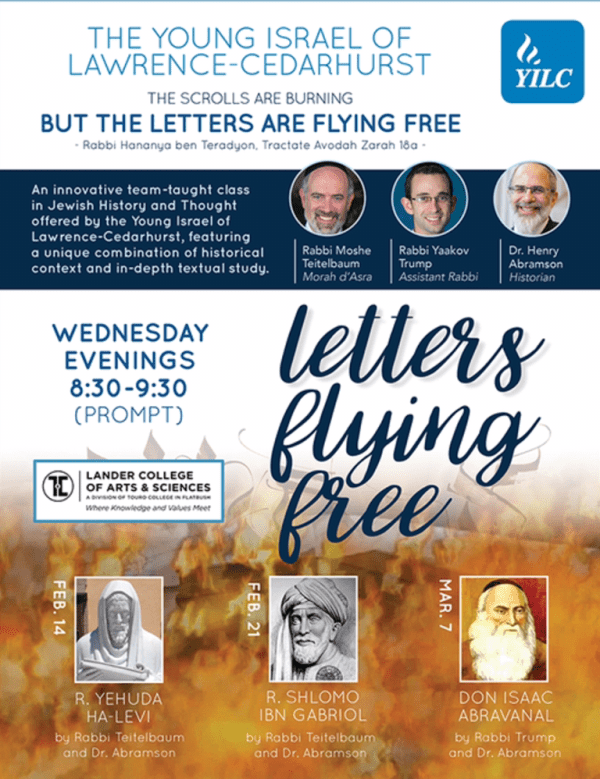
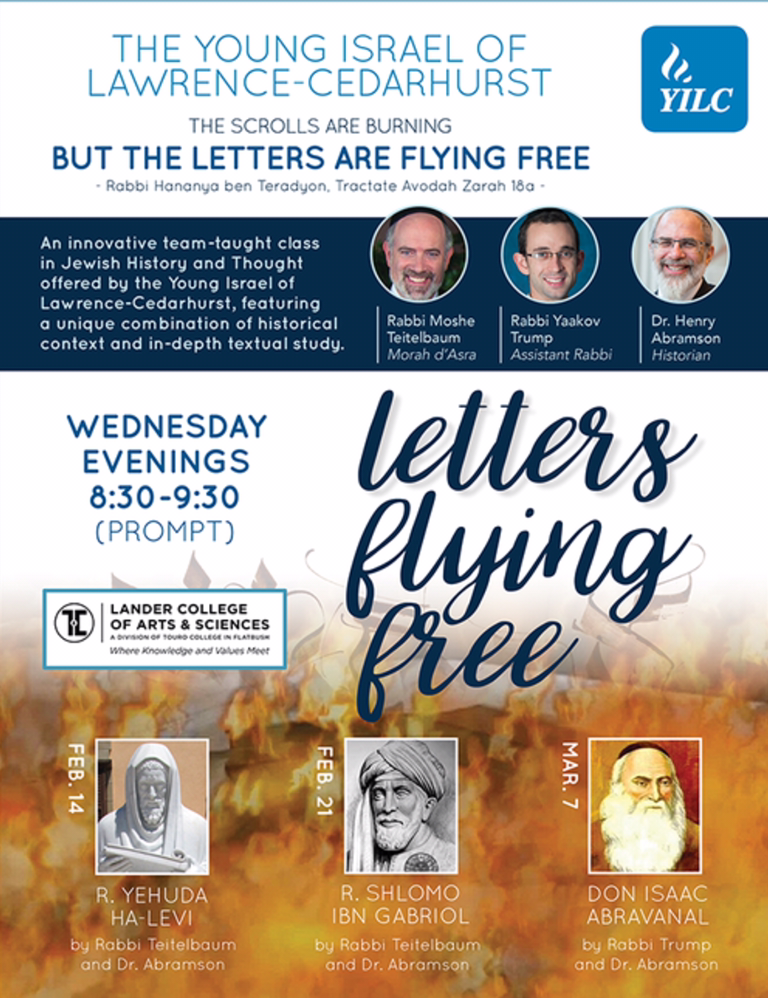 (Well, not Yehudah Ha-Levi, but a lecture about the great Spanish-Jewish poet-philosopher of the 12th century). With Rabbi Moshe Teitelbaum.

Sponsored by Brandon Sultan in honor of the Sultan and Benarroch Families, whose Sephardic roots are expressed in a desire to honor the Convivencia; and also in loving memory of Mrs. Jean Milstein, whose relentless optimism was an inspiration to all.
Just like that. Watch for our Shul President, Jeremy Chwat, and his wife–he apparently has an unusual motivation for coming to Shul three times a day, and she has a great, euphemistic comeback.

Someone told me that this was printed in The Vues. I’m not a Rabbi, but I’m kind of pleased that Ari Hirsch asked for my opinion anyway. Makes me feel like I actually belong in Brooklyn, somehow, if I’m included in this paper known as “the Heimishe Voice.”

The last weeks of winter 1942, ironically, represented a kind of plateau for the Jews of Warsaw. The typhus epidemic abated, and the Nazis had established some work facilities (“shops”) that led many to believe that through productive labor, the Jews would endure. The general feeling was, in the words of historians Barbara Engelking and Jacek Leociak, “in the second year of the Ghetto they were sufficiently hardened to survive to the end of the war. No one doubted that the Germans would lose the war; it was only a question of time. What seemed important was to hold out until that moment arrived.” What the Jews did not know, however, was that the worst was yet to come. On January 20, 1942, in a Berlin suburb called Wannsee, the Nazi leadership formally adopted what became known as the Endlösung, or Final Solution: the deportation of Europe’s Jews to specially constructed Death Camps for mass murder.
The Rebbe, along with all the Jews of Warsaw, were of course unaware of the momentous and terrible nature of that conference in Wannsee. On Parashat Yitro (February 7, 1942), the Rebbe delivered an unusually long exhortation on behalf of Shabbat observance, with barely a comment on suffering until the conclusion:
All the suffering, whether in Egypt or even now, even though it leads one to madness, may the Merciful One rescue us, nevertheless it is for this purpose: to crush and overwhelm the human mind, which thinks that it understands and is self-reliant, as in one who increases knowledge increases pain—to crush and overwhelm it in order that afterwards God’s knowledge may be revealed in the innermost spaces of each and every person, and the entire universe.
That crushing, overwhelming pain came shortly thereafter, with the arrival in Warsaw of Jacob Grojanowski, an escapee from the Chelmno Death Camp. His report was as shocking as it was accurate. The observant young man from the Hasidic stronghold of Izbica was deported and forced to work as one of the Sonderkommando, processing the bodies of thousands of Jews and Gypsies murdered at Chelmno, an experimental facility that had been operating since December 1941. Over the course of his ghastly duties, he recognized the corpses of his parents and many of his townspeople before escaping on January 19 and making his way to Warsaw. Recognizing the importance of his testimony, the Oneg Shabbat staff prepared the “Grojanowski Report” and used connections in the underground to convey it to the Polish Government in Exile in London. The Grojanowski Report described horrific atrocities beyond anything experienced in the Ghetto, and detailed precisely how the Nazis had advanced their killing technologies since the mobile killing squads began months earlier:
In order to prepare for the disinfection they were told to undress, men to their drawers, women to shirts. Documents and valuable had to be tied in a handkerchief and all the money sewed in the clothes had to be ripped out, to prevent damage during the disinfection. After these preparations the people were taken to the bathroom through the door leading to the stairs below. Here the temperature fell suddenly because the corridor was not heated at all. To the people’s complaints the German answered politely that they should be patient until they get out of the bath. The bath turned out to be the prepared ramp, to which the unfortunate were rushed with the help of whips, butts and machine-guns, then loaded on the execution van, which was standing on the opposite side of the ramp. The van, into which the unfortunate were rushed, was the size of a big grey truck, hermetically closed and furnished with closely fastened doors bolted from the outside. The walls of the van were covered with tin, small ladders were laid out on the floor, covered with straw mats. Under the small ladders, on both sides of the van, two gas-pipe blowers, closed with a strainer were placed. The two pipes led to the cab, where they were connected to a gas-appliance, furnished with a number of buttons. After the van had been loaded and the door hermetically closed, it drove to a forest, 7km distant from Koło, where the slaughter took place. It was a field surrounded by soldiers armed with machine-guns and in the middle of it ran a mass-grave prepared in advance. These were 5 meters deep, 1.5 wide at the bottom and 5m wide at the top. The van stopped about 100m from the grave. The driver-murderer pressed the buttons of the appliance in the cab and got out. The drivers were SS-men in uniform, with a skull on their hats. Deadened cries and knocks on the walls came from the van. About a quarter of an hour later the driver climbed a ladder and looked through a special eyehole into the van. After checking that all the victims were dead, he drove the van closer to the grave and five minutes later gave an order to open the door of the van. The burial was carried out by some scores of Jewish forced labor grave-diggers. At the order of the commandant of the slaughter place, an SS-officer, they started throwing out the corpses smelling of gas and excrement and lying in great disorder. The corpses were brutally pulled out by hair, hands and feet. The commandant shouted incessantly and struck the grave-diggers. The corpses were piled up, then two German civilians searched the still warm bodies for valuables. The search was very scrupulous. Chains were torn from necks, golden teeth were extracted with tongs. They checked very closely if there were any valuables in female sexual organs and in rectums. Only then were the corpses thrown into the grave, where two Jewish grave-diggers arranged them with their faces to the ground, so that the feet of one were next to the head of another. Six to nine vans were buried a day. Each layer of corpses was covered with earth. From January 17 they also added chloride. Eight grave-diggers, who were dealing directly with the corpses, stayed in the grave all day long. Before the end of the day, one of the officers would order them to lie down facing the corpses and with a hand-machine-gun put holes into their heads.
The Ghetto was paralyzed by the news from Chelmno. Even Czerniaków, the leader of the Jewish Council, noted in his diary that “disturbing rumors are multiplying in the population about expulsions, resettlement, etc.” The Hasidim who gathered to hear the Rebbe’s thoughts on Parashat Mishpatim (February 14, 1942) must have been filled with trepidation. The Rebbe responded with arguably the most powerful sermon of his life.
It is possible that since the Blessed One is infinite, and for this reason is not apprehensible in this world, consequently, the anguish that God experiences over the suffering of the Jewish people is similarly infinite. Not only would it be impossible for a human to endure such great suffering, it would be impossible for a human to grasp the tremendous suffering which the Blessed One experiences, and hear God’s voice saying, “woe unto Me that I have destroyed My house…and exiled My children,” because this is beyond human limitation…
This is also the reason that the world continues to exist and is not destroyed by the anguish and the voice of the Holy One who is Blessed over the suffering of God’s people and the destruction of God’s home: the terrible anguish of the Holy One who is Blessed cannot be made manifest in the world. Perhaps this is also the meaning of the introduction to Midrash Eikhah, in which an angel says, “’Master of the Universe, I will weep, but let You not weep.’ He responded, ‘if you do not allow me to weep now, I will enter a place that you are not permitted to enter, and there I will weep,’ in secret places does My soul weep,’” see there. In the Tana d’vei Eliyahu Rabah it states, “the angel said, ‘it is unseemly for a king to weep in the presence of his servants.’” If it were merely “unseemly” that God weep in the presence of servants, the angel could simply have left God’s presence, and thus God would not weep in the presence of His servants. In light of what we have discussed, the angel’s intent was to say that it is unseemly for a king to need to cry in the presence of his servants—yet since God’s anguish was, as it were, infinite, greater than the universe, thus it could not be made manifest in the universe, and the universe remained unshaken by God’s anguish. Thus the angel said, “I will weep, but let You not weep,” for just as the angels are messengers of God, the agents who perform the Will of the Blessed One, therefore the angel wanted to express God’s weeping, as it were, in the universe, making the weeping manifest in the universe and making it unnecessary, so to speak, for God to weep. For when the universe would hear the sound of the weeping of God, the universe would hear and explode—a spark of Divine anguish would enter into the universe and all of God’s enemies would be incinerated. At the sea, the Holy One who is Blessed said, “my handiwork is drowning in the sea—and you wish to sing songs of praise?” Now, however, that the Jewish people are drowning in blood—shall the universe continue to exist?
The Rebbe’s theological response to the news of Chelmno combined the elements of the sympathetic suffering of God with an apparently anti-theodic position. The incredible persecution of the Jews was like the martyrdom of Rabbi Akiva and the Ten Martyrs of the State, somehow fatefully ordained by the very fabric of God’s universe, as inevitable as it was terrible. Faced with the ineluctable choice between expressing anguish and destroying the universe, God exits the world to an inner chamber in order to seal off the withering impact of Divine rage from the cosmos.
The Rebbe’s following sermon was on Parashat Zakhor, discussing the meaning of the incomprehensible, terrible hatred of Jews by the biblical nation of Amalek.
Adapted from Torah from the Years of Wrath: The Historical Context of the Aish Kodesh
Paperback: $24.95. New Hardcover Edition: $34.95, discounted to $29.71.

 Henry Abramson