
An introductory lecture on the role of Jews in the medieval economy. Part of the Essential Lectures in Jewish History series.
Lectures in Jewish History and Thought. No hard questions, please.

An introductory lecture on the role of Jews in the medieval economy. Part of the Essential Lectures in Jewish History series.


I’m so glad that so many of you decided to download my latest book, “The Kabbalah of Forgiveness: The Thirteen Levels of Mercy in Rabbi Moshe Cordovero’s Date Palm of Devorah (Tomer Devorah).” I’m also very grateful that many of you have found this work meaningful, especially in the rare moment of the season of repentance that we are enjoying for a few more days.
If you have time to jot down a few words describing your thoughts about the book (any highly superlative praise will do), perhaps you would consider going online and letting other potential readers know? Here’s a few links:
And if you haven’t had a chance to download a copy for yourself, don’t worry: the free offer extends until the 19th of October. Please visit smashwords and enter coupon code YT52E.
Do you prefer a hard copy? Please visit one of these booksellers:
Thanks and enjoy in good health!

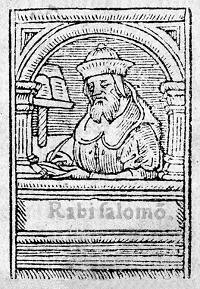
This lecture serves as an introduction to the Rishonim, a body of Rabbinic scholars associated with the 9th through the 15th centuries of the common era. Part of the Essential Lectures in Jewish History series.
Image source: Wikimedia Commons.


Brief video highlighting the life and work of Rabbi Israel Meir Kagan (1838-1936), one of the most influential Rabbis of the 20th century. Better known as the Chofetz Chaim (*one who desires life,” taken from Psalm 34).


“The Insulted King,” Illustration of Level 1 by Rebecca Odessa, Courtesy The Wisdom Daily



“The Moment of Innocence,” illustration of Level 13 by Rebecca Odessa, Courtesy The Wisdom Daily
Translator’s Introduction
The Thirteenth and final Level of mercy carries an absolute guarantee: one who masters this level can forgive anyone. The Thirteenth Level renders all the earlier levels unnecessary, but there’s a big catch: the Thirteenth Level is spiritually exhausting, and can only be sustained for brief periods of time. It requires phenomenal concentration and a massive investment of personal energy, and as such it should only be invoked when all other levels prove insufficient.
The theory is simple, the technique complex. The basic idea of the Thirteenth Level is that no matter how despicable a person has become, there was certainly a time when that person was completely innocent. No matter how damaged the relationship, there was a time when it was new and healthy. Contemplating that moment of innocence is the essence of the Thirteenth Level, which Rabbi Cordovero calls “the level that contains all previous levels.”


“Family Tree (Remember Where They Came From),” illustration of Level 12 by Rebecca Odessa, Courtesy The Wisdom Daily
Translator’s Introduction
The final element of the triad is Level Twelve. In Level Ten we discussed how to forgive ordinary people and in Level Eleven we examined how to forgive especially good people. Level Twelve deals with forgiving people who seem to be beneath our consideration, having failed habitually to live up to moral challenges. How can such people, who have a long history of wrongdoing, merit our forgiveness? Even after considering the previous eleven strategies, it may be difficult to find a path to forgiveness for these people.
The Twelfth Level suggests a shift of focus, from the offender to his or her family background. Rabbi Cordovero, writing for a Jewish audience, places this level in the context of Jewish peoplehood. Even when a Jew behaves inappropriately, and little excuse for the behavior may be found, nevertheless that Jew is still a child of Abraham, Isaac, Jacob, and deserves forgiveness purely out of respect for their ancestral merit. Rabbi Cordovero’s argument may be extended to the family of the entire human race.


“Serve and Protect (Do More for Those Who Do More),” illustration of Level 11 by Rebecca Odessa, Courtesy The Wisdom Daily
Translator’s Introduction
The second part of the triad of Levels Ten, Eleven and Twelve refers to how we must forgive people who have a long history of helping others. In the Tenth Level, we examined how we must extend just a little bit more credit to people as a matter of course, regardless of their moral character. In the Eleventh Level, we see how we must go still further to forgive people who habitually put others before themselves. They, like all of us, experience moral challenges and sometimes fail. Their prior demonstrated commitment to helping others, however, means that they deserve an additional measure of mercy. Like the patriarch Abraham, known for his generous hospitality and caring for others, people who behave selflessly earn an additional measure of forgiveness.


“The Hook (Do the Right Thing Anyway),” illustration of Level 10 by Rebecca Odessa, Courtesy The Wisdom Daily
Translator’s Introduction
The Tenth, Eleventh and Twelfth Levels together comprise a triad of strategies for forgiving others, particularly people with whom we have more casual relationships. The Tenth Level addresses the average person, with neither elevated nor stunted morality, the Eleventh Level describes forgiveness for the person who habitually goes beyond the minimum requirements to help others, and the Twelfth Level focuses on forgiving people who typically fall short of our moral expectations.
The Tenth and Eleventh Levels are also associated with the Patriarchs Jacob and Abraham, respectively. Jacob, whose tribulations frequently involved suffering at the hands of cruel and deceitful individuals like his brother Esau and his father-in-law Laban, learned strategies for coping with challenging people without sacrificing the fundamental trait of Truth. The Tenth Level therefore addresses this issue of truth in forgiveness, and just as Jacob’s deception of Isaac is understood as appropriate despite its manipulation of apparent truth, so too does forgiveness require a slight but intentional deviation from the apparently just. Simply put, even though an individual might deserve a strict retribution for a hurtful act, nevertheless one should just ease that response slightly in favor of mercy, tempering judgment with kindness even though the situation may not otherwise warrant a forgiving response.
 Henry Abramson