Rabenu Gershom: Me’or Ha-Golah Jewish Biography as History

Jews in Synagogue, 15th c. Mantua, Italy.  (Codex Rossianus 555, fol. 12v) [Public domain], via Wikimedia Commons
Jews in Synagogue, 15th c. Mantua, Italy. (Codex Rossianus 555, fol. 12v) [Public domain], via Wikimedia Commons
Rabenu Gershom, Me’or Ha-Golah (Our Teacher Gershom, Light of the Exile) was one of the most influential Jewish legislators of the High Middle Ages, affecting a wide variety of Jewish practices including monogamy, divorce law, and the right to privacy. Part of the Jewish Biography as History lecture series by Dr. Henry Abramson.

Yocheved bat Rashi (Jewish Biography as History)

14th century illuminated manuscript. Source: Wikimedia Commons.
14th century illuminated manuscript, Italy. Source: Wikimedia Commons.

Yocheved  was the daughter of one of Judaism’s greatest scholars: Rabbi Shlomo Yitzhaki, better known as Rashi.  A fascinating woman in her own right, this lecture will survey some of the references to Yocheved (and her illustrious sisters) and what light this sheds on the history of medieval Jewish women.

The Golden Age of Spanish Jewry (History of the Jewish People I)

Sephardic Migrations. By Universal Life (http://michel.azaria.free.fr/History.htm) [GFDL (http://www.gnu.org/copyleft/fdl.html) or CC-BY-SA-3.0 (http://creativecommons.org/licenses/by-sa/3.0/)], via Wikimedia Commons
Sephardic Migrations. By Universal Life (http://michel.azaria.free.fr/History.htm) [GFDL (http://www.gnu.org/copyleft/fdl.html) or CC-BY-SA-3.0 (http://creativecommons.org/licenses/by-sa/3.0/)%5D, via Wikimedia Commons
To view the Prezi associated with this lecture, please click here.

http://www.youtube.com/watch?v=1OnArXdHQdc


L.L. Zamenhof and Esperanto (This Week in Jewish History)

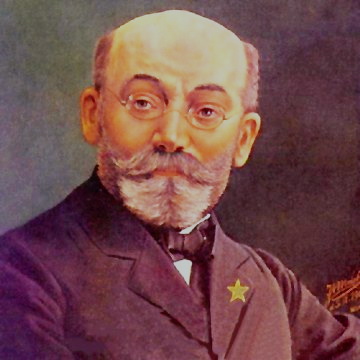
L.L. Zamenhof (Source: Wikimedia Commons)

L.L. Zamenhof (1859-1917) was a Polish Jew who invented the world’s most successful artificial language, Esperanto.  Conceived as a vehicle for world peace, Esperanto is even regarded by the Oomoto religion of Japan as the “language of heaven.”

Origins of Polish Jewry (This Week in Jewish History)

Jan Matejko (1838-1893), "Reception of the Jews in Poland in 1096,"
Jan Matejko (1838-1893), “Reception of the Jews in Poland in 1096,”

This week marks the death anniversary of King Boleslaw V (The Chaste) in 1279.  Boleslaw followed the tradition of his predecessors in Poland by creating incentives for Jewish settlement in Poland, including the establishment of Magdeburg Recht.  Ultimately, these policies proved extremely attractive to Ashkenazi Jews from the Rhineland, making Poland a great center of Jewish civilization by the early modern period.

The Jewish Kingdom of Khazaria HIS 155 1.9

By Sol Podolefsky, Di geshikhte fun di Kazarn un zeyer ideshe meluche in tsentrel Eyrope. New York: Rokhman, 1971. Page 148 (http://www.khazaria.com/sarkel.html) [CC0], via Wikimedia Commons
To view the Prezi associated with this lecture, please click here.

Jews in the Early Muslim Period HIS 155 1.8

By G. Eric and Edith Matson Photograph Collection [Public domain], via Wikimedia Commons

To view the Prezi associated with this lecture, please click here.

The Fourth Lateran Council of 1215 (This Week in Jewish History)

Depiction of Host Desecration in Sternberg, Germany (1492). Diebold Schilling the Younger [Public domain], via Wikimedia Commons
The Fourth Lateran Council, which met in 1215 at the behest of Pope Innocent III, issued several pieces of Church legislation with dire implications for Jews. The doctrine of transubstantiation was confirmed, leading to a new element in antisemitic canards: accusations that Jews “desecrated the host.”

Shmuel ha-Nagid (Jewish Biography as History)

The Alhambra By Jim Gordon (originally posted to Flickr as Alhambra, Granada) [CC-BY-2.0 (http://creativecommons.org/licenses/by/2.0)], via Wikimedia Commons.
The Alhambra By Jim Gordon (originally posted to Flickr as Alhambra, Granada) [CC-BY-2.0 (http://creativecommons.org/licenses/by/2.0)%5D, via Wikimedia Commons.
Poet, politician and philosopher,  Shmuel ha-Nagid

was an exemplar of the Golden Age of Spanish Jewry.

Anwar Sadat Visits Israel (This Week in Jewish History)

Menachem Begin, Jimmy Carter, and Anwar Sadat at Camp David (1978). By Fitz-Patrick, Bill, photographer [Public domain], via Wikimedia Commons
In November of 1977, Egyptian President Anwar Sadat flew to Israel to address the Knesset.  His meeting with his former enemy Prime Minister Menachem Begin ultimately resulted in the sometimes strained but nevertheless enduring Israel-Egypt peace accord, but his unpopularity with hardline Egyptians, opposed to making peace with Israel, resulted in his assassination in 1981.

Create a website or blog at WordPress.com

Up ↑