Yemenite Jew (National Geographic 1914) Source: Wikimedia Commons.
Sa’adia Gaon was an important Jewish philosopher and communal leader of the 9th and 10th centuries, famous in particular for his massive Book of Beliefs and Opinions. A child prodigy to rose to the highest ranks of Jewish scholarship, his thought left an indelible imprint on the Jewish spiritual tradition.
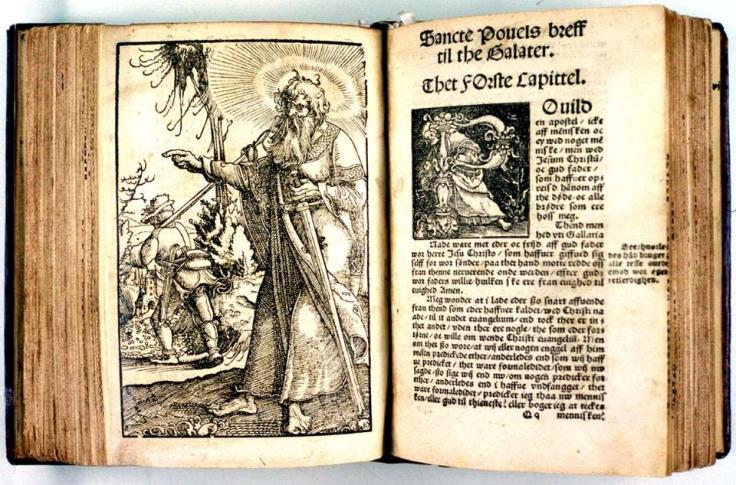
Illustration from Melchior Lotter’s Bible (Sweden, 1524). Source: Wikimedia Commons.
Credited with the popularization of Christianity, Saul (later Paul) of Tarsus was influential in mediating Jewish ideas to an increasingly Gentile audience. Combining appealing concepts such as life after death and a personal Deity with a relaxed approach to the requirements of Rabbinic Judaism, the former Pharisee succeeded in spreading Christianity well beyond its narrow origins among a small group of Jews in Jerusalem to become a massively powerful world religion, albeit distant from its Jewish origins.
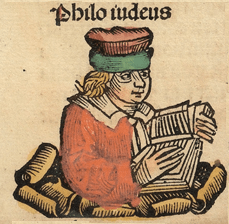
Depiction of Philo Judaeus in the Schedelsche Weltchronik (1493).
Virtually ignored by Jewish philosophers, Philo of Alexandria represented the high point of synthesis between Greek and Jewish thought in the ancient world, and had a huge influence on early Christian thinkers. A prominent representative of the Egyptian Jewish community to the Roman Emperor, and well-respected in his day by his coreligionists, he nevertheless had little impact on the development of Jewish thought. Why was Philo removed from the currents of the Jewish intellectual tradition, yet so well-regarded in other faiths? This lecture was delivered on Wednesday, October 9 at 8:30 pm at the Young Israel of Bal Harbour.
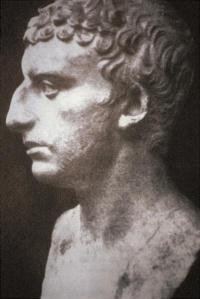
Roman bust believed to be a likeness of Flavius Josephus. Looks Jewish to me.
Captured by the Romans, Josephus was a Jewish general who ultimately served as a military advisor to General Titus. Josephus recorded his first-hand observations of the destruction of the Temple, and went on to a brilliant literary career in Rome, describing Jews and Judaism to a wider audience. Who was Josephus–traitor to his people or unfortunate captive to his circumstances? Self-hating Jew or apologist for Judaism? This lecture, delivered on October 2, 2013 at the Young Israel of Bal Harbour, discusses some of these questions.
Here’s a new version of the Albert Einstein lecture, edited by the wonderful people at TorahCafe.com to include the PowerPoint. It’s basically the same, except without the lame jokes. Click on the icon below to watch the video.
Isaac Bashevis Singer. Source: MDCarchives cropped by Beyond My Ken, Wikimedia Commons.
This is a lecture I delivered at the University of Central Florida back in October 2004 (my hair was quite a bit darker and, well, there). Found the CD when I was cleaning out some old files. There’s a PPT that goes with this lecture, and I’m going to try to find a way to post it. Anyway, this is the summer, so I won’t be sending out too many new lectures, thought I would add this one as well. Isaac Bashevis Singer (1902-1991) was a Nobel Laureate for Literature, the first Yiddish writer to receive this distinguished award. He was also a resident of my current home in Surfside, Florida. Hope you enjoy it!
Rabbi Menachem Mendel Schneerson. Photograph aby Mordecai Baron. Source: Wikipedia Commons.
A presentation on the life and work of Rabbi Menachem Mendel Schneerson (1902-1994), the Seventh Rebbe of the Chabad-Lubavitch movement. A native of Nikolaev, Ukraine, and educated in Germany and France, his leadership transformed his Hasidic followers into an international movement that continues to shape the lives of Jews world wide. The lecture was held at the Young Israel of Bal Harbour on Wednesday, June 5th.
A presentation on the life and work of Betty Friedan, a prominent American Jewish feminist leader. The author of the landmark The Feminine Mystique (1963), she later became the Founder of the National Organization of Women, and an important political activist for women’s rights. The lecture was held at the Young Israel of Bal Harbour on May 29, 2013.







 Henry Abramson