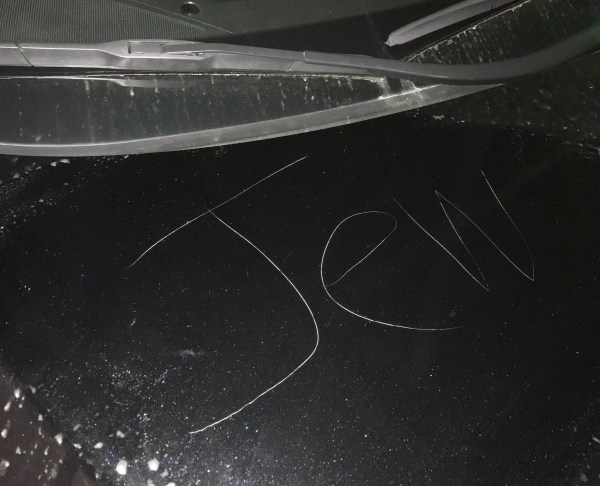
To the antisemitic vandal who defaced my car: thank you.

vandalismDear Old Friend:

First of all, thanks for not using an adjective.

I know you understand the word “Jew” to be a slur in itself, but it’s a bit softer without the modifier. I never liked it when you spat “dirty” Jew at me in the playground. I always saw red whenever you jeered “cursed” Jew, using the Québécois term maudit juif. Exchanges like that usually resulted in scuffles and fisticuffs, and ultimately we ended up glaring at each other on the bench outside the principal’s office, bloody-nosed and sweaty. As a teenager, you shouted “F-ing Jew” as you zoomed by in your car as I walked home from shul on Saturday mornings. In recent years your anonymous invective on social media has been especially creative.

So it’s a kindness on your part to simply label me “Jew,” something I would proudly affirm. Your hateful, anonymous scribblings on the hood of my car just reinforces solidarity with my ancestors who endured far worse, as well as my African-American neighbors who moved to our safe Jewish neighborhood because you scrawled a swastika on their front door. 

Hamburg JUde
Berlin, 1933. The sign reads, “Germans! Defend Yourselves! Do not buy from Jews!”

Second, thanks for timing it such that I didn’t discover your message until right before Shabbat. I don’t know if you intended to sour my mood moments before walking into synagogue, but your nasty surprise was overwhelmed by two unexpected, and infinitely preferable, developments.

My fourteen-year old son was the first to see the damage, and you gave me the precious opportunity to teach him some ancient truths about our long-standing relationship. His childhood was more sheltered than mine—he’s grown up in various American shtetls, and as far as I can tell, he’s never encountered you in any meaningful way. I’m hoping that your venomous message, diluted in the form of a cowardly one-word act of vandalism, will inoculate him against the live, active version of the disease you represent. You gave me the unscripted opportunity to teach him how to react with dignity and equanimity, just as my father of blessed memory taught me so many years ago. (A prayer: May it be Your will, my G-d and G-d of my ancestors, that this be the full extent of his contact with you).
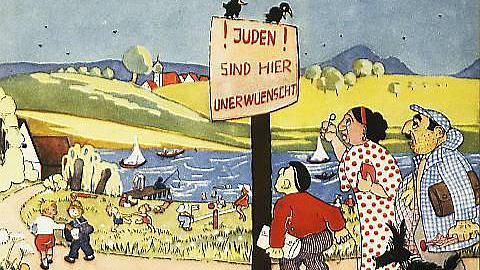
Antisemit.Kinderbuch v.Elvira Bauer 1936
“Jews are Unwelcome Here,” from Elvira Bauer’s twisted children’s book, Trau keinem Fuchs auf gruener Heid / Und keinem Jud bei seinem Eid, Ein Bilder- buch fuer Gross und Klein Elvira Bauer, Nurenberg (Stuermer-Verlag) 1936.

The other amazing surprise revealed itself when I  broke the news to my wife. Given that the Sabbath is a time of rejoicing and relaxation, I was concerned that the news of your reappearance would upset her, so I told our son not to mention it at the table and I didn’t share your communication until after the Havdalah ceremony on Saturday night. You should have seen her reaction! Her normally luminous green eyes turned a hard, gun-metal grey as she pursued her lips in that dark expression that says, “congratulations, soldier–you were looking for trouble, and you certainly found it.” I was worried that she might be frightened or at least intimidated, but man, if I were you I would lay low for a while. You and I have had the occasional conflict, but you do not want to mess with Jewish women.


260px-Glikl_Pappenheim
Bertha Pappenheim as Glueckl of Hameln, her 17th century ancestor.
1600px-Flickr_-_Israel_Defense_Forces_-_Female_Soldier_at_the_Shooting_Range_(1)
Your typical soldier in the Israeli Defense Forces.
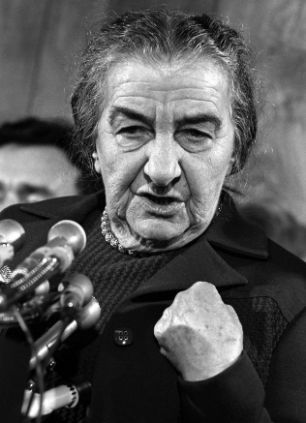
GOLDA MEIR
Golda Meir, Prime Minister of Israel 1973. AP Photo/Bob Daugherty

My eldest daughter decided to share photos of your art on her social media account (like I said—those Jewish women). And you know what? She got a ton of supportive messages from her online friends and colleagues. Jews for sure, but plenty of Christians and Muslims, maybe some Hindus as well: kind and sympathetic messages from men and women representing the kaleidoscope of human races, colors and religions. I’m sorry, old friend, but even your dramatic torch-lit marches can’t hide a basic truth: there are more people like us, ordinary people who love their families and just want to mind their own business and get along with each other, than there are people like you. Yell all you want, we’re not affected.

charlotessvile
“Unite the Right” Rally, Charlottesville, VA, August 2017 Photo: Samuel Corum | Anadolu Agency | Getty Images

See, the chip in your brain that is supposed to recognize our common humanity is busted. You don’t see me as a regular middle-aged guy just trying to take care of his family. Instead you dream up all kinds of crazy pathological fantasies about me, like I drink Christian blood on Passover, or I faked 9/11, truly messed-up stuff. You should take better care of yourself, see someone about that, because it’s not healthy, you know? 

Simon_von_Trient_Schedelsche_Weltchronik
Blood Libel of Simon of Trent, 15th c.

Which reminds me: thanks also for limiting your self-expression to my car. The ancient Sages, when they contemplated the destruction of the Temple in Jerusalem almost 2,000 years ago (the anniversary is coming up, as I’m sure you know), proclaimed, “wood and rocks.” Meaning, no matter how awful the loss, the Temple was ultimately only wood and rocks, inanimate things. “Sticks and stones,” in the vernacular. Yes, I know full well that you are capable of breaking bones as well. My ancestors’ bones, which lie in an unmarked mass grave in Lithuania, testify to your genocidal capacity. That’s why I’m happy you restricted yourself to the car.
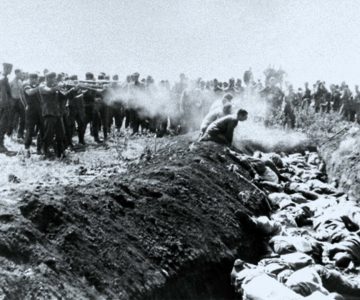
Einsatzgruppen-Episode1-V4-360x300
Einsatzgruppen Murders, 1941.

But back to the broken chip in your brain. What you probably don’t realize is that I actually care for you. I worry about whatever it was you experienced that made you hate me—even though you never met me—and wish I could do something about it.

Love, wrote King Solomon, is as strong as death (Song of Songs 8:6). As much as you wish to negate me and my people, you will never succeed, because we love life, and believe it or not, we even love you, you pathetic little person–I mean, come on, you write on people’s cars when they are not looking! We are an exuberant, entrepreneurial, generous, creative people, and whenever you try to put us down with your threats of violence, we will be in your face with our irrepressible joie de vivre, courage, spiritual exaltation, and humor. It takes a lot more than this to knock us down.

Sincerely,

your old friend,

Henry

P.S. I was also pleasantly surprised that the Nassau County Police took this whole thing really seriously. I reported your crime, figuring it would just be for the statistics, but they sent out a squad car and two detectives (!). They will be reviewing a pile of security camera footage, my friend, so maybe we will get a chance to catch up on things in court.


The Last Hasidic Rebbe of Warsaw: Interview with Zev Brenner on Talkline

I had the pleasure of speaking with Zev Brenner of the famous Talkline last week; really pleased that there’s a lot of interest in the work of the Piaseczno Rebbe. The broadcast was aired last Saturday night and will be rebroadcast again tonight at 8pm EST on WSNR AM 620. Here’s the link to the broadcast.


Screen Shot 2018-06-26 at 5.41.15 PM
Click Here

Proud to Honor Dean Stanley Boylan at Harvard Club

Dean Boylan has been a mentor of mine since I joined Touro in 2006. Proud to be with him this morning at the Harvard Club as he receives the Education Update Outstanding Educator of the Year Award. With Dean Moshe Sokol of Lander College for Men and Executive Dean Robert Goldschmidt of the Mighty Avenue J campus of Touro College.

Parashat Hukat in the Warsaw Ghetto (July 5, 1941)

Rabbi Shimon Huberband, a student of the Piaseczno Rebbe, recorded a tragic incident that was circulating through the Ghetto in the summer of 1941:

In late June a couple appeared before the rabbi; he was roughly thirty years old, and she was much younger.  The husband said that he had been seized from his bed on Passover of that year and was sent off to a labor camp.  There he suffered greatly; he was beaten with terrible blows, and suffered from infections and lice.  Many of his comrades died from the blows and from shootings, but he was lucky enough to survive.  In the most difficult moments, he kept before his eyes the image of his young, beautiful wife.

When he returned home, drained of all his energy, he found a stranger in his bedroom.  His wife wept and expressed regret.  People told her that everyone who had been taken to the labor camp had died there.  Had she known that he was alive, this never would have happened.  She wept, he wept; and the divorce was carried out.

The Rebbe spoke that Shabbat on the need for personal balance in the face of awful tragedy. On the one hand, he said, we should direct our attention to our spiritual lives, separating from the mundane physical experiences. He alluded to a teaching of the Ba’al Shem Tov that appears with some frequency in his prewar writings: paraphrasing Moses’ words on Deuteronomy 5:5, I stood between God and you–it is the “I” (אנכי) that stands between God and an individual. The Rebbe noted that a strong self-consciousness can interfere with one’s spiritual growth:

A person who wishes to elevate himself further and develop a closer connection with God, however, must diminish his sense of self and accustom himself that all his divine service be solely for the sake of God. His fear is not self-directed, nor is his desire for reward, rather all his emotions are directed toward his desire to serve Hashem. This depends on the degree to which he is able to diminish his sense of self [אנכיות]. Every person can accustom himself to this according to his level of spiritual development; if not perpetually then at least occasionally he may rise to his pure level of divine service.

Yet, continued the Rebbe, how is it possible for a person to diminish one’s sense of self when one is in pain, experiencing the terrible tragedies of the Warsaw Ghetto?

When Jacob is suffering, while it is true that this provides atonement for his sins, nevertheless this accustoms the person to be ever more aware of his physical condition, for he is daily immersed in his own suffering: “I have pain,” “I have need.” Is it possible for a person to be struck and not experience physical pain? Since his daily preoccupation is over his very life which is hanging in the balance before him, and he is immersed in his pain and suffering, he regresses to a lower form of Divine service which is predicated upon this awareness of his physical condition.

The solution, taught the Rebbe, is to direct that heightened self-consciousness of suffering into sympathy for the plight of others.

In order to arouse Divine mercy above for the Jewish people, and to temper the harshness of Divine judgement, we must arouse within ourselves mercy for our fellow Jew. Not only are we required to provide them with whatever we are capable of giving, but the very mercy which we arouse within ourselves has an affect in the Heavenly realm. We must not become accustomed to Jewish suffering, that is, we should not become numbed to the overwhelming degree of suffering such that our mercy for Jews be deadened. On the contrary, the heart should melt, Heaven forbid, at the bitterness of this suffering. Arousing mercy within us will have affect two things: firstly, our prayers on behalf of the Jewish people will be more heart-felt, and secondly, as is known from the Holy literature, there are times when a decree of salvation for the Jews has already been issued in Heaven, but its implementation is delayed due to its other-worldliness and its inability to descend to this world and assume physical garb. Consequently, when a person has more than an intellectual awareness alone that Jews have an obligation to support one another, rather he manifests mercy with his entire being, then his prayers are beneficial in drawing down the salvation into this world and the realm of the physical, since he has made himself into a vessel of mercy, both in his heart and with his entire character.

Post script 2018: The Rebbe’s words here, spoken in July 1941, reflect his principal preoccupation with the welfare of his Hasidic congregation and the larger Jewish population of the Ghetto. The larger arc of his thought, however, would certainly support expanding this passage to concern, sympathy and prayer for the welfare of all people.


Forthcoming October 2018:

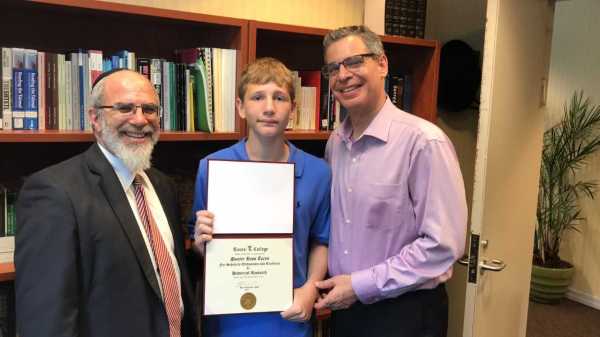
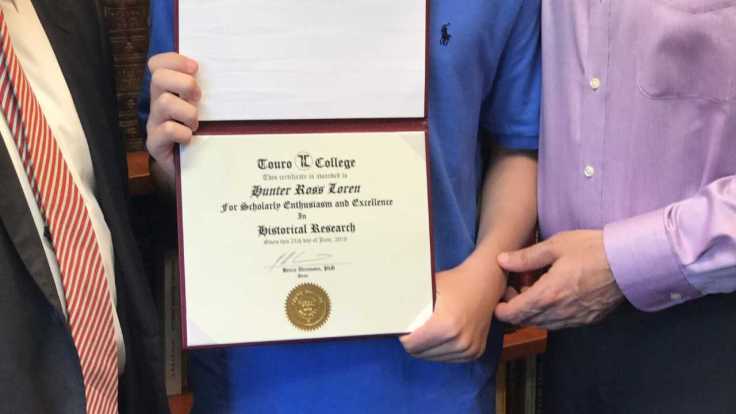
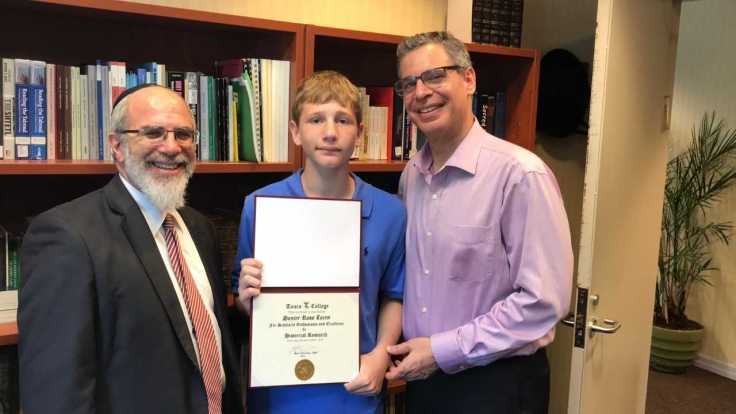
Mr. Hunter Ross Loren Receives Award for Scholarly Enthusiasm in Jewish History

Meet Mr. Hunter Ross Loren, a precocious 13-year old who, together with his uncle Alan Loren, contacted me this week to discuss Jewish history. Hunter is an avid fan of Jewish history–especially, of all things, the Jews of the Polish-Lithuanian Commonwealth–and he is probably my youngest student online. As a follow-up to his Bar Mitzvah, his uncle arranged to come visit me in my office at the Mighty Avenue J campus of Touro College to ask me some really hard questions (thankfully, I survived–they were actually quite excellent questions).

In recognition of his academic prowess, we prepared a small certificate for him, recognizing his Scholarly Enthusiasm and Excellence. Thanks to my assistant, Ms. Jamie Venezia, for masterminding the execution of this moment.

Congratulations Mr. Loren! Your family should be very proud of you. Looking forward to seeing your name on a book in a few years…

231

Jews and Ukrainians since HURI (1968-2018)

Here’s a new video from the Ukraine in the World Conference I attended last month at the Harvard Ukrainian Research Institute. Introduction by Dr. Lubomyr Hajda of Harvard at 1:03, and my talk begins about a minute later. The presentation basically reviews the intersecting worlds of Jews and Ukrainians over the last half-century, with some musings on what the future might hold.


SURVIVE JEWISH HISTORY: Take this free online course!

Colleagues, I’m pleased to post a version of my new experimental course online for the public good. Please visit bit.ly/survivejewishhistory to access the course.

The course is divided into twelve Existential Crises, covering historical eras from the Hellenistic to the Spanish Expulsion. Undergraduate students are required to complete several academic exercises to “survive” each level and pass the course (the syllabus is located at bit.ly/survivejewishhistory). The lighter version of the course presented here does not award undergraduate credit, but students are encouraged to participate by posting their responses in the comments section. I also encourage new visitors to click on the “follow” button at the bottom right of the website in order to receive course updates.

I hope you enjoy this experimental new course! Learn in good health.

(Photo by the incredible Yaakov Naumi/Flash 90)

Parashat Shlach in the Warsaw Ghetto (June 22, 1940)

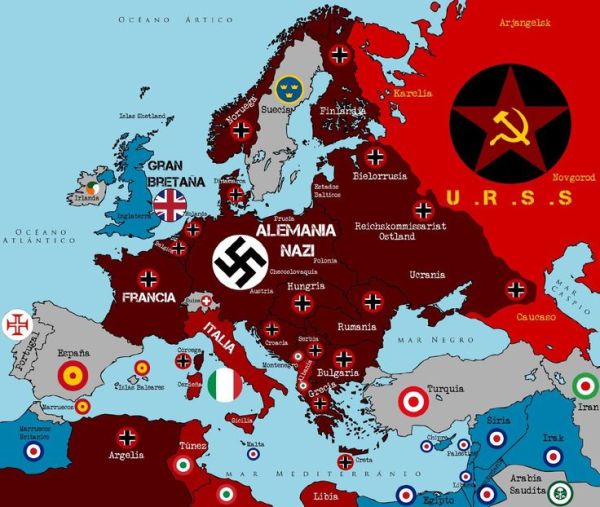
The Hasidim of the Piaseczno Rebbe who gathered for the Seudah Shelishit in his Beit Midrash on 5 Dzielna Street in Warsaw must have been unusually somber that fateful June 1940 afternoon. Over the previous week, ominous news had filtered into the Ghetto: France had fallen to the powerful Nazi armed forced. With the collapse of this major western power, Hitler was nearing his high-water mark of European domination, occupying the continent from the English Channel to the borders of the Soviet Union. Many in the Ghetto had hoped that France would be able to halt the advance of German forces, but in the summer of 1940 it looked as if the “1000-year Reich” was ever closer to becoming a reality. Germany appeared invincible.

The Rebbe, by contrast, was undaunted. Taking his cue from the weekly parashah, he fearlessly delivered a bold, undiluted message of courage. His starting point was Caleb’s call to action, exhorting the Jewish people, once a slave nation, to begin the conquest of Israel. Contradicting the fearful report of the other spies, who bemoaned that the military odds facing the Israelites were hopeless, Caleb and Joshua remained steadfast in their faith in the Divine promise.

Let us go up and take it over, for we certainly can. Let us understand: the spies certainly spoke meaningfully and reasonably, but the nation is powerful…and the cities are fortified. Why did Caleb not argue with them to rebut their rationale and their arguments? Instead, he simply said, let us go up.

Who in the audience could not help but hear the subtext? In the Torah, the spies returned from scouting the land of Israel and came back with a realistic assessment: attempting to conquer the land was absolutely futile, well beyond the military capabilities of the Jewish people. Caleb, however, did not even bother to respond to their reasoned arguments. Through thinly veiled rhetoric, the Rebbe argued that Warsaw Jews should not succumb to despair:

Such must be the faith of the Jew. Not only when he sees an opening and path to his salvation, that is that he reasonably believes, according to the course of natural events, that God will save him, and thereby he is strengthened; but also at the time when he does not see, Heaven forbid, any reasonable opening through the course of natural events for his salvation, he must still believe that God will save him and he is thereby strengthened in his faith and trust. On the contrary, at such a time it is better that he not engage in intellectual convolutions to find some rationale and opening through natural means, since it is clear that he will not find one—consequently it is possible that his faith will be diminished. This diminution in his faith and trust in God might serve to prevent his salvation, Heaven forbid. Rather, he must declare that it is all true, that the nation that lives there is in fact powerful, it is true that the cities are fortified.  Nonetheless, I proclaim my faith in God, that God is beyond limitation and nature, that God will save us. Let us go up and take it over, beyond reason and beyond logic. Such faith and trust in God draws our salvation closer.

The Rebbe’s message is clear: Jews were not to give credence to the doomsayers of the Ghetto. Like Caleb’s report to Moses on the enemy forces in Canaan, the Jews need not focus on the power of the German army, they need only proclaim let us go up and take it over, for we certainly can. The Third Reich, no matter how powerful, is no match for the Almighty.

Excerpted from

Torah from the Years of Wrath: The Historical Context of the Aish Kodesh

Hardcover: $29.71 (15% discount with this link)

Softcover: $24.95

torah from the years of wrath final cover- front

New Experimental Jewish History Course

Hello Jewish History fans–

Here’s a new project you might find interesting. A few months ago I came across the work of Ken Bain (What the Best College Teachers Do), which inspired me to take a dramatic new look at the way I’ve been teaching a bread-and-butter course for a long time: History of the Jewish People I, your basic undergraduate survey course, covering Jewish history from the Mishnah to the Spanish Expulsion. Professor Bain emphasizes the value of the journey of discovery in learning, and with that in mind and a bunch of behavioral economics theory, I’ve completely rethought the course. I’m really excited about how undergraduate students will appreciate it.

At the same time, I’d like to make a simpler version of the course available to my students on the web. Please stick around, as I hope to upload some really interesting stuff over the next few weeks and into the next academic year! Please visit this page to see the full syllabus as I’ve presented it to undergraduates, and here’s the introductory video.

Please let me know your thoughts!

Thanks,

HMA

Parashat Naso in the Warsaw Ghetto (June 8, 1940)

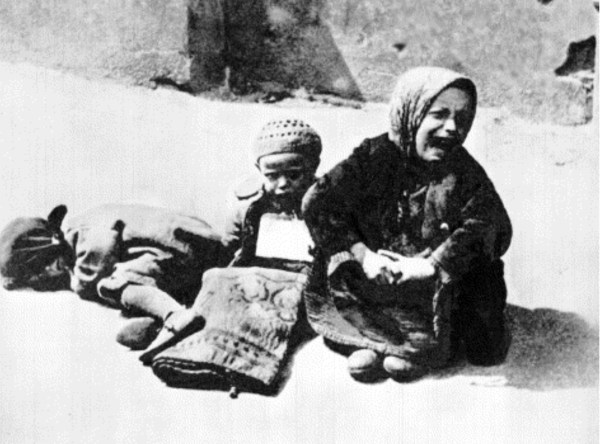
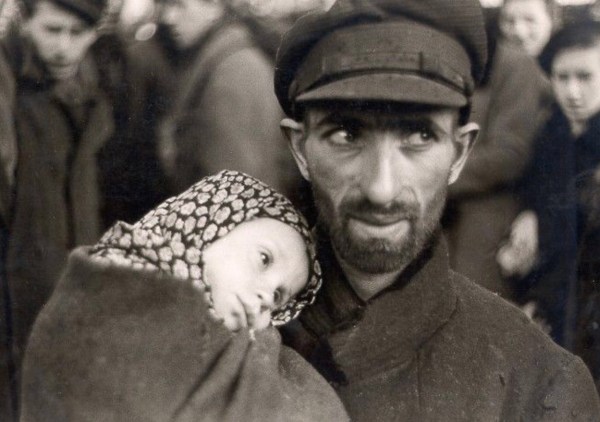
Chaim Kaplan, an unemployed former Jewish day school principal and resident of the Warsaw Ghetto, recorded the mood as the Jews received increasingly distressing news of German military victories on the western front in the summer of 1940:

All normal conduct of business has ceased.  In place of business, peddling has come, and the place for all such vending is in the street.  So the streets are filled with men, women, and little children, as in the good old days, even though all the stores are closed and the houses demolished.  Mob upon mob fills the sidewalks until it is as crowded as a market day.  And every crowd of vendors is also a crowd of politicians.  Every oddity finds listening ears and spreads so fast that within an hour “all of Warsaw” is discussing it.  There is no limit to the lies.

Our Jews don’t believe in the murderer’s victories in France.  The newspapers announce victories which cannot be denied, whose truth is apparent — yet the Jews don’t admit them.  They stick to their conviction: The Germans will end in destruction.

The Rebbe’s message for parashat Naso resonated with the themes of Shavuot and the receiving of the Torah. He exhorted his Hasidim to invest themselves in Torah study and Hasidic life with every fiber of their being, even under the pressurized environment of the Ghetto:

It is not sufficient for a person to merely perform a commandment to fulfill one’s duty as a Jew, rather one must transform one’s self into a Jew in the sense of and you will be a nation of priests unto Me, and a holy nation.  This is the transformation represented by the phrase,and you will be.  Consequently, the Jew must employ one’s entire character, nature, and inclinations for the purpose of holiness. 

A parable is mentioned in the work Zot Zikaron by the righteous and holy Rabbi of Lublin in the name of the great and holy Maggid that when a person wishes to arouse love of God before prayer, one should contemplate one’s love for one’s children or even material possessions.  Stirred by this love, the Jew should then recall that these blessings represent the greatness and kindness that God has bestowed, and this will inspire greater love of God. In other words, even one’s base love of material possessions are elevated into a love of God.  

The Rebbe was cognizant, however, that many in his audience had lost all their possessions, and indeed many had lost children–the Rebbe himself lost his only son and daughter-in-law in the brutal Luftwaffe bombing during the initial invasion of Warsaw in the fall of 1939. He tempered his spiritual directives with an acknowledgment of the suffering of his Hasidim, yet stressed the importance of renewed spiritual effort in a new reading of Exodus 15:2, this is my God, Whom I will exalt; the God of my father, Whom I will glorify.

All this, however, is impossible when a person is immersed in suffering, Heaven forbid, and for this we pray that God save us with great acts of loving kindness, as my father of blessed memory wrote regarding the words and perform for us great acts of loving kindness.  While everything that God does for us is an act of loving kindness, we pray that he should perform acts which also appear to us as good.  For even if we perform commandments, if we do so while we are downtrodden, then we do not perform them with the depths of our being.  Is it possible to immerse oneself in the study of Torah when one’s mind is ailing?  Is it possible to experience fiery enthusiasm when one’s heart is sick, Heaven forbid?   This is my God–this is my personal God, Whom I will serve with my innermost being, and also the God of my father, Whom I will glorify.  I will not be satisfied with the sense of holiness and Divine Service which I inherited from my ancestors, rather Iwillalsoexalt God.

The Rebbe brought his drashah to a close with a prayer for concrete, material blessings of redemption for his Hasidim, alluded to in the Priestly blessing that appears in the Torah reading:

“Each generation according to its interpreters, its interpreters according to their generation.”  An interpreter must be in touch with his generation, in order that he be closer to them and their inclinations so that he may train their distinctive natures to Divine Worship.  Similarly, the salvation that God affords them should not remain beyond them, in some sort of metaphysical sense alone, rather the salvation should be drawn down them personally and for their practical benefit.  As it is written in my holy father’s work, that Abraham our father should not say, “you fulfilled the prophecy of and they will will enslave and torture them, [but you have not fulfilled and I will take them out amidst great wealth],” for were it not for this claim, God could have fulfilled the prophecy and afterwards they will go out with great wealth, referring only to great spiritual wealth.  In order that Abraham our father [should not make this claim], God fulfilled this prophecy in concrete terms, with silver and gold.

This is the sense of thus shall you bless the Jewish people…may God bless you.  Granted, God will bless them, but they will place My name on the Jewish people, meaning literally upon them, and not remain merely above them, in a manner that will only benefit them in Heaven alone.  They are, after all, human beings, and need even physical salvation, as Rashi comments on these [priestly] blessings, “with children” and “with possessions.”

Torah from the Years of Wrath, 1939-1943: The Historical Context of the Aish Kodesh

Create a website or blog at WordPress.com

Up ↑