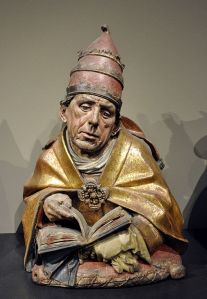
15th century bust of Gregorius I Maximus by Hans Bilger. Source: Wikimedia Commons.
Pope Gregory I (“the Great”) was one of the most influential Church leaders of the medieval period. His policy on the treatment of Jews in Christian Europe, known by the Latin phrase “Sicut Judaeis,” instituted an official if ambivalent position that lasted from the sixth century to the beginnings of the modern era.
Isidor Kaufman (1853-1921), Portrait of a Yeshiva Boy. Source: Wikimedia Commons.
Reeling from the humiliating defeat of the Crimean War, the Russian Empire decides its policy of forcibly conscripting Jewish boys into military service is counterproductive, and finally abandons the cruel decades-old policy of taking underage children into thirty-one years of military training and service.
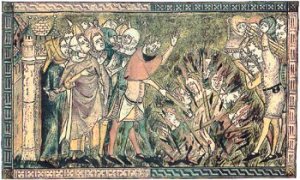
Jews Burned to Death in Strasbourg, c. 1349. Source: Wikimedia Commons.
The summer of 1321 was plagued with rumors that Jews had entered into a conspiracy with lepers (some versions also included Muslims) to poison the wells of Europe, resulting in mass hysteria and mob violence. King Philip V was eventually able to quell the movement, but it resurfaced twenty years later in a much more potent form as the Black Death swept through Europe.
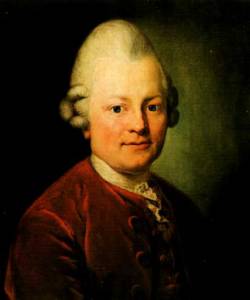
In August of 1778, the non-Jewish writer Gotthold Ephraim Lessing wrote to his brother of a new literary project designed to further tolerance of Jews in German society. The result was Nathan the Wise, a sensation that was initially banned by the Church and heavily criticized by antisemites of the day.
Emil Flohri, “Stop Your Cruel Oppression of the Jews” (1904). Source: Wikimedia Commons.
Officially banned in 1479, no Jews lived in the Russian Empire until Tsarina Catherine II conquered a major portion of Polish territory, instantly inheriting the largest single concentration of Jews in the world. Under her rule the Pale of Settlement was established, determining the region where Jews were allowed to reside, however tenuously, until the 20th century.
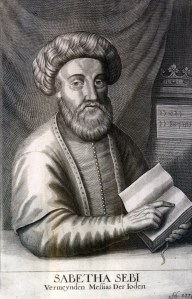
Devastated and demoralized after the violence of the Khmelnytsky rebellion, the Jews of Europe were astounded to hear that a young Kabbalist named Shabbetai Tsvi had proclaimed himself the long-awaited Messiah.
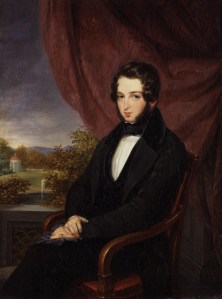
Lionel Nathan de Rothschild by Moritz Daniel Oppenheim (Source: Wikimedia Commons)
In 1847, the citizens of London elected its first Jew, Lionel de Rothschild, to the House of Commons. Rothschild, however, refused to take the Christian oath required of all members, and resigned without taking his seat in Parliament. He was immediately reelected a second and even a third time until the Jews’ Disabilities Act was passed on July 23, 1858, allowing Rothschild to represent Londoners without sacrificing his Jewish principles.
Beloved for his children’s stories, Henryk Goldszmidt wrote under the pen name Janusz Korczak.
A lifelong advocate for children’s rights, he ran an orphanage in Warsaw that was world-famous for his innovative pedagogic techniques.
Imprisoned in the Warsaw ghetto during the Nazi occupation, he continued to serve in this capacity until the terrible order to deport the Jews to the Treblinka death camp in August 1942. He refused all offers of personal rescue, choosing rather to remain with his young charges right to the very end.
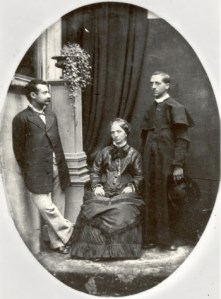
R-L: Edgardo Mortara, mother Marianna, and unidentified brother, c. 1880. Source: Wikimedia Commons.
In the summer of 1858, 6-year old Edgardo Mortara, a Jewish boy living in Bologna, Italy, was forcibly taken from his home by Italian police acting at the behest of the Inquisition. It had come to the attention of the Church that a teenage non-Jewish servant girl had performed an “emergency baptism” on Edgardo several years earlier, fearing that he would die of a childhood illness and not be allowed entry into Heaven. Despite strenuous efforts by Jewish communities around the world, Pope Pius IX refused to release Edgardo, who ultimately became a priest in the Augustinian order and devoted his life to converting Jews to Catholicism.