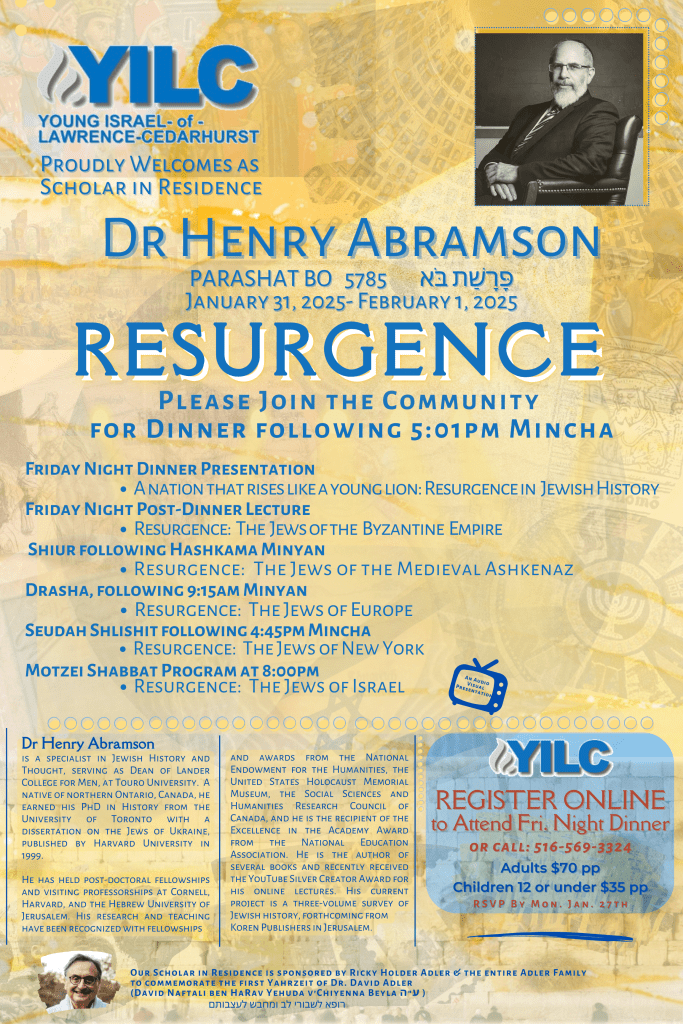
Really looking forward seeing my friends at YILC!

Lectures in Jewish History and Thought. No hard questions, please.


JEWISH HISTORY @ AVENUE J A Community Project of the Lander College of Arts and Sciences Monday Evenings, 7-8 pm, 1602 Avenue J, Brooklyn NY 11230 Beginning October 19, 2015 Open to the Community Separate Seating All Lectures are Free of Charge

Free for the High Holiday Season: a free download of The Kabbalah of Forgiveness, a translation and commentary of Rabbi Moshe Cordovero’s Tomer Devorah. Especially valuable reading in preparation for Yom Kippur! To download, visit https://www.smashwords.com/books/view/464044 and enter coupon code BQ57Y, valid through October 7, 2015. If you really must have a hard copy, visit Amazon…

Brief discussion of the anniversary of Tisha B’Av, the onset of World War I, and its implications for Jewish History.

In July of 1942 (coinciding with Av 5702), the Nazis began a major deportation of Jews from the Warsaw ghetto to the Treblinka concentration camp. By September, 235,000 Warsaw Jews were murdered in the gas chambers.

Rashi (Rabbi Shlomo ben Yitshak) was a great 11th century commentator on the Torah. This brief video outlines his major scholarly contribution within historical context.

Viktor Frankl was a noted psychologist whose experience in the Holocaust formed the basis of logotherapy, his therapeutic approach to help people find meaning in suffering and in life.

A brief biography of Sigmund Freud, with emphasis on his Jewish background and identity. Part of the Jewish Biography as History Series, more available at http://www.henryabramson.com.

An introduction to the major themes in modern antisemitic ideology (1880-present). Warning: not quite as nasty as the lecture on medieval antisemitism, but disturbing nevertheless. Part of the Essential Lectures in Jewish History series, more available at http://www.henryabramson.com.

Rabbi Yosef Yitzchak Schneerson, also known as “Der Frierdiker Rebbe” (The Earlier Rebbe) to distinguish him from his successor, Rabbi Menachem Mendel Schneerson, was the sixth leader of the Chabad-Lubavitch movement. Living in tumultuous times, he shifted the center of the movement from its Eastern European origins to its current headquarters in the United States.


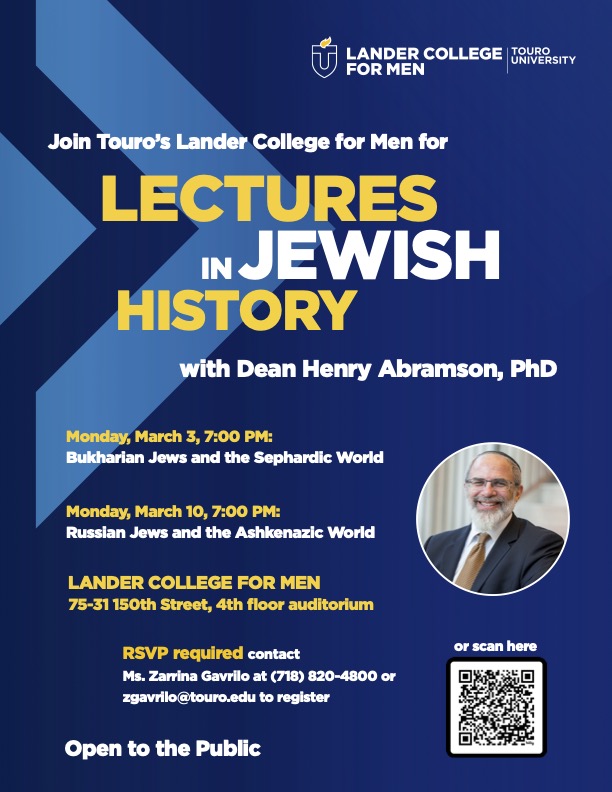
Tonight at Machon Chana: part two of The History of Sephardic Jewry series. Last week we looked at the origins of Spanish Jewry and the Muslim period; tonight we will focus on the Reconquista up to the Expulsion of 1492.

Main Auditorium of the Mighty Avenue J campus of Touro College 1602 Avenue J, Brooklyn NY 11230 7pm Free and open to the community. No hard questions, please. For more information please click here.

My old friend Dr. Michael Chigel tagged me on Facebook this morning with his remarkably kind and generous unsolicited review of Torah from the Years of Wrath. I’m deeply moved and grateful to Mike for promoting the Torah of the Aish Kodesh, as well as for the undeserved praise he lavished on my small contribution, but also…

Very pleased to see this revised edition of my first book available. Includes a new foreword and afterword.

To the Hasidim steeped in the religious significance of the ritual calendar, the Sabbath known as Zakhor (March 23, 1940) must have seemed a cruel redundancy. Literally called “remember,” the Sabbath preceding the holiday of Purim is named for a few publicly read Torah verses (Deuteronomy 25:17-19) that memorialize the attack of Israel’s primordial enemy,…

Hey friends in Crown Heights! Please drop by and say hello.

(Well, not Yehudah Ha-Levi, but a lecture about the great Spanish-Jewish poet-philosopher of the 12th century). With Rabbi Moshe Teitelbaum.

Sponsored by Brandon Sultan in honor of the Sultan and Benarroch Families, whose Sephardic roots are expressed in a desire to honor the Convivencia; and also in loving memory of Mrs. Jean Milstein, whose relentless optimism was an inspiration to all.
Just like that. Watch for our Shul President, Jeremy Chwat, and his wife–he apparently has an unusual motivation for coming to Shul three times a day, and she has a great, euphemistic comeback.

Someone told me that this was printed in The Vues. I’m not a Rabbi, but I’m kind of pleased that Ari Hirsch asked for my opinion anyway. Makes me feel like I actually belong in Brooklyn, somehow, if I’m included in this paper known as “the Heimishe Voice.”

The last weeks of winter 1942, ironically, represented a kind of plateau for the Jews of Warsaw. The typhus epidemic abated, and the Nazis had established some work facilities (“shops”) that led many to believe that through productive labor, the Jews would endure. The general feeling was, in the words of historians Barbara Engelking and…

The life and times of an important woman of the early post-Expulsion generation of Sephardic Jews. Can’t see the video? Click here please.