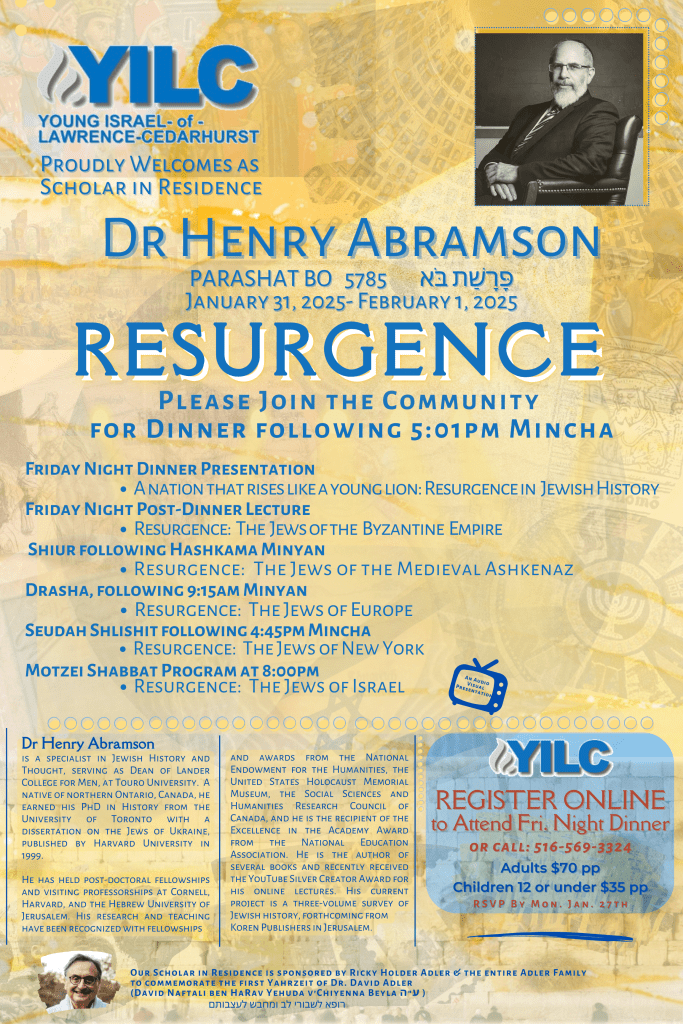
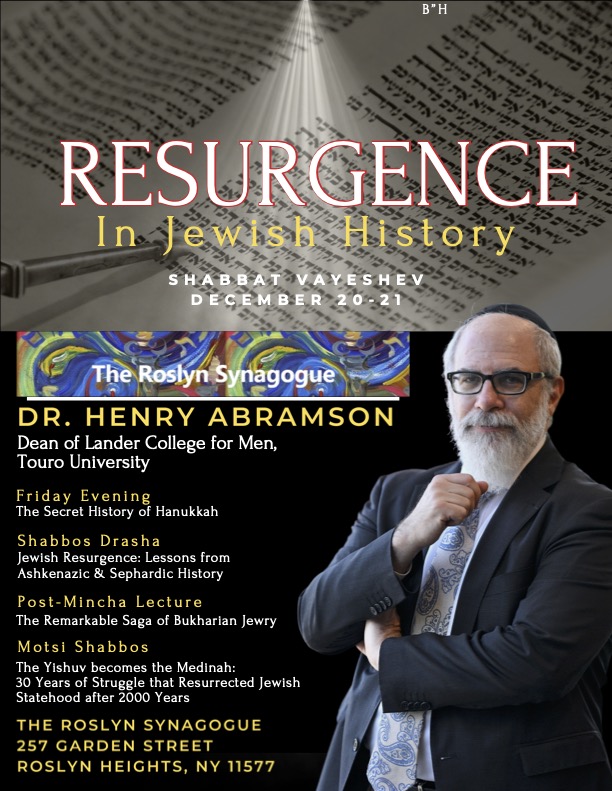
Really looking forward seeing my friends at YILC!

Lectures in Jewish History and Thought. No hard questions, please.


We’re starting on Monday! Please visit http://www.jewishhistorylectures.org for details on the schedule. Free and open to the community, Monday nights at 7:00 pm at the mighty Avenue J campus of Touro College, 1602 Avenue J, Brooklyn NY 11230. Call (718) 535-9333 or write to me at henry.abramson@touro.edu. Some sponsorships are still available ($250 per lecture),…

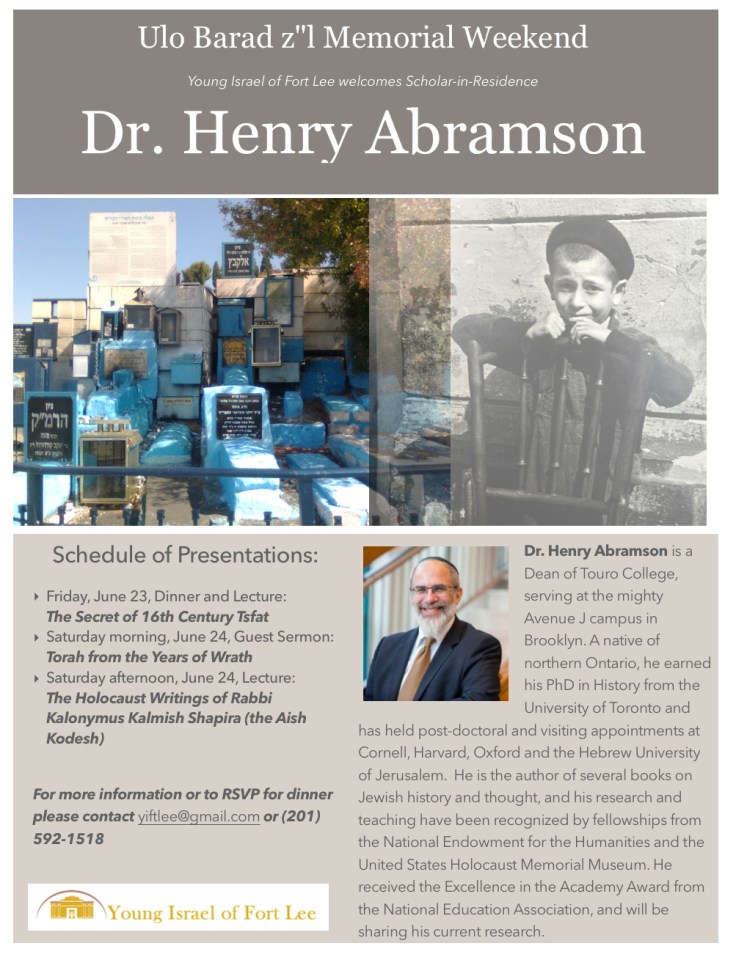
Searching for an escapee from the notorious Pawiak Prison, the Nazis arrested 255 Jewish leaders in the Warsaw Ghetto, holding them hostage and demanding that the community turn over the 21-year old resistance fighter Andrzej Kott. The rebel was not found. The Jewish hostages were eventually killed. The Rebbe was forced to spend that Sabbath…

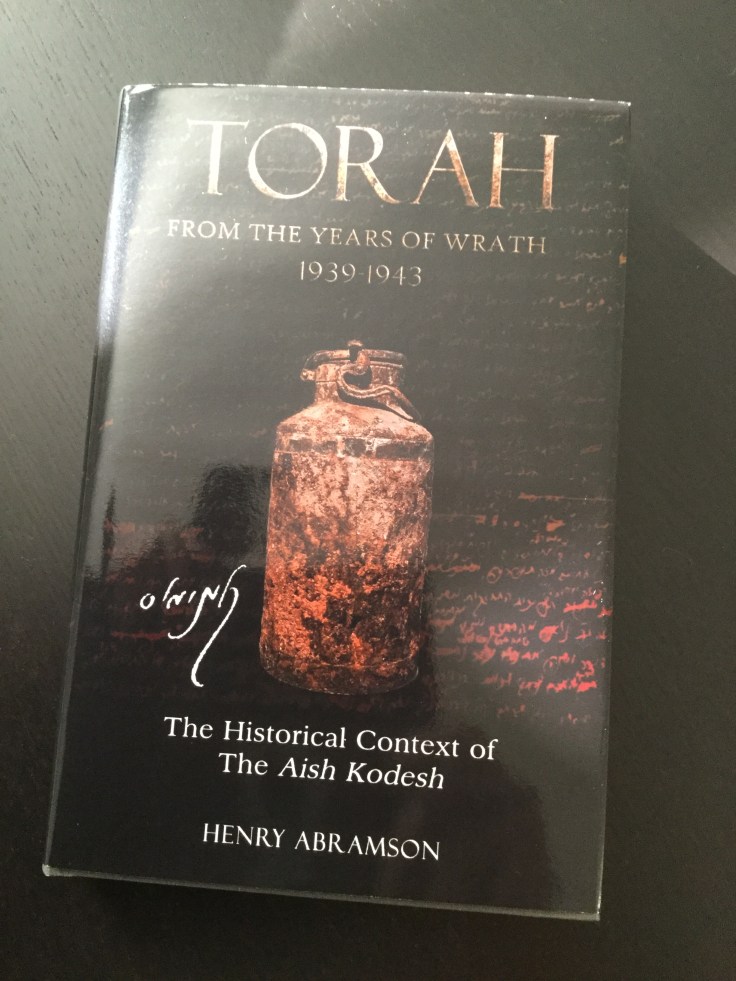
Just got my first copy of the hardcover edition of Torah from the Years of Wrath: The Historical Context of the Aish Kodesh. Special thanks to Mr. Sam Sapozhnik for making this possible! The hardcover edition hasn’t migrated yet to Amazon, but the good news is that I can offer my students, colleagues and friends 20%…

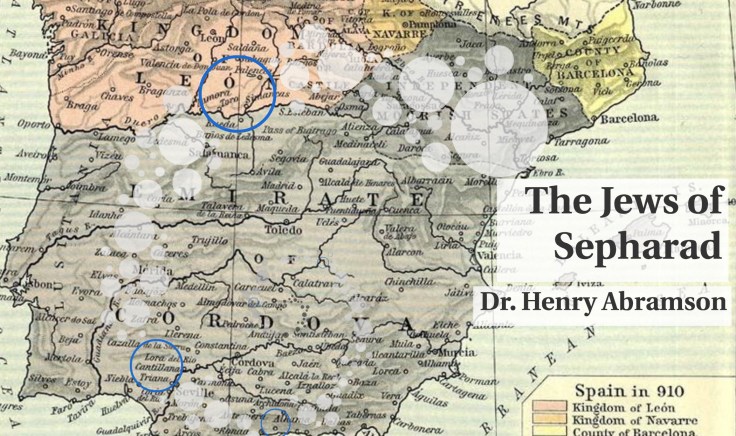
I’m really thrilled to be cruising the Douro River this summer with Kosher Riverboat Cruises, lecturing on the history of Spanish and Portuguese Jewry (my wife plans to come along, which means I really have to bring my A-game). I just learned that there’s only 18 cabins left, so if you’re interested, please click the…

Conference presentation at the “The 100th Anniversary of the Ukrainian Revolution and the Proclamation of Ukraine’s Independence,” held at the Ukrainian Institute, New York, Sunday, January 21. My talk was inspired by a thought-provoking article in the Forward by Avital Chizik-Goldschmidt. A fascinating panel, which included Anna Procyk of CUNY, Serhy Yekelchyk of University of…

On Parashat Beshalah (January 20, 1940), a young rebel escaped from the notorious Pawiak Prison, located not far from the Piaseczno Bet Midrash. Andrzej Kott, the 21-year old leader of the military wing of a resistance movement called the Polish People’s Independence Action, was a child of assimilated Jewish parents who had converted to Christianity.…

The recent translation of the work of Rabbi Shimon Gershon Rosenberg (Rav Shagar, 1949-2007) promises to elevate his distinctive thought to a broader audience of readers (Faith Shattered and Restored: Judaism in the Postmodern Age), many of whom will resonate with Dr. Yitzchak Mandelbaum’s comment on his discovery of Rav Shagar: “I knew I had…

The Rebbe’s entry for Parashat Bo (January 13, 1940) is unusual. Recorded in the scribe’s careful hand, with minimal annotation, it has two bold diagonal lines drawn through the center of the text, indicating that the Rebbe rejected it altogether. A brief and uncharacteristic first-person comment is appended: “more of what we said I do…

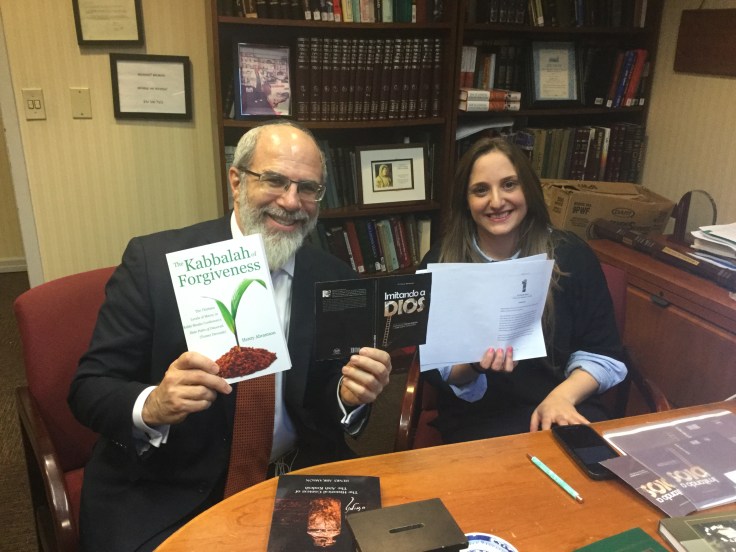
Really nice to meet with Jésica Neuah of Editorial Perspectivas to work on the tentative cover and book design of the Spanish edition of The Kabbalah of Forgiveness! Great to work with her and the whole team. G-d willing the book will be released in the summer of this year.

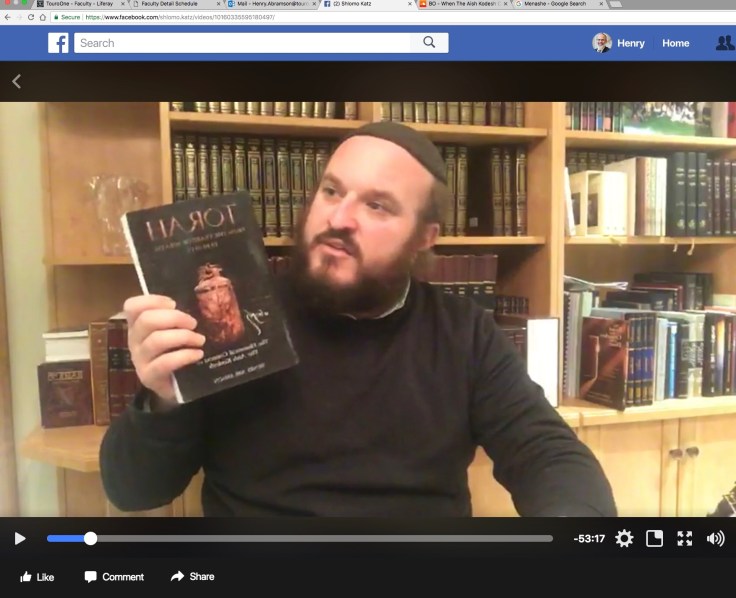
I had chills listening to Rabbi Shlomo Katz review the Rebbe’s words on this week’s parashah. I am grateful for his kind words of praise for my recent book on the historical context of the Aish Kodesh, but to tell the truth, I hardly recognized my own words from the masterful treatment they received from…

Chaim Kaplan recorded the mood in the Warsaw Ghetto in January 1942: The cold is so intense that my fingers are often too numb to hold a pen. There is no coal for heating and electricity is sporadic or nonexistent. In the oppressive dark and unbearable cold your mind stops functioning. Yet even in such…

Five months into the Nazi occupation, the Jews of Warsaw struggled to keep up with the barrage of administrative decrees inflicted upon them by the Germans. When the Rebbe spoke on Parashat Vaera, which fell on January 6, 1940, the worst was still far off. The Nazis had replaced the leadership of the Jewish Council…


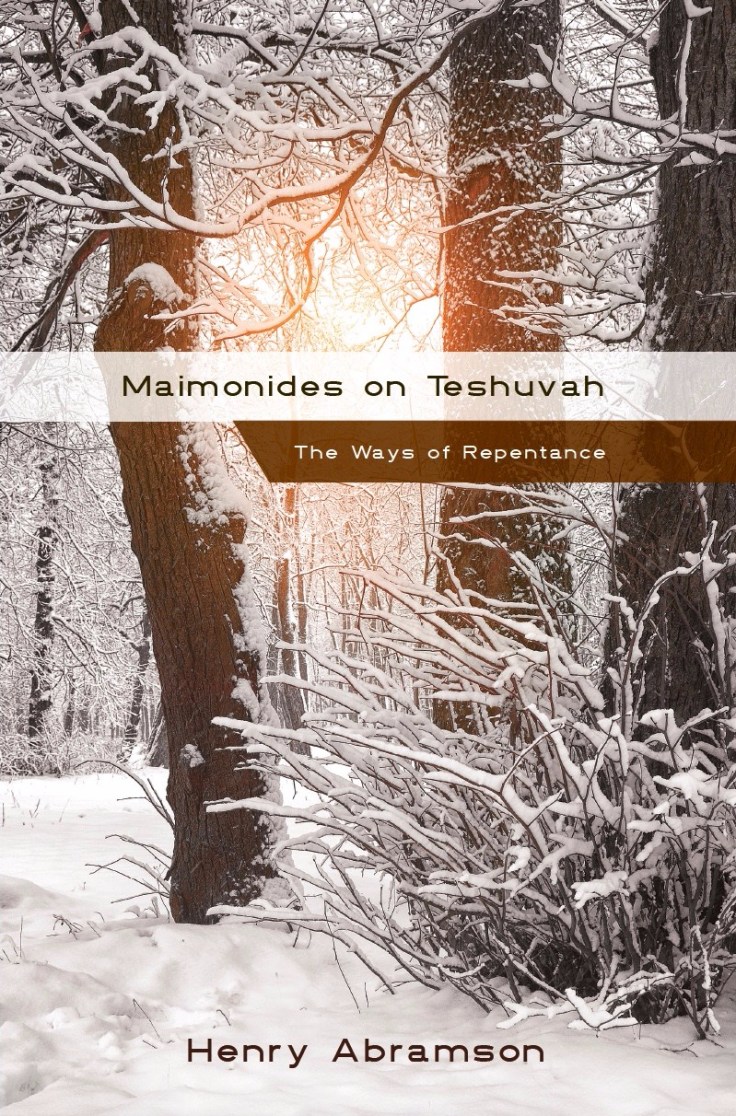
Dedicated to the memory of my father: A new translation and commentary of Moses Maimonides’ classic work on repentance. Softcover, 253 pages, illustrations. $18 after August 3, pre-order now for special price of $9 plus shipping. 5th edition (2017) Visit bit.ly/ordermot for more details.

Dedicated to the memory of my father: A new translation and commentary of Moses Maimonides’ classic work on repentance. Softcover, 253 pages, illustrations. $18. Click here to order.

All lectures will be held in the Main Auditorium of the mighty Avenue J Campus 7:00 PM Free and Open to the Community Touro College 1602 Avenue J Brooklyn, NY 11230 September 11 September 18 September 25 October 2 No Class October 9 October 16 October 23 October 30 November 6 November 13…

This amazing trip is now open to non-matriculated, visiting students! Join us–it promises to be a fantastic experience. Email me at abramson@touro.edu for more information.
The sixteenth century witnessed a phenomenal, short-lived explosion of Jewish spiritual creativity, centered in the sleepy Galilean town of Safed (Tsfat). Along with greats such as Rabbi Yosef Karo, Rabbi Moshe Cordovero was one of the founders of that unusual place, attracting still more Rabbis and especially Kabbalists to the mountaintop community, including Rabbi…
A brilliant 13th-century scholar of Rabbinic thought, Nahmanides’ defense of Judaism in a forced Church-sponsored debate earned him exile from his native Spain. An elderly sage, he emigrated to the Land of Israel, where he found a tiny Jewish community, desperately hanging onto the traditions of their ancestors. Summoning upon an immense reserve of energy,…
Brief survey of the major historical developments and themes affecting the land of Israel between the 2nd-century Bar Kochba rebellion and the Muslim conquest in the seventh century. Part of the Israel: The Land and its People series.
Certainly one of the greatest Rabbis of the entire Talmud, Akiva son of Joseph did not begin his study of Judaism before adulthood. His trajectory of incredible spiritual growth was punctuated by moments of great personal tragedy, and his martyrdom at the hands of the Romans after the failed second-century Bar-Kochba revolt has an enduring…
One of the greatest builders of ancient Israel, King Herod exploited his power as a Roman-sponsored ruler to develop the Temple, yet earned a reputation as a feared tyrant responsible for horrific massacres. HIs rule set the tone for the political climate in the Land of Israel during the tumultuous decades prior to the growth…
Born in the times of the Hasmonean rebellion celebrated with the holiday of Chanukah, Yohanan Cohen Gadol was one of the most prominent Jewish leaders during the brief period of Jewish freedom in the 2nd century BCE. Caught in the swirling controversy of internal religious debate, in his old age he abandoned his Pharisaic roots…
“Sweet singer of Israel,” David was the poet-warrior King who led the Jewish people to political and cultural prominence. Denied his most cherished goal of building the Temple, he lived a life of great personal challenge and heroic resurgence from tragedy, and his biography left an indelible mark on the Jewish understanding of leadership.