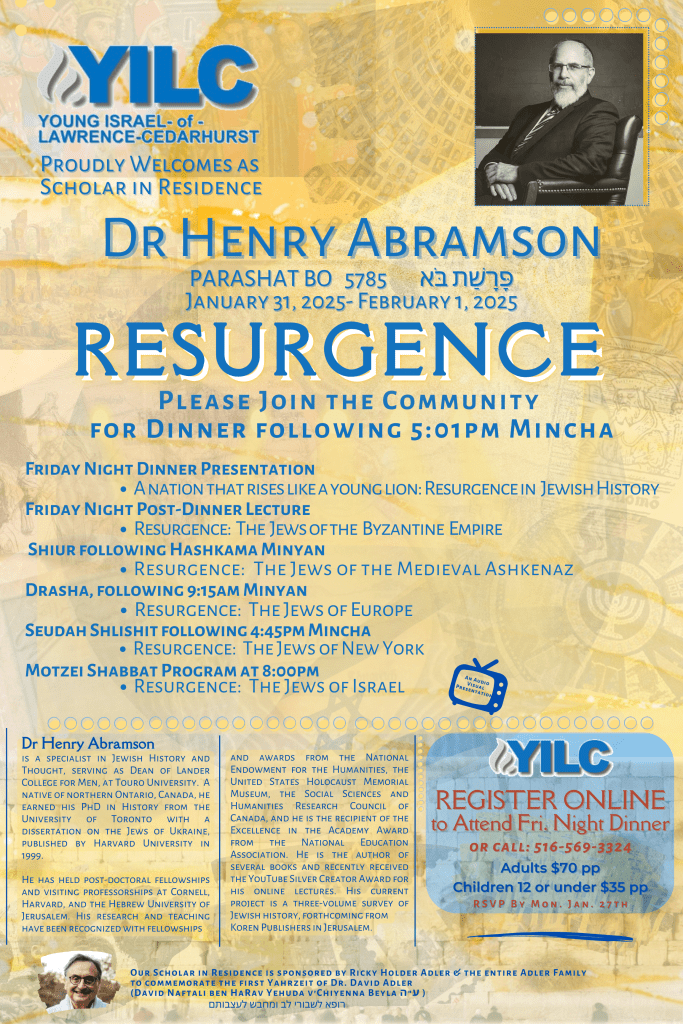
Really looking forward seeing my friends at YILC!

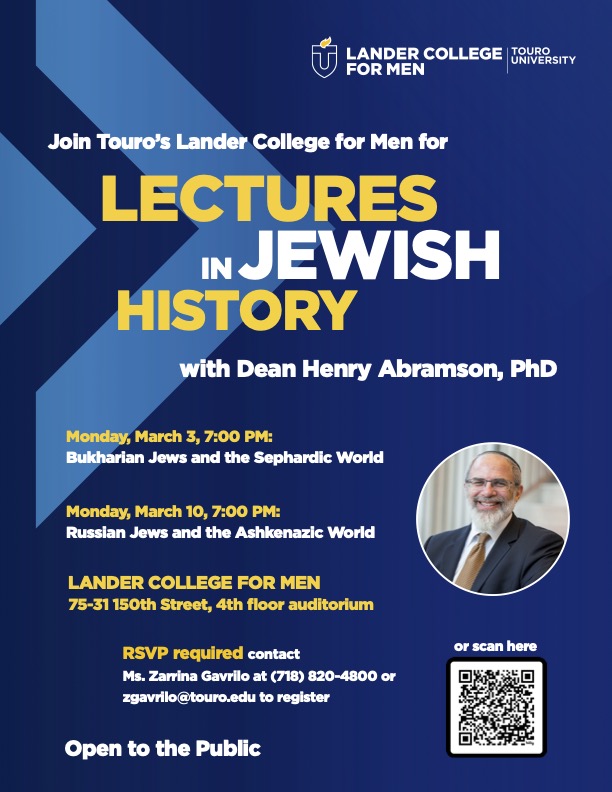
Lectures in Jewish History and Thought. No hard questions, please.


We’re starting on Monday! Please visit http://www.jewishhistorylectures.org for details on the schedule. Free and open to the community, Monday nights at 7:00 pm at the mighty Avenue J campus of Touro College, 1602 Avenue J, Brooklyn NY 11230. Call (718) 535-9333 or write to me at henry.abramson@touro.edu. Some sponsorships are still available ($250 per lecture),…

Searching for an escapee from the notorious Pawiak Prison, the Nazis arrested 255 Jewish leaders in the Warsaw Ghetto, holding them hostage and demanding that the community turn over the 21-year old resistance fighter Andrzej Kott. The rebel was not found. The Jewish hostages were eventually killed. The Rebbe was forced to spend that Sabbath…

Just got my first copy of the hardcover edition of Torah from the Years of Wrath: The Historical Context of the Aish Kodesh. Special thanks to Mr. Sam Sapozhnik for making this possible! The hardcover edition hasn’t migrated yet to Amazon, but the good news is that I can offer my students, colleagues and friends 20%…

I’m really thrilled to be cruising the Douro River this summer with Kosher Riverboat Cruises, lecturing on the history of Spanish and Portuguese Jewry (my wife plans to come along, which means I really have to bring my A-game). I just learned that there’s only 18 cabins left, so if you’re interested, please click the…

Conference presentation at the “The 100th Anniversary of the Ukrainian Revolution and the Proclamation of Ukraine’s Independence,” held at the Ukrainian Institute, New York, Sunday, January 21. My talk was inspired by a thought-provoking article in the Forward by Avital Chizik-Goldschmidt. A fascinating panel, which included Anna Procyk of CUNY, Serhy Yekelchyk of University of…

On Parashat Beshalah (January 20, 1940), a young rebel escaped from the notorious Pawiak Prison, located not far from the Piaseczno Bet Midrash. Andrzej Kott, the 21-year old leader of the military wing of a resistance movement called the Polish People’s Independence Action, was a child of assimilated Jewish parents who had converted to Christianity.…

The recent translation of the work of Rabbi Shimon Gershon Rosenberg (Rav Shagar, 1949-2007) promises to elevate his distinctive thought to a broader audience of readers (Faith Shattered and Restored: Judaism in the Postmodern Age), many of whom will resonate with Dr. Yitzchak Mandelbaum’s comment on his discovery of Rav Shagar: “I knew I had…

The Rebbe’s entry for Parashat Bo (January 13, 1940) is unusual. Recorded in the scribe’s careful hand, with minimal annotation, it has two bold diagonal lines drawn through the center of the text, indicating that the Rebbe rejected it altogether. A brief and uncharacteristic first-person comment is appended: “more of what we said I do…

Really nice to meet with Jésica Neuah of Editorial Perspectivas to work on the tentative cover and book design of the Spanish edition of The Kabbalah of Forgiveness! Great to work with her and the whole team. G-d willing the book will be released in the summer of this year.

I had chills listening to Rabbi Shlomo Katz review the Rebbe’s words on this week’s parashah. I am grateful for his kind words of praise for my recent book on the historical context of the Aish Kodesh, but to tell the truth, I hardly recognized my own words from the masterful treatment they received from…

Chaim Kaplan recorded the mood in the Warsaw Ghetto in January 1942: The cold is so intense that my fingers are often too numb to hold a pen. There is no coal for heating and electricity is sporadic or nonexistent. In the oppressive dark and unbearable cold your mind stops functioning. Yet even in such…

Five months into the Nazi occupation, the Jews of Warsaw struggled to keep up with the barrage of administrative decrees inflicted upon them by the Germans. When the Rebbe spoke on Parashat Vaera, which fell on January 6, 1940, the worst was still far off. The Nazis had replaced the leadership of the Jewish Council…


Known as simply “The Rav,” Rabbi Dr. Yosef Baer (J.D.) Soloveitchik was arguably the most influential figure shaping the Orthodox Rabbinate in the United States in the 20th century. From his position at the Rabbi Isaac Elchanan Rabbinical Seminary at Yeshiva University, he ordained some 2,000 Rabbis over four decades. To view the Prezi associated…

Discovered in the rubble of the Warsaw Ghetto, the wartime writings of Rabbi Kalonymus Kalmish Shapiro (1889-1943) offer a unique and powerful perspective on the life and suffering of religious Jews during the horrific years of the Nazi occupation. By Dr. Henry Abramson According to my knowledge of the words of the Sages and the…

I’m a runner. I’ve been running as long as I can remember, including my first half-marathon at age 12 and my first full marathon at 14. Running gives me energy, and makes me feel like I can accomplish anything. I’m proud of my finishes, and even more proud that over the years I’ve raised almost…

Rabbi Israel Meir Kagan, better known as the Chofetz Chaim for his classic work on the sanctity of speech, was one of the major Rabbinic leaders of the late 19th and early 20th century. To view the Prezi associated with this lecture, click on the image below or here.
Hello students– We are scheduled to resume our lecture series this evening with a presentation on the Chofetz Chaim,one of the most influential Rabbinic thinkers of the late 19th and early 20th century. Rabbi Israel Meir Kagan is known principally for his dramatically creative analysis of the topic of forbidden speech (lashon ha-ra), and rose…

This video describes the changes in the political boundaries of the State of Israel from its inception 1948 through the disengagement from Gaza in 2005. Part of the Essential Lectures in Jewish History series by Dr. Henry Abramson. To view the Prezi associated with this video please click here.

Jacob Rodrigues Periera (1715-1780) was the inventor of dactylology, a method for teaching deaf-mutes to communicate. A crypto-Jew from Portugal, his first student was his sister. His methodology received phenomenal acclaim, he received honors from the King of France and was named to both the Royal Society of London. This video is part of This…

This is a brief academic presentation of the history of the Nazi attempt to destroy the Jews of Europe during World War II. Part of the Essential Lectures in Jewish History series by Dr. Henry Abramson. To view the Prezi used in this lecture, please click here.

Revered by many as Germany’s greatest poet, Heine struggled mightily with his Jewish identity in the culturally inimical milieu of the 19th century. This phenomenon, known as Judenschmerz, was widespread among 19th century western European Jews. Despite his 1825 conversion to Christianity, Heine maintained a long, albeit conflicted, relationship to his Jewish background. Part of…

Sarah Schenirer (1883-1935) founded the Bais Yaakov (Bet Ya’akov) school system for women. One of the most visionary educators of the twentieth century, her movement had global impact. To view the Prezi associated with this lecture, please click here.

Baptized at age 12 as the result of his father’s dispute with a synagogue, Benjamin Disraeli (1804-1881) rose to prominence as a novelist and politician, serving several times as England’s Prime Minister. Colorful and flamboyant, Disraeli dismissed his antisemitic critics by emphasizing, rather than downplaying, his Jewish origins.

The discovery of the mutilated body of a young boy in Kiev led to the false arrest of a Jewish laborer named Mendel Beilis. Ignoring the argument of investigating officers, the Russian government under Tsar Nicholas II pressed ahead with the prosecution of Beilis, arguing that the boy was murdered as part of a Passover-related…