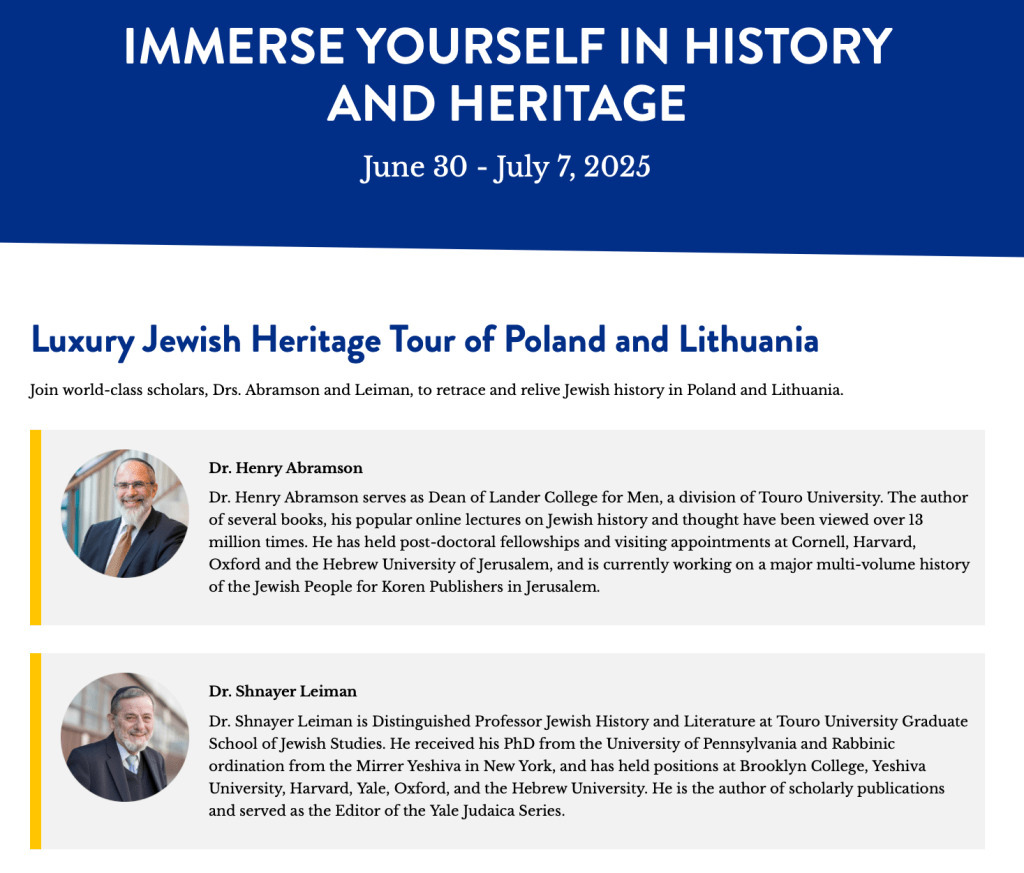
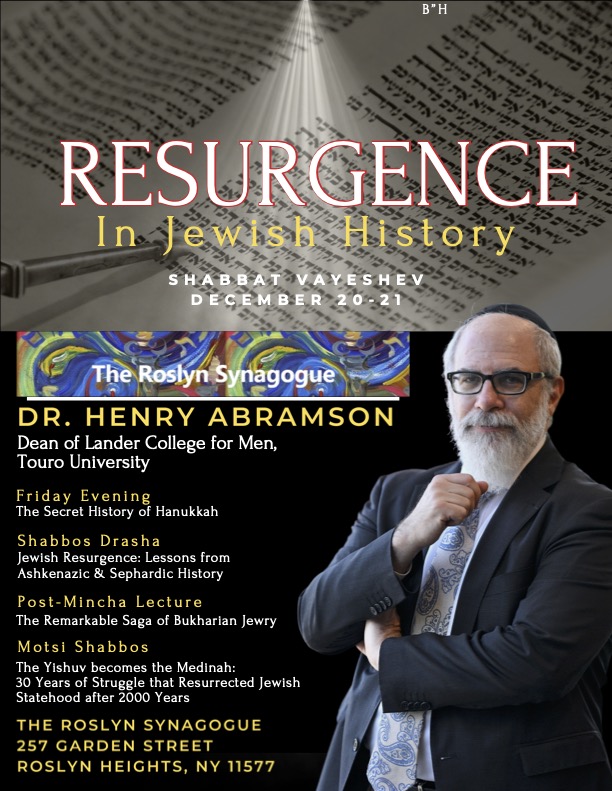
Really looking forward seeing my friends at YILC!

Lectures in Jewish History and Thought. No hard questions, please.


This is a new experiment, suggested by Elya at TorahCafe.com: a weekly, 3-minute “This Week in Jewish History” mini-lecture. I’m trying it out, let me know what you think! Please click here for the refined, edited version from TorahCafe.com.

Here’s a new version of the Albert Einstein lecture, edited by the wonderful people at TorahCafe.com to include the PowerPoint. It’s basically the same, except without the lame jokes. Click on the icon below to watch the video.

This is a lecture I delivered at the University of Central Florida back in October 2004 (my hair was quite a bit darker and, well, there). Found the CD when I was cleaning out some old files. There’s a PPT that goes with this lecture, and I’m going to try to find a way to…

A presentation on the life and work of Rabbi Menachem Mendel Schneerson (1902-1994), the Seventh Rebbe of the Chabad-Lubavitch movement. A native of Nikolaev, Ukraine, and educated in Germany and France, his leadership transformed his Hasidic followers into an international movement that continues to shape the lives of Jews world wide. The lecture was held…

A presentation on the life and work of Betty Friedan, a prominent American Jewish feminist leader. The author of the landmark The Feminine Mystique (1963), she later became the Founder of the National Organization of Women, and an important political activist for women’s rights. The lecture was held at the Young Israel of Bal Harbour on May 29,…

A presentation on Albert Einstein (1879-1955), one of the best-known Jews of the twentieth century. Although he had a complicated relationship with Judaism, he maintained a distinct pride in his Jewish identity, and once said “A Jew who abandons his Judaism is like a snail that abandons its shell. It’s still a snail.” The lecture…

An excerpt from The Kabbalah of Forgiveness: A Reader’s Guide to Rabbi Moshe Cordovero’s The Palm Tree of Devorah, a new translation and commentary on the 16th-century classic of Kabbalistic musar, is now available online. Anticipated publication date is August 2013. The Palm Tree of Devorah first appeared in 1588 and became and instant classic.…

A presentation on the life and work of Stephen Samuel Wise (1874-1949), an important American communal leader. The lecture will take a broader focus, looking at the history of Jewish settlement in the United States during the 19th century and the major issues facing this immigrant community through the middle of the twentieth century. The…

A study of the life of Menachem Begin (1913-1992). A native of Poland, he was a proponent of Vladimir Jabotinsky’s Revisionist party that stood in dramatic contrast to the dominant left-wing tendency in the Zionist movement. A major figure in Israel’s struggle for statehood, and a founder of the Likud party, he was elected to…

This lecture presents a broad overview of the three main intellectual-religious trends present in 19th century Jewish Eastern Europe: the traditionalist Mitnagdim, the innovative Hasidim, and the modernizing Maskilim. Good as an overall introduction, although I go into more detail on all of these movements in other lectures on this website. Taped on April 21,…


The summer of 1321 was plagued with rumors that Jews had entered into a conspiracy with lepers (some versions also included Muslims) to poison the wells of Europe, resulting in mass hysteria and mob violence. King Philip V was eventually able to quell the movement, but it resurfaced twenty years later in a much more…

In August of 1778, the non-Jewish writer Gotthold Ephraim Lessing wrote to his brother of a new literary project designed to further tolerance of Jews in German society. The result was Nathan the Wise, a sensation that was initially banned by the Church and heavily criticized by antisemites of the day.

Officially banned in 1479, no Jews lived in the Russian Empire until Tsarina Catherine II conquered a major portion of Polish territory, instantly inheriting the largest single concentration of Jews in the world. Under her rule the Pale of Settlement was established, determining the region where Jews were allowed to reside, however tenuously, until the…

To view the Prezi associated with this lecture, please click here. Excerpt from “The Jewish Diaspora: A Brief History” Henry Abramson 2. Jews and Judaism in the Year Zero Two Jews, three opinions. The year zero was not nearly as auspicious or significant for Jews as it would later be for Christians. Jews observe a…

Instructions: please watch the lecture, review the reading below, and kindly take the anonymous poll. Thank you! To view the Prezi associated with this lecture, please click here. Excerpt from The Jewish Diaspora: A Brief History Henry Abramson 1. What is Jewish History? “They tried to kill us, we survived, let’s eat.” So runs the…

Devastated and demoralized after the violence of the Khmelnytsky rebellion, the Jews of Europe were astounded to hear that a young Kabbalist named Shabbetai Tsvi had proclaimed himself the long-awaited Messiah.

In 1847, the citizens of London elected its first Jew, Lionel de Rothschild, to the House of Commons. Rothschild, however, refused to take the Christian oath required of all members, and resigned without taking his seat in Parliament. He was immediately reelected a second and even a third time until the Jews’ Disabilities Act was…

Beloved for his children’s stories, Henryk Goldszmidt wrote under the pen name Janusz Korczak. A lifelong advocate for children’s rights, he ran an orphanage in Warsaw that was world-famous for his innovative pedagogic techniques. Imprisoned in the Warsaw ghetto during the Nazi occupation, he continued to serve in this capacity until the terrible order…

This is a course trailer for JSH 481: Jewish Biography as History, scheduled for the Fall 2013 semester.

In the summer of 1858, 6-year old Edgardo Mortara, a Jewish boy living in Bologna, Italy, was forcibly taken from his home by Italian police acting at the behest of the Inquisition. It had come to the attention of the Church that a teenage non-Jewish servant girl had performed an “emergency baptism” on Edgardo several…

For a larger discussion of the five historical narratives, please see my article The end of intimate insularity: new narratives of Jewish history in the post-Soviet era, in Acts of Symposium “Construction and Deconstruction of National Histories in Slavic Eurasia,” originally delivered at Hokkaido University, Sapporo, Japan, on July 10–13, 2002.