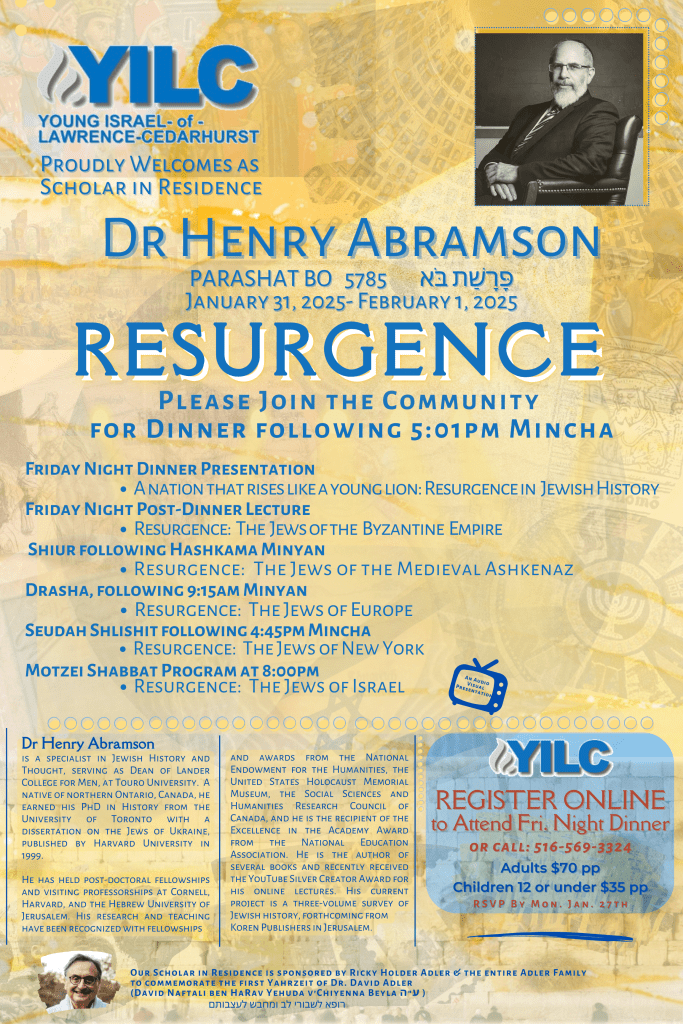
Really looking forward seeing my friends at YILC!

Lectures in Jewish History and Thought. No hard questions, please.


Compiled by Rabbi Yehuda Ha-Nasi in an exceptionally difficult time for the Jewish people, the Mishnah created the possibility of creating a “portable Judaism.” After the destruction of the Temple in 70 and the dramatic escalation of the diaspora, the Mishnah allowed Jews to define their religion within an intellectual and textual context, outside of…

Virtually ignored by Jewish philosophers, Philo of Alexandria represented the high point of synthesis between Greek and Jewish thought in the ancient world, and had a huge influence on early Christian thinkers. A prominent representative of the Egyptian Jewish community to the Roman Emperor, and well-respected in his day by his coreligionists, he nevertheless had…

Wrongly accused of espionage, Captain Alfred Dreyfus was sentenced to Devil’s Island on the basis of remarkably tenuous evidence. May critics, including the famous writer Emile Zola, argued that Dreyfus was unfairly charged simply because he was a Jew in the French army. As evidence mounted that another officer was guilty, the Dreyfus Affair exposed…

Captured by the Romans, Josephus was a Jewish general who ultimately served as a military advisor to General Titus. Josephus recorded his first-hand observations of the destruction of the Temple, and went on to a brilliant literary career in Rome, describing Jews and Judaism to a wider audience. Who was Josephus–traitor to his people or…

Rembrandt is well-known for his depictions of Jewish subjects, both as contemporary portraits and as models for Christian biblical characters.

Photo: Aryeh Abramson looks out over Iroquois Falls, Ontario, Canada, where he spent the Sukkot vacation visiting his grandparents. Captured by the Roman General (and later Emperor) Vespasian while defending the Galilee, Josephus ultimately turned against his coreligionists and served as an advisor to the forces besieging Jerusalem during the first Roman-Jewish War. His first-hand…

Moses Maimonides (1135-1204) was one of the greatest minds the Jewish people ever produced: philosopher, jurist, physician, and an extremely prolific writer who left us classics like The Guide for the Perplexed and the Mishneh Torah. For several years I have been in the habit of reviewing his Laws of Repentance in the weeks leading up to the…

Pope Gregory I (“the Great”) was one of the most influential Church leaders of the medieval period. His policy on the treatment of Jews in Christian Europe, known by the Latin phrase “Sicut Judaeis,” instituted an official if ambivalent position that lasted from the sixth century to the beginnings of the modern era.

Reeling from the humiliating defeat of the Crimean War, the Russian Empire decides its policy of forcibly conscripting Jewish boys into military service is counterproductive, and finally abandons the cruel decades-old policy of taking underage children into thirty-one years of military training and service.

To view the Prezi associated with this lecture, please click here. Excerpt from “The Jewish Diaspora: A Brief History” Henry Abramson 3. The Roman-Jewish Wars Our sources for the Roman-Jewish wars of the first and second centuries are more substantial than those of earlier periods, primarily because the importance of developments in this tiny…

Born in turbulent times, Christianity emerged from its intensely Jewish roots to become the official religion of the Roman Empire within a remarkably brief period of time. As a daughter religion to Judaism, however, dissent between the two faiths slowly dominated the discourse as Christianity became less of a Jewish movement, and more of a…


This is a new experiment, suggested by Elya at TorahCafe.com: a weekly, 3-minute “This Week in Jewish History” mini-lecture. I’m trying it out, let me know what you think! Please click here for the refined, edited version from TorahCafe.com.

Here’s a new version of the Albert Einstein lecture, edited by the wonderful people at TorahCafe.com to include the PowerPoint. It’s basically the same, except without the lame jokes. Click on the icon below to watch the video.

This is a lecture I delivered at the University of Central Florida back in October 2004 (my hair was quite a bit darker and, well, there). Found the CD when I was cleaning out some old files. There’s a PPT that goes with this lecture, and I’m going to try to find a way to…

A presentation on the life and work of Rabbi Menachem Mendel Schneerson (1902-1994), the Seventh Rebbe of the Chabad-Lubavitch movement. A native of Nikolaev, Ukraine, and educated in Germany and France, his leadership transformed his Hasidic followers into an international movement that continues to shape the lives of Jews world wide. The lecture was held…

A presentation on the life and work of Betty Friedan, a prominent American Jewish feminist leader. The author of the landmark The Feminine Mystique (1963), she later became the Founder of the National Organization of Women, and an important political activist for women’s rights. The lecture was held at the Young Israel of Bal Harbour on May 29,…

A presentation on Albert Einstein (1879-1955), one of the best-known Jews of the twentieth century. Although he had a complicated relationship with Judaism, he maintained a distinct pride in his Jewish identity, and once said “A Jew who abandons his Judaism is like a snail that abandons its shell. It’s still a snail.” The lecture…

An excerpt from The Kabbalah of Forgiveness: A Reader’s Guide to Rabbi Moshe Cordovero’s The Palm Tree of Devorah, a new translation and commentary on the 16th-century classic of Kabbalistic musar, is now available online. Anticipated publication date is August 2013. The Palm Tree of Devorah first appeared in 1588 and became and instant classic.…

A presentation on the life and work of Stephen Samuel Wise (1874-1949), an important American communal leader. The lecture will take a broader focus, looking at the history of Jewish settlement in the United States during the 19th century and the major issues facing this immigrant community through the middle of the twentieth century. The…

A study of the life of Menachem Begin (1913-1992). A native of Poland, he was a proponent of Vladimir Jabotinsky’s Revisionist party that stood in dramatic contrast to the dominant left-wing tendency in the Zionist movement. A major figure in Israel’s struggle for statehood, and a founder of the Likud party, he was elected to…

This lecture presents a broad overview of the three main intellectual-religious trends present in 19th century Jewish Eastern Europe: the traditionalist Mitnagdim, the innovative Hasidim, and the modernizing Maskilim. Good as an overall introduction, although I go into more detail on all of these movements in other lectures on this website. Taped on April 21,…