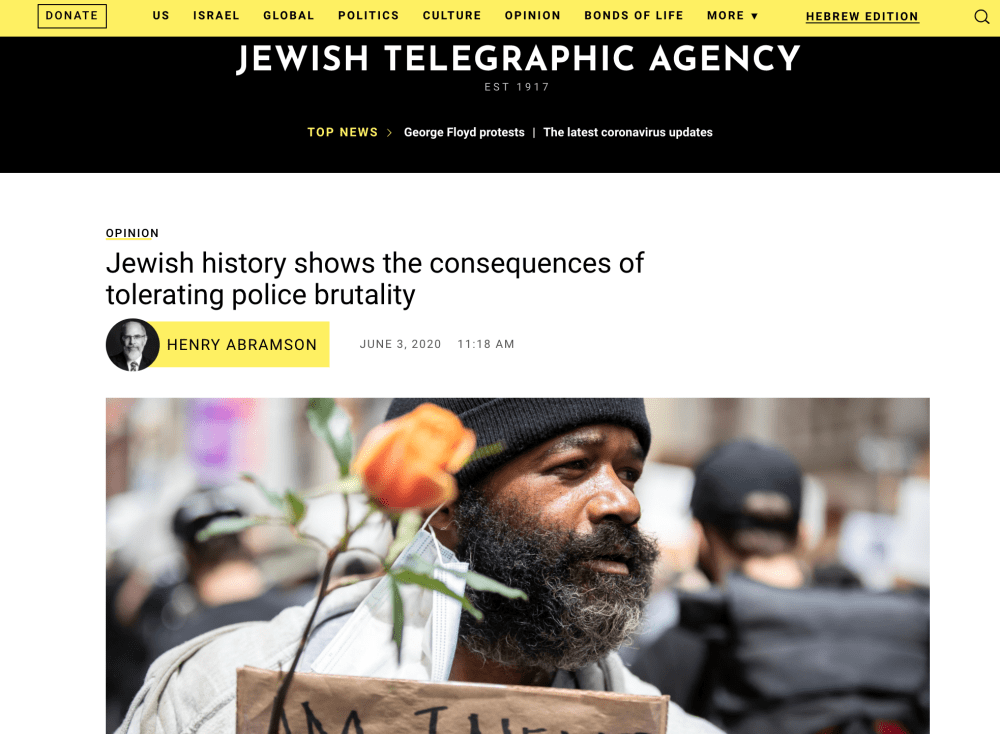
Jewish history shows the consequences of tolerating police brutality

NEW YORK (JTA) — “Pray for the welfare of the state,” Rabbi Hanina writes, “for if it were not for the fear thereof, people would swallow each other alive.”

As cities around the nation burn with righteous indignation over yet another horrific incident of police brutality directed against a black man, Jewish leaders must reflect on our own long and ambiguous history with police as we grapple with our role in what is unfolding today. 

Historically, Jews have had an ambiguous relationship with the police. Their stabilizing role in society is essential for us, a vulnerable minority. But we also know what it is like to be the victims of law enforcement twisted by systemic hatred. 

As a minority, Jews generally strive for harmonious relations with the ruling authorities, as per Rabbi Hanina’s dictum, and may be inclined to overlook smaller abuses of power in the interest of social stability. Egregious offenses, however, may push many representative Jewish organizations to take a side — “in solidarity with people of color in this moment,” as the Jewish Community Relations Council of Washington recently put it

Please click here to read the rest of the article at JTA.

My wife donated a kidney. Here’s what she wants us to do now.

Please visit https://www.rayze.it/kidney/abramson to help support Renewal.

Rabbi Moshe Chaim Luzzatto’s Last Words

Looking forward to this special presentation at Congregation Ohav Emeth via Zoom: a look at the incomparable Rabbi Moshe Chaim Luzzatto’s last words to his students and an overview of his tragically brief yet incredibly important life, filled with contributions to the religious, scholarly and intellectual future of the Jewish people. In honor of Yom Yerushalayim and the 274th anniversary of his passing during the plague of 1746.

Please visit bit.ly/ohavemethabramson to RSVP and receive the password.

Plague and Pandemic in Jewish History: Today at 2pm, with Live Chat

Join me for a live chat on the historical perspective to our contemporary public health emergency. 2PM EDT. If you cannot see the image, here’s the link: https://youtu.be/GQTtvikHvmk. Stay healthy, everyone!

Jewish Higher Ed post-COVID

My favorite editor, Laura Adkins of JTA, asked me for some thoughts on what Jewish institutions of higher education might face in the post-coronavirus era. I’m really glad she did! Please click here for the article.

Plague and Pandemic in Jewish History

Please join me on Thursday at 2PM for “Plague and Pandemic in Jewish History,” a brief overview of the experience of epidemics and pandemics in Jewish history. Please visit bit.ly/pandemicjewishhistory for more information.

The Response to Pandemics in Jewish History

2 PM (EST) Thursday, May 14, 2020.

Please join me for a special webinar on The Response to Pandemics in Jewish History, scheduled for Thursday, May 14 at 2:00 pm EST. Participation is free and open to the community, but registration in advance is required to maintain security and prevent the unwanted intrusions of intellectual vandals. Please click on the image or visit https://bit.ly/responsetopandemics to RSVP. Wishing you all good health.

Finding Velcro on the Moon: How YouTube will Revolutionize Your Teaching Forever

Good morning–this is a recording of a recent webinar for educators.

Av Harachamim, The Crusades, and the Formation of Ashkenazic Identity

Really enjoyed this conversation with Rabbi Avi Heller in the OU Daily Dvar. Please visit ou.org/dvar for more!

This is not the biggest plague in Jewish history, but it may be the most consequential.

Some thoughts on COVID-19 in a Jewish context, recently published in OU Torah.

Judaism, as we know it today, bears the scars of multiple plagues throughout history. Perhaps the largest is the weeks-long period known as sefirah, which commemorates the death of 24,000 students of Rabbi Akiva in the 2nd century.

The Rabbis of the Talmud decreed that these tragic deaths be memorialized by forbidding live in-person concerts and postponing haircuts and weddings until at least the early summer holiday of Lag B’Omer.

The specific disease that felled Rabbi Akiva’s students is a matter of dispute for the Rabbis of the Talmud: Rav Nachman suggested the cause was a mysterious illness called askarah, often identified with the bacterial infection diphtheria. Thankfully, today we can inoculate our children against diphtheria, but the Talmud also suggests that the root cause of the illness was their failure to show respect for each other (and an effective vaccine for this condition has yet to be developed).

Two thousand years before the establishment of the World Health Organization, the Mishnah defined the threshold mortality rate for a specific contagion to be formally identified as a “plague” (adjusted for New York State, that would equal about forty-two people a day, a paltry number in light of the horrific devastation of COVID-19 just in New York City alone).

But Jewish history will likely remember COVID-19 for more than its mortality rate. Just as the plague victims of Rabbi Akiva’s time are recalled eighteen centuries later with the attenuated mourning practices of sefirah, the coronavirus will likely shape how Jews do Judaism in the future.

Consider, for example, the impact of the cholera epidemics of the 19th century, described by Elli Fischer in a recent article, brilliantly titled “Rov in a Time of Cholera.” Rabbi Akiva Eger (1761-1837), widely considered the greatest scholar of the era, ruled that synagogues should practice social distancing techniques by limiting synagogue gatherings to 15 people, and even went so far as to suggest that the police should be enlisted to enforce the limits.

Rabbi Eger also changed an important element in the traditional service. Given the sudden increase of cholera-based mortality, the existing custom of having one mourner say the prayer for the dead on behalf of the entire congregation was no longer sufficient to meet the demand of surviving family members. Rabbi Eger’s solution was to allow several mourners to recite the kaddish simultaneously, a custom which has become virtually universal ever since.

Another scar on the Jewish body politic, a distant reminder of our historical encounter with plague.

We have never been here before

Jews are also no strangers to social distancing, whether it be a result of a plague, the aftermath of a plague or other reasons. We have also learned how to worship in private, from secret synagogues for conversos in Portugal to clandestine minyanim in the Warsaw Ghetto. Over the centuries we have received extensive guidance from the Rabbis on how to conduct ourselves in the absence of a prayer quorum. What’s so different about COVID-19?

The Internet. That’s what’s different.

For the first time in our history, we have a way to be together — sort of — while we are physically apart. The thing is, I’m not sure if that’s good for the Jews or bad for the Jews. We can use video conferencing technology like Zoom to see and speak to each other in real time, which is a big level up from a voice-only telephone call, but a deeply alienating experience nevertheless. My shul, for example, has instituted something called DAST: Davening At Same Time, which allows us to meet on Zoom and recite our individual prayers simultaneously.

Is it even half as good as being physically in the same room? No. Is it better than catching the virus? Oh yeah.

But video conferencing is not neutral technology. It is bristling with implications that are potentially deeply corrosive to Jewish society as we know it. I am reminded of the Conservative movement’s fateful 1950 decision to allow driving to services on Shabbat. This break from traditional halacha may have been a recognition, ex post factoof post-war Jewish willingness to settle in suburbs far from the traditional neighborhood shul, but the end result was to give a seal of approval to Jews choosing homes in more far-flung neighborhoods, splintering Jewish communities still further and contributing to the process of assimilation. Ironically, by making it easier to get to shul, the movement accelerated the process of driving Jews further apart from each other.

Will this happen to us, once COVID-19 is long past? The public health experts are telling us that we won’t have a working vaccine for a year or more. After such a long time of davening on our own, even with DAST, how long will it take before we return to regular levels of attendance?

Maybe the ultra-Orthodox might be more insulated from the side effects of Zoom, but I don’t think so. Commenting on a recent Yiddish-Hebrew-English online concert by Motty Steinmetz, Rabbi Gil Student made a “sociological observation about haredim and the Internet…[despite the fact that Steinmetz has] no crossover appeal to the non-Orthodox. His YouTube Live concert has over 3K viewers.” That’s 3,000 haredim watching the concert simultaneously on the Internet. And, Rabbi Student continues, “he started while a Schwekey concert was going on.”

In other words, as the old song goes, “it’s hard to keep the kids on the farm after they’ve seen Paree.” COVID-19-inspired accommodations have promoted greater engagement with the Internet across the Jewish spectrum. The relationship between exposure to the larger world and abandonment of Jewish practice is a noted phenomenon from Josephus to Shulem Deen, and finding the right balance between openness to society and cultural insularity has been the number two challenge to Jewish survival since, well, ever. (I say “number two” because anti-Semitism of the genocidal variety is unfortunately alive and well).

Rabbi Akiva knew what to do: he started over.

In Station Eleven, a hauntingly prescient pandemic-themed novel by Emily St. John Mandel, a character is “crushed by a sudden certainty that this was it, that this illness…was going to be the divide between a before and an after, a line drawn through his life.” COVID-19 has that same 9/11 quality, and I’m frankly quite concerned.

A few weeks ago I saw my shul President in our local kosher grocery store. Buoyed by the opportunity to say hello to a friend who wasn’t trapped behind the screen of my laptop, we spoke at a respectably anti-social distance across the produce aisle. I asked him if the leadership had given any thought to how we might celebrate Shavuot in six weeks, a night that we observe with a massive, all-night communal Torah study session.

His emotions were evident even behind the mask that covered most of his face. “I’m just trying to get through Pesach,” he said, obviously exhausted by the sudden burden that COVID-19 had placed on him in his communal responsibilities. The deaths of synagogue members and their loved ones, and isolation of the mourners. The heroic sacrifices of our many members working as doctors, nurses, and other health care professionals. The prayers for members on ventilators, in ICUs, or alone at home and symptomatic. The members who are now unemployed thanks to coronavirus.

When we go back to normal —what will normal look like?

I cannot help but think that after our immersion in video conferencing technology, the post-COVID Jewish world will be more sophisticated, more inclusive and more flexible. It may also be more pallid, more tepid, more discretionary. And we won’t even notice the difference until it’s too late.

Rabbi Yonason Rosenblum’s 1993 biography of Rabbi Yaakov Kamentsky includes a poignant, fragrant passage regarding Reb Yaakov’s childhood in Dolhinov (Daŭhinava, Belarus) at the turn of the 20th century. This small shtetl had a custom of keeping the synagogue open all night every Friday, so as to allow blue-collar working men additional time to study Torah, and his father used to bring him there at 2:00 AM: “the memory of the special kichel that were prepared for those who got up to learn remained fresh in his mind a century later.”

Sorry to state the obvious, but you can’t smell kichel through Zoom. You can wake up at 2:00 AM to attend a class (you might have to, given time zones), but it’s not the same as holding your father’s hand as you walk down the dark, silent streets of the shtetland enter the beit midrash to the cacophony of kol Torah. Those experiences, formative for one of the greatest rabbis of the 20th century, were made possible by hundreds of anonymous Jews who committed to a physical gathering, not to mention whoever baked those kichel. The Holocaust ended their lives — 75 years later, we still haven’t rebuilt ourselves to that level. What damage can video conferencing do to our fragile, diasporic society?

We all know the emotional disconnect that characterizes a Zoom funeral, especially when COVID-19 restrictions for us to lay a loved one to rest without the benefit of a traditional taharah. Now that this technology is here, however, how likely are we to drop everything to fly off to a funeral when we can attend by video conference? Or how about the local rabbi’s class in halacha: if it’s available via synchronous Zoom, will we elect to pass up on the post-shiur kibitzing with friends, or maybe we will think about skimming through the recording later? What will this convenience do to the fragile web of our society, if we do not have regular moments to gather in person? Can we do Jewish online?

Returning to our opening observation, which connects our current struggle with COVID-19 to the semi-mourning period known as sefirah and the plague deaths of 24,000 Torah students. The Talmud describes Rabbi Akiva’s response: “the world was destroyed until Rabbi Akiva came to the Rabbis of the south, and taught them: Rabbi Meir, Rabbi Yehudah, Rabbi Yosi, Rabbi Shimon and Rabbi Elazar ben Shamua. They were the very students who upheld the Torah in those times.”

Who were the pre-plague students? Numerous, yet we know so little about them. Those five post-plague students, on the other hand, shine brightly in the Talmudic constellation. Perhaps Rabbi Akiva somehow taught them differently, using the wisdom hard-earned through tragedy.

We, too, will have our post-plague moment, when we should take stock and consider how to proceed. Our amazing technologies make so many things possible, but we should consider carefully how we implement them. A too-rapid deployment of an untested measure, like allowing driving on Shabbat, may do more harm than good. On the other hand, a social innovation such as allowing multiple mourners to recite kaddish simultaneously may serve to bring more people into our communities, physically and in real time.

But for now, let us maintain our social distancing strategies until it is safe for us to smell the kichel.

Create a website or blog at WordPress.com

Up ↑