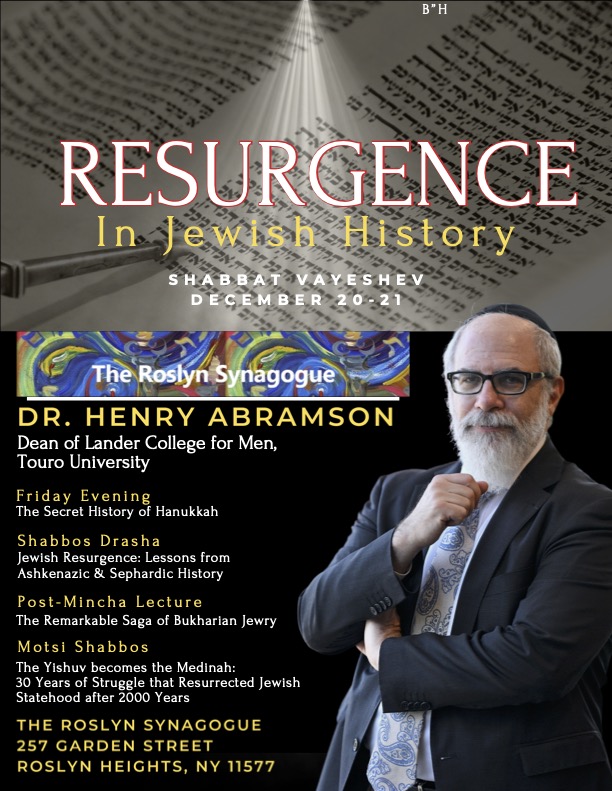
Really looking forward to meeting this community!

Lectures in Jewish History and Thought. No hard questions, please.


I’m really thrilled to be cruising the Douro River this summer with Kosher Riverboat Cruises, lecturing on the history of Spanish and Portuguese Jewry (my wife plans to come along, which means I really have to bring my A-game). I just learned that there’s only 18 cabins left, so if you’re interested, please click the……

Conference presentation at the “The 100th Anniversary of the Ukrainian Revolution and the Proclamation of Ukraine’s Independence,” held at the Ukrainian Institute, New York, Sunday, January 21. My talk was inspired by a thought-provoking article in the Forward by Avital Chizik-Goldschmidt. A fascinating panel, which included Anna Procyk of CUNY, Serhy Yekelchyk of University of……

On Parashat Beshalah (January 20, 1940), a young rebel escaped from the notorious Pawiak Prison, located not far from the Piaseczno Bet Midrash. Andrzej Kott, the 21-year old leader of the military wing of a resistance movement called the Polish People’s Independence Action, was a child of assimilated Jewish parents who had converted to Christianity….…

The recent translation of the work of Rabbi Shimon Gershon Rosenberg (Rav Shagar, 1949-2007) promises to elevate his distinctive thought to a broader audience of readers (Faith Shattered and Restored: Judaism in the Postmodern Age), many of whom will resonate with Dr. Yitzchak Mandelbaum’s comment on his discovery of Rav Shagar: “I knew I had……

The Rebbe’s entry for Parashat Bo (January 13, 1940) is unusual. Recorded in the scribe’s careful hand, with minimal annotation, it has two bold diagonal lines drawn through the center of the text, indicating that the Rebbe rejected it altogether. A brief and uncharacteristic first-person comment is appended: “more of what we said I do……

Really nice to meet with Jésica Neuah of Editorial Perspectivas to work on the tentative cover and book design of the Spanish edition of The Kabbalah of Forgiveness! Great to work with her and the whole team. G-d willing the book will be released in the summer of this year.

I had chills listening to Rabbi Shlomo Katz review the Rebbe’s words on this week’s parashah. I am grateful for his kind words of praise for my recent book on the historical context of the Aish Kodesh, but to tell the truth, I hardly recognized my own words from the masterful treatment they received from……

Chaim Kaplan recorded the mood in the Warsaw Ghetto in January 1942: The cold is so intense that my fingers are often too numb to hold a pen. There is no coal for heating and electricity is sporadic or nonexistent. In the oppressive dark and unbearable cold your mind stops functioning. Yet even in such……

Five months into the Nazi occupation, the Jews of Warsaw struggled to keep up with the barrage of administrative decrees inflicted upon them by the Germans. When the Rebbe spoke on Parashat Vaera, which fell on January 6, 1940, the worst was still far off. The Nazis had replaced the leadership of the Jewish Council……

The winter of 5702 brutalized the Jews of the Warsaw ghetto with unforgiving cold. Chaim Kaplan, a school principal whose journal Scroll of Agony survived the war, recounts in his typically blunt prose how the physical privations of January 1942 affected the spiritual life of Ghetto inhabitants: Gone is the spirit of Jewish brotherhood. The……

The Sephardic Diaspora Spring 2018 Lecture Series Monday Nights @ 7:00 pm Main Auditorium, Touro College, 1602 Avenue J Brooklyn NY 11230 (718) 535-9333 Free and Open to the Public No hard questions, please. Image: Eleanora of Toledo, student of Benvenida Abravanel February 5: Who Was Benvenida Abravanel? February 12 :Who Was Samuel Usque? (No Class Feb……

On December 27, 1941, the Piaseczno Rebbe delivered his last recorded drashah on Parashat Vayigash in the Warsaw Ghetto. The previous month was especially brutal: an especially cold winter, combined with a severe coal shortage, exacerbated the typhus epidemic, and each morning a detail of the chevra kadisha patrolled the streets to collect the bodies……


To view the Prezi associated with this lecture, please click here. http://www.youtube.com/watch?v=1OnArXdHQdc

L.L. Zamenhof (1859-1917) was a Polish Jew who invented the world’s most successful artificial language, Esperanto. Conceived as a vehicle for world peace, Esperanto is even regarded by the Oomoto religion of Japan as the “language of heaven.”

This week marks the death anniversary of King Boleslaw V (The Chaste) in 1279. Boleslaw followed the tradition of his predecessors in Poland by creating incentives for Jewish settlement in Poland, including the establishment of Magdeburg Recht. Ultimately, these policies proved extremely attractive to Ashkenazi Jews from the Rhineland, making Poland a great center of……

To view the Prezi associated with this lecture, please click here.

To view the Prezi associated with this lecture, please click here.

The Fourth Lateran Council, which met in 1215 at the behest of Pope Innocent III, issued several pieces of Church legislation with dire implications for Jews. The doctrine of transubstantiation was confirmed, leading to a new element in antisemitic canards: accusations that Jews “desecrated the host.”

Poet, politician and philosopher, Shmuel ha-Nagid was an exemplar of the Golden Age of Spanish Jewry.

In November of 1977, Egyptian President Anwar Sadat flew to Israel to address the Knesset. His meeting with his former enemy Prime Minister Menachem Begin ultimately resulted in the sometimes strained but nevertheless enduring Israel-Egypt peace accord, but his unpopularity with hardline Egyptians, opposed to making peace with Israel, resulted in his assassination in 1981.

To view the Prezi associated with this lecture, please click here. Excerpts from The Sea of Talmud: A Brief and Personal History Henry Abramson (2012) The Yeshiva administration must have put considerable thought into the wording of the hand-lettered sign posted outside the cafeteria. Many young men studying Talmud at this Jerusalem institution were taking……

Rabbi Moshe ben Maimon (1135-1204) was a towering figure in medieval Jewish history, and continues to cast a long shadow into the Jewish present. Nevertheless, the work of the philosopher-physician endured significant controversy, including an especially sad episode in which Jews actually consigned his works to the flames.

To view the Prezi associated with this lecture, please click here.