Please Join Me in Spain and Portugal

I’m really thrilled to be cruising the Douro River this summer with Kosher Riverboat Cruises, lecturing on the history of Spanish and Portuguese Jewry (my wife plans to come along, which means I really have to bring my A-game). I just learned that there’s only 18 cabins left, so if you’re interested, please click the link for more information. Looking forward to a fantastic experience!

Delightful Douro–Portugal and Spain

“Should We Tear Down Statues of Khmel’nyts’kyi and Petliura?”

Conference presentation at the “The 100th Anniversary of the Ukrainian Revolution and the Proclamation of Ukraine’s Independence,” held at the Ukrainian Institute, New York, Sunday, January 21.  My talk was inspired by a thought-provoking article in the Forward by Avital Chizik-Goldschmidt. A fascinating panel, which included Anna Procyk of CUNY, Serhy Yekelchyk of University of Victoria, and the incomparable Alexander Motyl of Rutgers. Discussant was Lubomyr Hajda of Harvard (lectures in English).

The 1999 Harvard printing of my book, A Prayer for the Government: Ukrainians and Jews in Revolutionary Times, 1917-1920 has been out of print for some time, but a second, revised edition with new essays is forthcoming this Spring. The Ukrainian translation is available under the title Molytva za vladu: Ukraïntsi ta yevreï v revolutsiinu dobu (1917-1920), published in Kiev by Dukh i Litera (2017).

The Aish Kodesh On Beshalah (January 20, 1940 in the Warsaw Ghetto)

On Parashat Beshalah (January 20, 1940), a young rebel escaped from the notorious Pawiak Prison, located not far from the Piaseczno Bet Midrash. Andrzej Kott, the 21-year old leader of the military wing of a resistance movement called the Polish People’s Independence Action, was a child of assimilated Jewish parents who had converted to Christianity. Despite his tenuous connections to the Jewish community, the Nazis immediately posted signs around the ghetto offering a 2,000 zloty award for the arrest of “the Jew Andrzej Kott.” More ominously, the Nazis invoked once again their policy of collective punishment. By Thursday they had rounded up 255 Jews, searching primarily for well-known community leaders and professionals but also seizing Jews off the street in apparently random arrests. None of the hostages survived Nazi incarceration.
The Rebbe narrowly missed arrest and execution that week, as he briefly mentions in the following week’s message, delivered in hiding. On the Sabbath of Parashat Beshalah, however, he apparently ignored the commotion in the streets and delivered his shalosh seudos drashah as ever. He began with a passage that describes God’s protection of the Jews in their flight from Egypt, an uncanny parallel to the protection that the Rebbe would soon receive in his personal flight from the Nazis:

And God goes before them…at night in a pillar of fire, to give them light so they may travel day and night…God will not remove…before the people. Prior to this passage, the verses are written in the past tense: It happened when Pharaoh sent; and Moses took; and they traveled from Sukos. Only this verse is written in the present tense: and God goes.

At this point, four months into the German occupation, the Rebbe used the moment to deliver a fairly traditional homiletic message. A major element of Piaseczno Hasidut relies of harnessing emotional experience as an engine to drive spiritual growth. Piaseczno techniques apply not only to positive emotional occurrences such as joy but also, Heaven forbid, to suffering:

This is the intent of and God goes “before them,” God and the Heavenly court, according to the communal need of the Jewish people. Even the fire will be for the purpose of providing light for them in their darkness, and all of the judgment will be for their benefit. We must also use the judgment and the suffering for the purpose of Divine Worship, to go day and night—for this refers to the advance, day and night, of the Jewish people. From this we learn that we should not only make progress in our Divine worship when times are good, but even amidst hardship and darkness, Heaven forbid. When a person is surrounded with ease, it is easy to serve God with joy, love, and fiery devotion. When a person suffers, Heaven forbid, one must use this situation to serve God with broken-heartedness and the pouring out of one’s soul.

Later in the war, after an escapee from the death camp Chelmno reached the Warsaw Ghetto and related his horrific experience to the Jewish underground, the Rebbe would advocate a different theological posture. For now, however, the Rebbe pursued a direction that flowed from his prewar writings, urging his Hasidim to seize the moment and reject themselves to higher levels of spirituality, immediately before he fled the Nazi patrols and went into hiding elsewhere in the Ghetto:

“Rabbi Yosi, when he prayed in one of ruins of Jerusalem, heard a Heavenly voice.” Why didn’t he hear it when he prayed in a synagogue? Isn’t it true that God is present when Jews gather to pray in synagogues? While we cannot arrive at a complete understanding of the greatness of Rabbi Yosi, we nonetheless can infer that he was able to hear the Heavenly voice as a consequence of the increased level of broken-heartedness he experienced while praying in one of the ruins of Jerusalem… let us not waste time. Is there nothing for us to do? Let us learn Torah and recite Psalms, to go day and night, and may God who is Merciful have mercy and overturn the judgment for our benefit, and God goes before them, according to their needs.

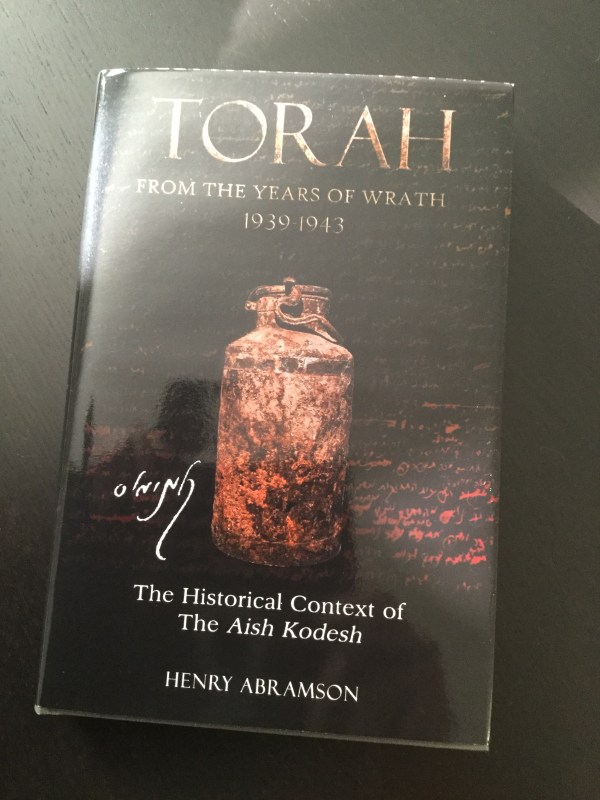
Torah from the Years of Wrath: The Historical Context of the Aish Kodesh 

The Aish Kodesh and Rav Shagar (Parashat Bo 5702, January 24, 1942)

The recent translation of the work of Rabbi Shimon Gershon Rosenberg (Rav Shagar, 1949-2007) promises to elevate his distinctive thought to a broader audience of readers (Faith Shattered and Restored: Judaism in the Postmodern Age), many of whom will resonate with Dr. Yitzchak Mandelbaum’s comment on his discovery of Rav Shagar: “I knew I had found what I didn’t know I had been searching for.” Students of the Aish Kodesh may also note many parallel elements in their respective approaches. Consider this passage from Rav Shagar’s essay, “My Faith”:

There is no proof of faith, and no certainty of faith to be gained with a proof. In any event, proofs do not impact our existence like a gun pointed at one’s temple; they do not touch upon the believer’s inner life. That is why, when it comes to faith, I prefer to use terms such as “occurrence” and “experience.” God’s presence in my prayers is as tangible to me as the presence of a human interlocutor. That is not a proof but rather an immediate experience. Similarly, I do not assert that the sight of someone standing in front of me is proof of the person’s existence. That would be foolish. After all, I see you….The language of faith is the first-person address of prayer. It is not speech about something, but rather activity and occurence.

The Rebbe’s message for Parashat Bo 5702 (January 24, 1942)  echoes some of this personal, first-person definition of faith, particularly in terms of accessing the secrets of Torah (sod). He begins with a discussion of a passage from his namesake’s classic 19th century Hasidic commentary:

The holy work Maor va-Shemesh explains that the secret aspect of Torah study [sod] is not a reference to Kabbalah, for these are things which are found in works of revealed Torah, and all who wish to may study them. Also, one may study them with one’s study partner, and this does not constitute sod.  Rather, the aspect of sod in the Torah is a Divine revelation which is apportioned to each individual according to his individual stature in Torah. This is the true nature of sod, which one cannot study with a partner nor with a student; it remains unique to each individual, in keeping with his condition and level of Divine service.

The Rebbe underlined this surprisingly postmodern thought with his appreciation of sod as a deeply transformative concept:

Consequently, after studying for several hours, or after prayer or some other act of Divine service, one must gaze inward to determine if one has drawn closer, even a bit closer, to the aspect of sod. Additionally, one must make a personal evaluation every few months or years at least, to determine if one has made progress as a whole.  One must perform this exercise after every session of learning or Divine service to determine this—that is to say, even if he has not advanced as a whole, nevertheless let him stand on his holy ground and become greater than he was. Let him at least realize that after an hour of Torah study he is not the same person as after an hour of wasted time.

The Rebbe’s message shifted to a discussion of the attack of the biblical Amalekites on the traveling Israelites, and its comparison to the weakening of Torah study in the Warsaw Ghetto. His sermon does not unduly press the with its obvious parallels to the incredible suffering  imposed by the Nazi occupiers, perhaps an indication of the Rebbe’s internal turmoil  (which is apparent in later entries). Rather, the Rebbe emphasized the prophylactic power of communal study. He began with a citation from Rabbi Schneur Zalman of Liadi, founder of the Chabad-Lubavitch Hasidim, and ended on a note that rings more personal, as if the Rebbe were lamenting the diminishing number of Hasidim attending his sermons:

The holy Rabbi, the memory of the righteous and holy is a blessing, in Tanya letter 23, writes these holy words:  “as I have heard from my masters, if a single angel were to stand in a gathering of ten Jews, engaged in discussing Torah, a boundless fear and trepidation would overcome the angel because of the Divine Presence which hovered over them, to the point that the angel would lose its very existence.” That is to say, that when the ten Jews are scattered, each one in his own home, each one is an individual, the presence of God is not as great as if they had been gathered together.  Therefore, when they come to hear the words of the living God from a master of rabbinic lore, that is to say from one person, then this constitutes a gathering and unification of all of them within this one person. As a consequence, this person experiences a greater Divine revelation which is clothed in the words of Torah which he speaks

fullsizeoutput_1d8b

Torah from the Years of Wrath: The Historical Context of the Aish Kodesh

The Deleted Drasha: Aish Kodesh on Parashat Bo 5700 (January 13, 1940)

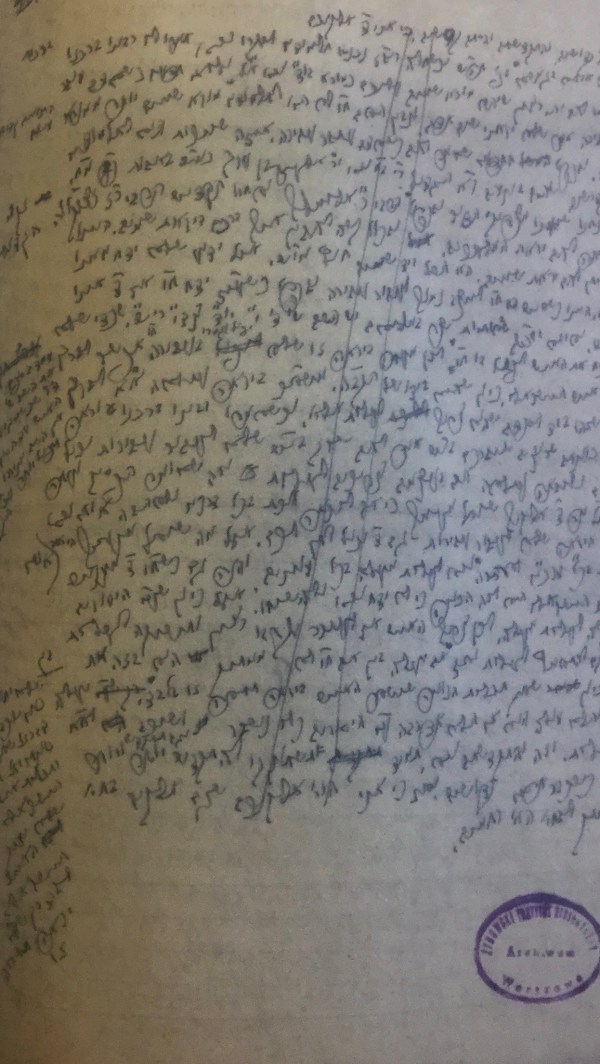
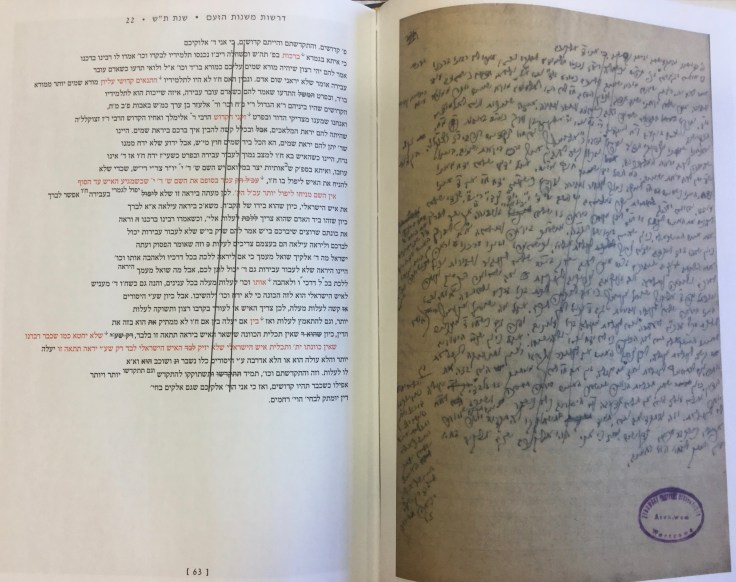
The Rebbe’s entry for Parashat Bo (January 13, 1940) is unusual. Recorded in the scribe’s careful hand, with minimal annotation, it has two bold diagonal lines drawn through the center of the text, indicating that the Rebbe rejected it altogether. A brief and uncharacteristic first-person comment is appended: “more of what we said I do not recall.” Perhaps the Rebbe rejected this entry because  his prepared remarks were overshadowed by a terrible announcement that appeared that Sabbath in the Nazi propaganda organs. Chaim Kaplan provides the context, which must have occupied the minds of all Warsaw Jewry, including those who gathered on that Sabbath afternoon to hear the Rebbe’s guidance:

Every Jewish man from the ages of twelve to sixty and every Jewish woman from fourteen to sixty, all of them, without exception, whether merchants or artisans, workmen or clerks, and even young children with their mother’s milk still on their lips, are required to register in the office to be established for this purpose by the Judenrat. After the registration is completed the work camps are to be completed—naturally in various gradations and of various types—and the workers will be deported for two years!

The Rebbe had chosen to speak that week on the memorable Talmudic passage (Sanhedrin 39b) in which God mourns the suffering of the Egyptians who drowned in the Sea of Reeds. The angels, witnessing the downfall of the hated enemies of the Jews, burst into spontaneous song, only to be silenced by the Almighty: “my creatures are drowning in the sea, yet you wish to sing songs of praise?” The sermon followed the Midrashic intent by evoking unexpected Divine sympathy for the Egyptian taskmasters. The parallel comparing the Egyptians to the Germans was implied.

It is clear that he was of two minds regarding the content of this sermon. On one hand, he marked it for deletion; on the other, he preserved it both by giving it to the copyist and later including it among the papers deposited in the Oneg Shabbat archive. One marginal notation on the sermon sheds light on his thinking: he added a brief qualification to the main thrust of his argument, with its exculpatory message for the Egyptians/Germans, by inserting a passage that began, “the Blessed One did not desire Egyptian awareness of God as much as Jewish awareness.” The Rebbe’s message of sympathy for the Egyptians/Germans, however mild and modulated, simply could not be maintained under the current historical circumstances.

fullsizeoutput_1ef6

Photo from Dr. Daniel Reiser’s 2-volume critical edition, רבי קלונימוס קלמיש שפירא, דרשות משנות הזעם.  See also the moving discussion of this section by Rabbi Shlomo Katz.

Working on Spanish Edition of Kabbalah of Forgiveness!

Really nice to meet with Jésica Neuah of Editorial Perspectivas to work on the tentative cover and book design of the Spanish edition of The Kabbalah of Forgiveness! Great to work with her and the whole team. G-d willing the book will be released in the summer of this year.

IMG_1024

Rabbi Shlomo Katz on the Aish Kodesh

I had chills listening to Rabbi Shlomo Katz review the Rebbe’s words on this week’s parashah. I am grateful for his kind words of praise for my recent book on the historical context of the Aish Kodesh, but to tell the truth, I hardly recognized my own words from the masterful treatment they received from a true Hasid of the Rebbe. Check out his class on Facebook: https://www.facebook.com/shlomo.katz?hc_ref=ARSiU_t7R2RkmNsbmHA0Z2-jZxWR7c2POFK4yhnAHK6L3L8RpxpJlWZtcjXF0BvRe2Y&pnref=story

Screen Shot 2018-01-16 at 11.35.36 AM

The Aish Kodesh On Vaera 5702 (January 1942 in the Warsaw Ghetto)

Chaim Kaplan recorded the mood in the Warsaw Ghetto in January 1942: 

The cold is so intense that my fingers are often too numb to hold a pen. There is no coal for heating and electricity is sporadic or nonexistent. In the oppressive dark and unbearable cold your mind stops functioning. Yet even in such a state of despair the human spirit is variable. The call for a free tomorrow rings in your ears and penetrates the bleakness in your heart. At such a moment one’s love of life reawakens. Having come this far I must make the effort to go on to the end of the spectacle. It is hard to foretell who will live and who will die, and it is especially hard to depart from this earth without knowing the final outcome. In the face of this battle of the giants one’s desire to live becomes overwhelming. In spite of the frightful suffering there are no suicides among the ghetto inhabitants. In these fateful hours, we long for life. “Blessed is he who hopes, he will live to see the restoration of Israel!”

The Rebbe’s message for Vaera (January 17, 1942), reflected on the meaning of cold in the Kabbalistic literature. First, however, he introduced a strange passage from the Talmudic tractate Arakhin:

“Rava bar Shila said in the name of Rav Masneh in the name of Shmuel: there was a magreifa in the Temple…which had ten perforations in it, and each one produced one hundred tones, which taken together produced one thousand tones.” Rashi explains the term magreifa as something which removes [gorfin] the ashes from the altar. We must understand: why did they need a tool used for removing ashes to serve as a musical instrument, and specifically an instrument which produced a thousand tones at once? Furthermore, it is stated in tractate Tamid that the magreifa could be heard as far away as Jericho!  

The Rebbe, well-known as a master of the hidden Torah, demonstrated his extensive fluency in the revealed Torah with a number of explanations, but focused on one understanding that specifically related to the suffering of the Jews in the Ghetto—the incomprehensible loss of life over the previous two and a half years of the Nazi occupation:

In tractate Tamid, chapter two, it is stated that the ashes were not removed on festivals, because this was considered the adornment of the altar. That is to say, it was a visual indicator that many sacrifices were offered…All the sacrifices were offered under the principle of in place of his son which was said regarding Avraham the Patriarch…We perceive the great number of animal sacrifices by means of the great amount of ashes which are left behind. 

When Jewish people are gathered in by the Divine will of the Blessed One, they rise as offerings to the Blessed One, then only after they are gathered in, do we perceive the magnitude of the sacrifice, in both quantity and quality. 

His listeners, many of whom were in extended periods of mourning, no doubt heard the personal message in his words, since the Rebbe has lost his only son, daughter-in-law, and mother in the bombongs of Fall 1939. 

Originally, when they were among us, despite how precious they were to us, as the apples of our eyes and the air we breathe, and as much as we had joy and delight in them, nonetheless we did not know how to appreciate what we had, and we didn’t know how to appreciate their value when they were among us. Now that they are lost, may the Merciful One rescue us, we see with greater clarity the magnitude of our loss. The heart yearns and aches, and there is no consolation except for the words of the Holy One who is Blessed to Moshe our Teacher: “this is an element of my design.”

The Rebbe then shifted his message to the concept of cold in Jewish thought and it’s relationship to the yetser ha-ra, or Evil Inclination: 

We learn from the Sha’ar ha-Kedushah of Rabbi Hayim Vital, the memory of the righteous and holy are a blessing, that the Evil Inclination is derived from the four elements. Anger comes from fire, pride comes from air, [desire comes from water] etc., and sloth comes from earth. In the holy work Imrei Elimelekh it is stated that the Evil Inclination’s burning desire to perform a transgression can be transformed into holiness and utilized to awaken a burning desire to fulfill a commandment. Such is not the case with the cold Evil Inclination, derived from Amalek, which cannot be transformed into holiness, see there. The Evil Inclination uses the four elements for evil, and the Evil Inclination of Amalek, derived from earth…

We must understand—wouldn’t it be possible to transform [this coldness] into the sloth to commit a transgression, [thereby transforming the Evil Inclination of Amalek into holiness]? This is impossible because the cold Evil Inclination undermines faith, and thus is intrinsically evil. That is to say, as long as the klipah of Amalek is not expressed in laziness and sloth, to undermine faith, then it is possible to use the four physical elements [of the Evil Inclination] for holiness. Since a person’s faith is undermined by coldness, Heaven forbid, then he cannot transform his laziness to transgress into holiness, nor can he transform his burning desire to transgress [into holiness], may the Merciful One rescue us.

What is the relationship between laziness, the element of earth, and the cooling of faith? How does the evil inclination of Amalek use this to damage faith, Heaven forbid? We have already discussed how the faith of a Jew is derived from the spirit of holiness within him, which allows him to have a faith which transcends his intellect and reason. The Evil Inclination can use laziness and sloth, however, to affect the heart, mind and entire body, making it heavy and dragging it down, preventing it from exaltation and elevation, and cleaving to holiness. In this fashion, one’s faith is damaged, may the Merciful One rescue us.  

The Rebbe expressed sympathetic understanding for his suffering Hasidim, and connects their self-sacrifice back to the magreifa and its function in the Temple. 

When a person experiences tremendous suffering, which breaks him and casts him down, it also damages his faith. Initially, though he does not entertain thoughts that are contrary to faith, Heaven forbid, but he does not experience spiritual exaltation due to his decline. He is prostrate, and it is as if he has become a stone, unfeeling in heart and mind, little by little, damaging and erroneous thoughts occur to him, may the Merciful One rescue us. 

Consequently, with the Divine Service of sacrifices, which the Jewish people offered in the fire of holiness, entirely to Hashem, all that remained was the ash, which is an aspect of earth, that did not enter into holiness, and needed to be removed. With what was it removed? With the magreifa that produced music, representing joy and Jewish salvation. Through salvation and joy, everything can be elevated, transforming darkness into light…

This is the intent of the musical sound of the magreifa used for the ashes, which are of the element of earth. Because of their very weight, a greater desire to sing is awakened in them… and by means of the awakening of sorrow, the redemption is aroused, and I will take you out.

Torah from the Years of Wrath: The Historical Context of the Aish Kodesh

The Aish Kodesh on Vaera 5700 (Torah from the Warsaw Ghetto, January 1940)

Five months into the Nazi occupation, the Jews of Warsaw struggled to keep up with the barrage of administrative decrees inflicted upon them by the Germans. When the Rebbe spoke on Parashat Vaera, which fell on January 6, 1940, the worst was still far off. The Nazis had replaced the leadership of the Jewish Council with their appointees, the wearing of the mandatory Jewish badge was recently imposed, and a horrific mass arrest and execution of Jews living at 9 Nalewki Street terrified the Ghetto—but the walls had not yet been constructed, and Jews still enjoyed considerable freedom of movement and association. Economic activity, however, was feeling the pressure of the occupation, as recorded by the martyred historian Emmanuel Ringelblum in his diary:

The economic situation is very hard, no basis for a normal economic existence.  Raw supplies are being removed on a large scale and sources are cut off…The doctors’ situation has taken a turn for the worse.  There were doctors who used to earn 1,000 zlotys a day.  Not nowadays.  People simply haven’t the money to be cured….The teachers are so bad off that some of them are going into glass blowing and are willing to take any kind of menial job, janitor or a domestic servant or the like…Decree (2nd of January): ban on posting obituary bills.  Punishment for printing them: culprit to be handed over to the authorities…Every few days another decree, one confiscating furniture, another kitchen utensils, etc…Yesterday, the 5th of January, an ordinance restricting street selling was published. Jews can only sell on the Ghetto streets, beginning with Cracow, Przedmieszcie, Karowa, Krolewska, Sienna, etc. You have to have a special commercial card.  The decree limiting the right of Jews to resettle is being interpreted as aimed against Jewish trade, smuggling, the immigration to Warsaw…The problem of how to protect the big book collections.  The Socialist-Zionist Hashomer Hatzair’s books are being used by the refugees to stoke ovens at 6 Leszno Street. 

The Rebbe’s message for Vaera of the Hebrew year 5700 was directed to Jewish leaders: perhaps to the Jewish Council (Judenrat) under Adam Czerniaków, perhaps even to himself (neither would survive the Holocaust—the Rebbe would be martyred in connection with an uprising in November 1943, and Czerników would swallow a cyanide pill in July 1942 when he realized he could not stop the deportation of Jewish children to the death camp Treblinka). The Rebbe drew a parallel to the leadership of Moses during the oppressive era of Pharaoh:

The Jews did not listen to Moses out of shortness of breath and difficult labor…[Moses said], if they have not listened to me, [how will Pharaoh listen to me?]… Rashi explains, “God commanded that Moses and Aaron should lead the Jewish people gently and be patient with them.” 

How is this relevant?  The Jewish people would not listen due to the oppression of Pharaoh, but why does this require Moses and Aharon to lead them gently?  Of what benefit would calm leadership be, if Pharaoh continued to torture them, Heaven forbid?

The Rebbe began the answer to his own question by describing three levels of Divine response.

We pray that God provide us with “grace, kindness, and mercy” (חן, חסד, ורחמים).  First grace, then kindness, and then mercy. This is because grace is invoked for one who is, Heaven forbid, not deserving of rescue, as we learn from the verse and Noah found grace, meaning that even Noah was not deserving of rescue, yet he found grace.  Kindness, which is understood as complete kindness, is also given to the undeserving.  It is only mercy that is intermixed with Divine justice.  Mercy is neither the full measure of Divine justice, nor Divine kindness, for one who is undeserving—rather it is intended for one who is somewhat deserving, hence mercy.

The Rebbe then subtly shifted his discussion from an appeal to Jewish leadership, to a prayer for Divine forbearance for weak Jewish observance of the commandments. Just as the Jews of Moses’ time were unable to respond adequately to the call for redemption, so too the situation of the Jews of Warsaw:

This is why our prayers read in this specific order.  It goes without saying that it is impossible to approach Divine justice itself, amidst suffering and affliction, when we are not fulfilling that which is incumbent upon us. Amidst suffering and affliction, we are not only unfit to approach Divine justice and be vindicated, it is even impossible for us to approach Divine mercy, which requires us to be somewhat worthy.  Therefore, we ask that we be first granted grace and kindness, so that even though we are not worthy, God may save us—and then we will be able to approach Divine mercy, for we will be at least somewhat worthy.  It is not merely the affliction that makes it difficult to for us to study Torah and do all that is incumbent upon us. Even that which we do manage to accomplish, is performed without spirit and vitality, rather with a broken heart and depressed, and without joy—may the Merciful One rescue us….as a consequence of the intensity of [Egyptian] enslavement, it was essential that the Jewish people first attain freedom…

Rebbe concluded his message with an allusion to the sequence of the specific names of God used in the Parashah (see Exodus 6:2,6:9, and 6:12-13). Elokim associated with Divine Justice, while the Tetragrammaton—rendered as Hashem—represents Divine mercy:

Initially, the verse stated, and Elokim spoke, and afterwards, I am Hashem.  Now, however, the verse first states and Hashem spoke. Thus Rashi comments on the phrase and Hashem commanded them regarding the children of Israel to mean, “to lead them gently.”  All conduct with them must not begin with justice, followed by mercy.  Rather, from the beginning, everything should be with gentleness.

img_0935

Torah from the Years of Wrath: The Historical Context of the Aish Kodesh

The Aish Kodesh on Shemot 5702

The winter of 5702 brutalized the Jews of the Warsaw ghetto with unforgiving cold. Chaim Kaplan, a school principal whose journal Scroll of Agony survived the war, recounts in his typically blunt prose how the physical privations of January 1942 affected the spiritual life of Ghetto inhabitants:

Gone is the spirit of Jewish brotherhood. The words “compassionate, modest, charitable” no longer apply to us. The ghetto beggars who stretch out their hands to us with the plea, “Jewish hearts, have pity!”  realize that the once tender hearts have become like rocks. Our tragedy is the senselessness of it all. Our suffering is inflicted on us because we are Jews, while the real meaning of Jewishness has disappeared from our lives.

Our oppressors herded us into the ghetto, hoping to subdue us into obedient animals. Instead, however, we are splitting and crumbling into hostile, quarrelsome groups. It is painful to admit that ever since we were driven into the ghetto our collective moral standard has declined sharply. Instead of uniting and bringing us closer, our suffering has led to strife and contention between brothers.  The Nazis, possibly with malice aforethought, put us in the hands of the Judenrat so that we might be disgraced in the sight of all. It is as if they were saying, “Look at them!  Do you call them a people?  Is this your social morality? Are these your leaders?”

It is not at all uncommon on a cold winter morning to see bodies of those who have died on the sidewalks of cold and starvation during the night. Many God-fearing, pious souls who, if the day happens to be the Sabbath, are carrying their tallith under their arms, walk by the corpses and no one seems moved by the sight.  Everyone hastens on his way praying silently that his will not be a similar fate. In the gutters, amidst the refuse, one can see almost naked children who were orphaned when both parents died earlier in their wanderings or in the typhus epidemic. Yet there is no institution that will take them in and care for them and bring them up as human beings. Every morning you will see their little bodies frozen to death in the ghetto streets. It has become a customary sight. Self-preservation has hardened our hearts and made us indifferent to the suffering of others. Our moral standards are thoroughly corrupted. Everyone steals! Petty thievery, such as picking pockets or stealing a hat or umbrella, is common.  Because kosher meat is terribly expensive, people have relaxed their observance of the laws regarding the eating of kosher food. Not only atheists and derelicts are guilty of this, but synagogue sextons and pious men as well. 

It is Nazism that has forced Polish Jewry to degrade itself thus.  Nazism has maimed the soul even more than the body!

The Piaseczno Rebbe’s words on the Shabbat of Parashat Shemot responded to the moral decline of the beleaguered Jewish population. The Rebbe was certainly aware of the ethical challenges of life in extremis in the Warsaw Ghetto. He identified three types of people who fear sin, for different reasons:

There is a kind of person who understands the bitterness of punishment for each and every sin, Heaven help us.  There also exists a greater type of person for whom the concept of sinning against God is in itself egregious.  This is without reference to a specific sin, rather it refers to anything which is contrary to God’s will, nonetheless he is not conscious of any personal sin, and he feels no fear that he may yet sin, continually assuring himself that he is good and his actions are good.  There is a third type of person, however, who is continuously in a state of trepidation that he not sin, and his heart is broken within him, saying ‘who knows if even now I am not rebelling against God?’  Insofar as he is sensitive, and always fearful, then he always discovers his own shortcomings. 

The difference between the three is as follows:  the first one, even though he knows the enormity of a given sin, has nevertheless failed to internalize fear within himself, and his heart does not tremble that he not sin.  The last of the three has internalized fear of sin, and his body, mind, and heart have been sensitized and tremble, that he not sin, finding within himself his shortcomings, and out of this extreme concern, he repents and those shortcomings are not able to take root within him.  Since the fear of sin and thoughts of repentance were established within himself prior to an act of sin, consequently repentance comes speedily after any shortcoming, Heaven forbid.

The last category—the person who feels deep concern for sin, even without committing any transgression—is discussed extensively in the Rebbe’s prewar writings, and is considered one who is capable of experiencing tremendous joy and spiritual growth. In the context of fear of sin, the Rebbe explains that this is because fear is an emanation fro the kabbalistic sefirah known as gevurah—for the spiritually unrefined, fear is sensed as regret for sinful behavior in the past tense. For those on a higher spiritual level, the energy of gevurah is accessed through fear of sin in general, in the future tense. The Rebbe continued his thought with an exhortation to renewed study of Hasidic thought:

For this reason, even now, when every mind is afflicted and every heart is sick, and it seems to people that they cannot speak of Hasidic matters…it is enough for us to hold on to the performance of simple, practical commandments. This is a mistake. First of all, we are bound by the imperative to serve God with all manner of devotion, even in these times. Secondly…a person who entertains such thoughts of fear [of sin]…after periods of introspection he sense will within himself an elevated consciousness, and even joy, because this is a purified fear, a form of “a delight in fear of You,” as we say in the Sabbath song, “Kah ekhsof,” a supernal fear which elevates the individual…

The fear is only the means of preventing sin, yet according to what we have written, it is all one. A person must acquire fear in order that he not sin, a perpetual fear that he not sin.  By means of this he will be elevated…as an expression of “delight in fear of You.” 

The Rebbe concluded his message with a reference to the Torah reading of the week. Moses was initially hesitant to accept God’s command to go to Pharaoh and demand the release of the Jewish people. God gives Moses as sign—a holy name, “I will be”—so that Moses will be able to convince the Jews that they will be freed:

This is alluded to within Moses our Teacher’s question, who am I…that I should take out [the Jewish people from bondage?].  Since he was the humblest of all people, therefore he began with thoughts such as these: who am Ithat I should take out [the Jewish people from bondage].

God responded, it is not that you are not worthy, and it is not that, Heaven forbid, that you have deficiencies, rather the fact that you question yourself is in itself a sign of holiness, Divine worship which illuminates and is drawn from the concept of “God—I will be.  Until now, a person was incapable of introspection, and said to himself: “until now I was nothing—but from now on I will be.” 

img_0935

Torah from the Years of Wrath, 1939-1943: The Historical Context of The Aish Kodesh

Create a website or blog at WordPress.com

Up ↑