Please enjoy this week’s column in the Five Towns Jewish Times!
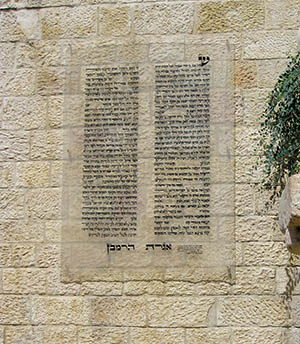
The Letter of Nachmanides
People Of The Book: Classic Works Of The Jewish Tradition
By Dr. Henry Abramson
“Accustom yourself to speak gently to all people at all times. This will protect you from anger—a most serious character flaw which causes one to sin.”
—Nachmanides’ Letter, translated
by Rabbi Avrohom Chaim Feuer
In the penitential month of Elul in the year 1267, the aged scholar Nachman ben Moshe penned a letter to his son in far-off Aragon. The venerable rabbi, exiled from his home in the Iberian Peninsula, had recently made the treacherous journey across the Mediterranean to Israel, a land which he found almost devoid of Jewish life: After nearly two centuries of war between European crusaders and the local Muslim rulers, even Jerusalem could not assemble a minyan without summoning Jewish farmers from the surrounding countryside.
Rabbi Nachman—known to historians as Nachmanides—would go on to a brilliant second career rebuilding Jewish life in the Holy Land, but that glorious future was unknown when he picked up quill and ink to record what he thought might be his last communication with his children. His classic letter has since been cherished by Jews over the centuries as a heartfelt, profound distillation of Jewish ethics and philosophy.
Nachmanides, a native son of Gerona, was nearly 70 years old when he was summoned by the king to participate in a “debate” on the merits of Judaism with Pablo Christiani, a recent convert to Catholicism who slandered his erstwhile faith and in particular the Talmud. The Disputation was held in Barcelona in 1263 with great pomp and circumstance. Prominent nobles and church officials attended, expecting a pageant that would culminate in the conclusive defeat of Judaism and a mass exodus of dispirited Jews into the welcoming arms of the church.
Christiani had, however, seriously underestimated the sheer intellectual power and erudition of his senior interlocutor, and the debate soon turned into an unexpected rout. Humiliated, Christiani claimed victory nevertheless, but even a cursory comparison of the multiple published accounts of the trial confirm Nachmanides’ decisive victory. The mass baptisms, forced or otherwise, were canceled, and the dignitaries returned to their homes confused and disappointed.
The king, who had no special love for the church, was thoroughly entertained and delighted with Nachmanides’ victory and personally awarded the rabbi 300 gold coins for his efforts. The church was not to be trifled with, however, and Nachmanides was forced to suffer the punishment of banishment for the temerity of ably defending Judaism. He was exiled from Aragon, forced to leave his family and followers. He chose to make aliyah to Israel, and wrote his famous letter upon arrival at the port of Acco.
The letter is some 500 words in the original Hebrew, roughly the length of this article. Despite its essential message of moral instruction, it is written with obvious warmth and affection for the son that he would never see again. The underlying mood of sadness at their forced separation, tempered by profound gratitude to Providence for safe passage across the Mediterranean, is palpable to readers centuries later. The principal theme of the letter is the interrelationship of anger, humility, and the fear of Heaven, with practical suggestions on how to develop self-control and spiritual sensitivity.
Nachmanides concludes with an exhortation that his son review the letter weekly, a custom that has gained such widespread prominence that many prayer books include it as an appendix to the daily Shacharit service. A readable English translation and extended commentary by Rabbi Avrohom Chaim Feuer was published some years ago by ArtScroll under the title A Letter for the Ages.
Dr. Henry Abramson is a specialist in Jewish history and thought. He serves as dean at the Avenue J Campus of Touro’s Lander Colleges and may be reached at abramson@touro.edu.





 Henry Abramson