People of the Book: Classics of the Jewish Tradition

People of the Book: Classics of the Jewish Tradition

Please click here for the original article in the Five Towns Jewish TimesAbramson-Rav-Cordovero-225x300

by Dr. Henry Abramson

Rabbi Moshe Cordovero’s ‘Tomer Devorah’

“Even if you cannot find any reason to forgive a person, there was nevertheless once a time when this person did no wrong. Think of the good this person did as a child, recall the love that a mother has for a nursing babe, and you will not be able to hold back a measure of forgiveness and mercy” (from the 13th Level of Forgiveness).

A work of soaring genius, Rabbi Moshe Cordovero’s Tomer Devorah is one of the greatest expressions of human spirituality of the past millennium. Well-known to students of mussar and Jewish mysticism, this slim work (some 35 pages in the first printing) gained mass popularity when generous excerpts were included in the widely circulated 17th century Shnei Luchos ha-Bris by Rabbi Yeshayahu Horowitz (the Shelah ha-Kadosh). It has been printed dozens of times since then, including translations into English, Spanish, French, and German.

Rabbi Cordovero (also known as the Ramak, an acronym formed from his name) was one of the leading figures of the 16th-century Tsfat Circle, a remarkable assembly of Jewish spiritual giants who were responsible for an explosion of intellectual creativity that was as brief as it was powerful. A descendant of refugees from the Portuguese Expulsion of 1497, he studied with Rabbi Yosef Karo (author of the Shulchan Aruch, the Code of Jewish Law) and Rabbi Shlomo Alkabetz (author of the Lecha Dodi liturgical poem sung on Friday nights). Rabbi Cordovero’s principal activity was in the realm of Kabbalah, and he earned his scholarly reputation with the publication of PardesRimonim (“The Orchard of Pomegranates”), the first systematic analysis of Zoharic mysticism, as well as the massive Or Yakar (“The Precious Light”), a commentary of the Zohar itself. Rabbi Isaac Luria (the Arizal), then living in Egypt, migrated to Tsfat to study at his feet. Their time together was cut short by Rabbi Cordovero’s untimely passing, but the Arizal regarded the Ramak as his principal teacher ever after.

Tomer Devorah begins with a deceptively simple premise: given that Jews are required to emulate G‑dly behavior (following Devarim 28:9, “and you will walk in G‑d’s ways”), then we are first required to know something about G‑d. This is made possible, argues the Ramak, by studying the sefiros, the kabbalistic conduits through which G‑d infuses the universe with vivifying energy. TomerDevorah is therefore a brief overview of the sefiros themselves, and a discussion of their implications for human behavior. The sefirah of chesed, for example, occasions a discussion of some of the vehicles for human kindness (visiting the sick and so forth).

When people emulate G‑d’s behavior in terms of chesed, these acts elicit a greater flow of energy from the sefirah of chesed into the world as a whole. The most widely studied section of Tomer Devorah is the glorious first chapter, which looks at the Thirteen Attributes of Mercy, describing the ways in which G‑d forgives the world, and in turn how we may learn to forgive others as well. Rabbi Cordovero’s work represents the beginning of a completely new genre of Jewish literature: Kabbalistic Mussar. Later works include Rabbi Chaim Vital’s ShaareiKedushah and Rabbi Eliyahu de Vidas’s Reishis Chochmah. TomerDevorah stands alone, however, as a unique exception to the general ban on the study of Kabbalah for students under the age of 40. Endorsed enthusiastically by Lithuanian Mussar masters such as Rabbi Israel of Salant and by Hasidic leaders such as Rabbi Chaim Halberstam of Sanz (the DivreiChaim), TomerDevorah is studied on a daily basis by many as a segulah for health and wellness, especially during the penitential season of Elul and the Ten Days of Repentance. v

Dr. Henry Abramson is a specialist in Jewish History and Thought. He serves as dean at the Avenue J Campus of Touro’s Lander Colleges and may be reached at abramson@touro.edu.
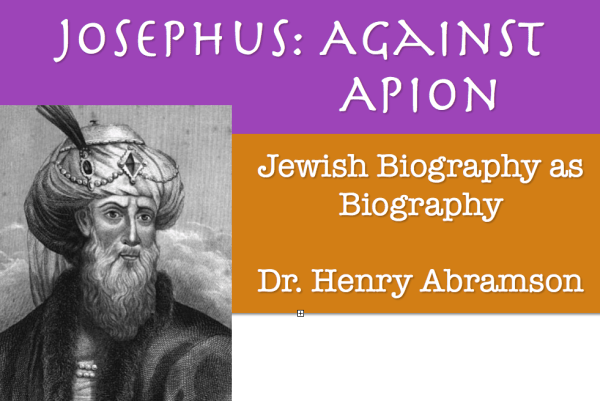
Josephus Against Apion (Jewish History @ Avenue J)

Lecture on Against Apion, an important literary response to antisemitism in the Roman Empire written by the 1st century historian Flavius Josephus.

And here’s the Prezi: http://prezi.com/yzmhlmrhf2ac/?utm_campaign=share&utm_medium=copy.

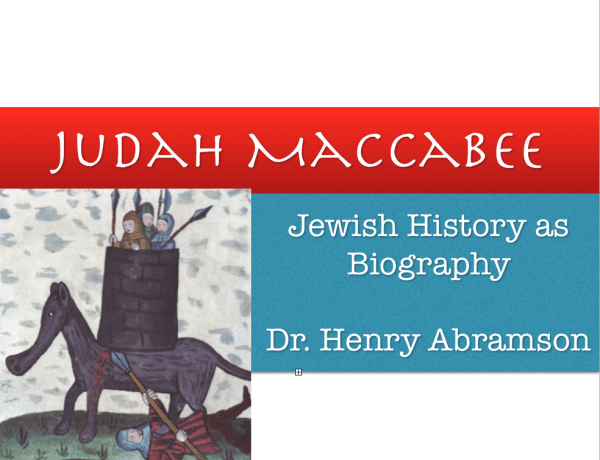
Judah Maccabee (Jewish Biography as History) First Lecture of the Fall 2015 Lecture Series!

We begin the Fall 2015 Lectures in Jewish History series with a presentation on the life and work of Judah (Yehudah) Maccabee, famed military commander of the Hasmonean revolt. Enjoy in good health!

Here’s the link to the Prezi.

New Column in the Five Towns Jewish Times!

Please enjoy my first column in the Five Towns Jewish Times!

People of the Book: Classic Works of the Jewish TraditionAbramson-Letter

By Dr. Henry Abramson

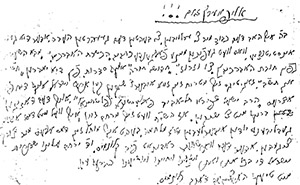
According to my knowledge of the words of the Sages and the history of the Jewish people in general, we have never experienced such horrific suffering as has been visited upon us by the wicked ones since the end of 5702 (fall 1942)—may Hashem have mercy on us and rescue us immediately.

—Entry from January 11, 1943.

Discovered in the rubble of the Warsaw Ghetto, the Aish Kodesh (Holy Fire) is one of the most remarkable works of Jewish spirituality to emerge from the Holocaust. A slim volume of some 150 pages in the first printing, Aish Kodeshpresents the Torah spoken at the clandestine seudahshlishis gatherings convened by Rabbi Kalonymus Kalman Shapiro, known to his followers as the Piaseczno Rebbe.

The author, a scion of the Grodzhisk Chassidic dynasty, was a creative thinker whose literary fame was established with the 1932 publication of Chovas haTalmidim (The Students’ Obligation). Trapped in Warsaw when the war broke out, he lived through all its tragedies: the sealing of the ghetto in the fall of 1939, the horrific typhus plague of the winter of 1941, the massive deportations to Treblinka in the summer of 1942, and the heroic but doomed uprising of April 1943. He was ultimately deported to a labor camp and shot in November 1943, most probably for his involvement in a second attempted uprising. Unlike Holocaust memoirs, journals, or diaries, Aish Kodesh is a book that is sui generis for many reasons.

Aish Kodesh is a public document, representing the real-time efforts of the beleaguered Jewish community to deal with the theological implications of the Holocaust as it unfolded in the Warsaw Ghetto. The intellectual task of understanding the meaning of unimaginable suffering was common to both Orthodox and secular Jews, and third-party reports of the Rebbe’s gatherings confirm that they were attended by believers and non-believers alike. Aish Kodesh is also a profoundly sustained work of theodicy, its pages filled with philosophical meditation on the meaning of evil in Jewish thought, and much scholarly attention has been devoted to this aspect of the work, notably Dr. Nehemia Polen’s masterly 1999 study, Holy Fire.

Aish Kodesh has not, however, been studied extensively by historians, who have typically been stymied by the sometimes abstruse Kabbalistic passages and the almost complete absence of explicit references to quotidian events in the ghetto: not once in the entire work do the terms “German” or “Nazi” appear, and the reader must wade through veiled Aesopian language to determine the message of hope that the Rebbe offered in response to the horrors of that week under Nazi occupation.

After the war, a desperate post-war search for the OnegShabbos archives (a collection of documents that chronicled the realities of ghetto life) unearthed the Rebbe’s manuscripts of Aish Kodesh and its subsequent publication in Israel. Popularized in song by Rabbi Shlomo Carlebach, a renaissance of interest in Piaseczno chassidus developed in both scholarly and popular circles, notably under the leadership of Rabbi Moshe Weinberger of Woodmere, whose Aish Kodesh congregation takes its inspiration from the life and work of Rabbi Kalonymus Kalman Shapiro.

Publication information: Esh Kodesh, Tel Aviv: Va’ad Hasidei Piaseczno, 1960

Dr. Henry Abramson is a specialist in Jewish History and Thought. He serves as dean at the Avenue J Campus of Touro’s Lander Colleges and may be reached at abramson@touro.edu.

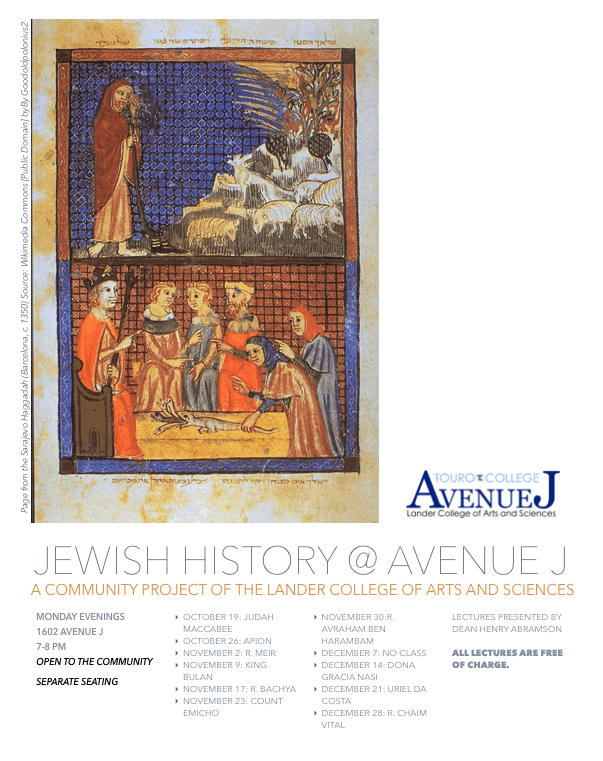
Jewish History Lectures Resume October 19 at Avenue J

JEWISH HISTORY @ AVENUE J

A Community Project of the Lander College of Arts and Sciences

Monday Evenings, 7-8 pm, 1602 Avenue J, Brooklyn NY 11230

Beginning October 19, 2015

Open to the Community

Separate Seating

All Lectures are Free of Charge

Fall 2015 Jewish History Lectures

Screen Shot 2015-07-28 at 1.17.28 PM

Free Download of The Kabbalah of Forgiveness (Tomer Devorah)

Free for the High Holiday Season: a free download of The Kabbalah of Forgiveness, a translation and commentary of Rabbi Moshe Cordovero’s Tomer Devorah.  Especially valuable reading in preparation for Yom Kippur!

To download, visit https://www.smashwords.com/books/view/464044 and enter coupon code BQ57Y, valid through October 7, 2015.

If you really must have a hard copy, visit Amazon or Createspace.

May you enjoy the cleansing power of forgiveness!

kof cover DMA_Fotorhttps://www.createspace.com/4920744

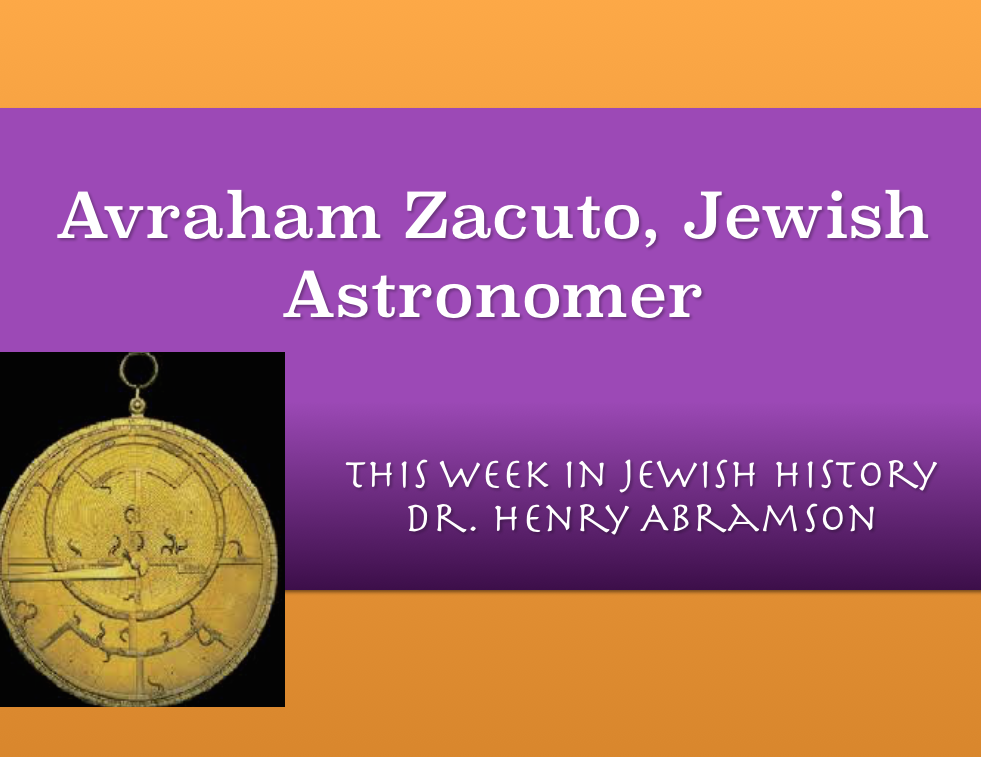
Avraham Zacuto, Jewish Astronomer to Columbus (This Week in Jewish History)

Screen Shot 2015-07-31 at 2.28.50 PM

Brief video describing the life and activity of Avraham Zacuto, Spanish-Jewish Astronomer and Historian whose work contributed directly to the travels of Christopher Columbus and other 15th-century explorers.

Jews, Tisha B’Av, and World War I (This Week in Jewish History)

Screen Shot 2015-07-22 at 4.51.35 PM

Brief discussion of the anniversary of Tisha B’Av, the onset of World War I, and its implications for Jewish History.

Create a website or blog at WordPress.com

Up ↑