The Kidnapping of Edgardo Mortara: This Week in Jewish History

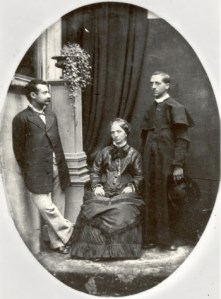
R-L: Edgardo Mortara, mother Marianna, and unidentified brother, c. 1880. Source: Wikimedia Commons.

In the summer of 1858, 6-year old Edgardo Mortara, a Jewish boy living in Bologna, Italy, was forcibly taken from his home by Italian police acting at the behest of the Inquisition. It had come to the attention of the Church that a teenage non-Jewish servant girl had performed an “emergency baptism” on Edgardo several years earlier, fearing that he would die of a childhood illness and not be allowed entry into Heaven.  Despite strenuous efforts by Jewish communities around the world, Pope Pius IX refused to release Edgardo, who ultimately became a priest in the Augustinian order and devoted his life to converting Jews to Catholicism.

The Pogroms of 1881-1884: This Week in Jewish History


Immigrants approaching Statue of Liberty. Photo by Edwin Levick, Source: Wikimedia Commons.

For a larger discussion of the five historical narratives, please see my article The end of intimate insularity: new narratives of Jewish history in the post-Soviet era, in Acts of Symposium “Construction and Deconstruction of National Histories in Slavic Eurasia,” originally delivered at Hokkaido University, Sapporo, Japan, on July 10–13, 2002.


This Week in Jewish History: The Jewish Badge

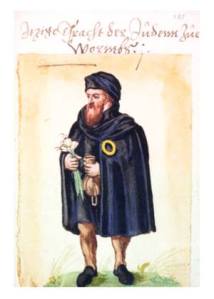
Jewish Man in Worms, Germany, 16th c. Source: Wikimedia Commons.

This is a new experiment, suggested by Elya at TorahCafe.com: a weekly, 3-minute “This Week in Jewish History” mini-lecture.  I’m trying it out, let me know what you think!

Please click here for the refined, edited version from TorahCafe.com.

Albert Einstein Video (now with PowerPoint) from TorahCafe editors

Here’s a new version of the Albert Einstein lecture, edited by the wonderful people at TorahCafe.com to include the PowerPoint. It’s basically the same, except without the lame jokes. Click on the icon below to watch the video.

Watch on TorahCafé.com!

Isaac Bashevis Singer: Singer in the Shtetl, the Shtetl in Singer (2004 lecture)

Isaac Bashevis Singer. Source: MDCarchives cropped by Beyond My Ken, Wikimedia Commons.

This is a lecture I delivered at the University of Central Florida back in October 2004 (my hair was quite a bit darker and, well, there).  Found the CD when I was cleaning out some old files. There’s a PPT that goes with this lecture, and I’m going to try to find a way to post it.  Anyway, this is the summer, so I won’t be sending out too many new lectures, thought I would add this one as well.  Isaac Bashevis Singer (1902-1991) was a Nobel Laureate for Literature, the first Yiddish writer to receive this distinguished award.  He was also a resident of my current home in Surfside, Florida. Hope you enjoy it!

Rabbi Menachem Mendel Schneerson of Chabad

Rabbi Menachem Mendel Schneerson. Photograph by Mordecai Baron. Source: Wikipedia Commons.
Rabbi Menachem Mendel Schneerson. Photograph aby Mordecai Baron. Source: Wikipedia Commons.

A presentation on the life and work of Rabbi Menachem Mendel Schneerson (1902-1994), the Seventh Rebbe of the Chabad-Lubavitch movement. A native of Nikolaev, Ukraine, and educated in Germany and France, his leadership transformed his Hasidic followers into an international movement that continues to shape the lives of Jews world wide. The lecture was held at the Young Israel of Bal Harbour on Wednesday, June 5th.

Betty Friedan: Jews and American Feminism

Betty Friedan in 1960. Source: Wikipedia Commons

A presentation on the life and work of Betty Friedan, a prominent American Jewish feminist leader. The author of the landmark The Feminine Mystique (1963), she later became the Founder of the National Organization of Women, and an important political activist for women’s rights.  The lecture was held at the Young Israel of Bal Harbour on May 29, 2013.

Albert Einstein: Time, Space and the Jewish People

Albert Einstein, 1947 (Source: Wikipedia Commons)

A presentation on Albert Einstein (1879-1955), one of the best-known Jews of the twentieth century.  Although he had a complicated relationship with Judaism, he maintained a distinct pride in his Jewish identity, and once said “A Jew who abandons his Judaism is like a snail that abandons its shell.  It’s still a snail.”  The lecture was delivered at the Young Israel of Bal Harbour  on May 22, 2013.

Here’s the improved version, edited by TorahCafe with the missing powerpoint. Thank you Torahcafe.com! Please click on the icon below:

Watch on TorahCafé.com!

Create a website or blog at WordPress.com

Up ↑