Heinrich Graetz (1817-1891) was the first encyclopedic historian of the Jewish people, and his massive 10-volume History of the Jews had a phenomenal impact on the way Jews saw themselves as a nation living in the diaspora.
Imagine that, while browsing in the library, you come across one book unlike the rest, which catches your eye because on its spine is written the name of your family. Intrigued, you open it and see many pages written by different hands in many languages. You start reading it, and gradually you begin to understand what it is. It is the story each generation of your ancestors has told for the sake of the next, so that everyone born into this family can learn where they came from, what happened to them, what they lived for and why. As you turn the pages, you reach the last, which carries no entry but a heading. It bears your name.
Jonathan Sacks, A Letter in the Scroll
We believe:
that the study of Jewish history adds value and meaning to human existence for both Jews and non-Jews
that academic Jewish history lectures need not sacrifice content to be entertaining
that access to high-quality information on Jewish history should be free
that shared intellectual curiosity about Jewish history is a healthy way to build a community
that the study of Jewish history is one of many paths that lead to the study of Torah, and that Torah study is enriched by a fuller understanding of Jewish history
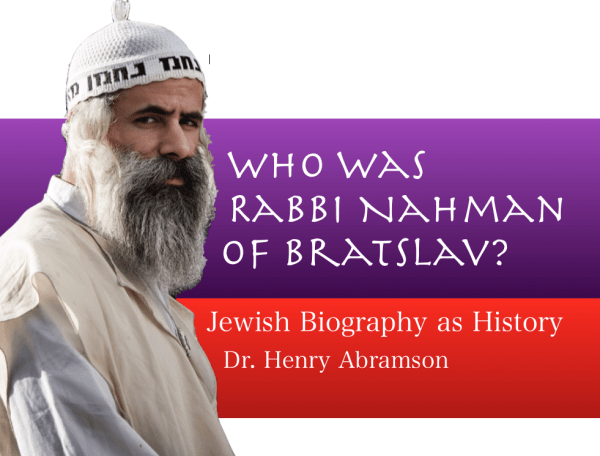
One of the most creative, unusual, and controversial Hasidic leaders at the turn of the 19th century, Rabbi Nahman of Bratzlav (Nachman of Breslov) continues to inspire generations of disciples. Part of the Jewish Biography as History series, more available at http://www.henryabramson.com.
This is a more-or-less scholarly discussion of the origins of modern Jewish history in Enlightenment Europe. Warning: there are a few jokes in this video, but they only start around the 15 minute mark. The rest is more theoretical and historical. Part of the Essential Lectures in Jewish History series, more available at http://www.henryabramson.com.
****************
Here are a few of Dr. Abramson’s recent publications. He’s not very funny in print (but taller).
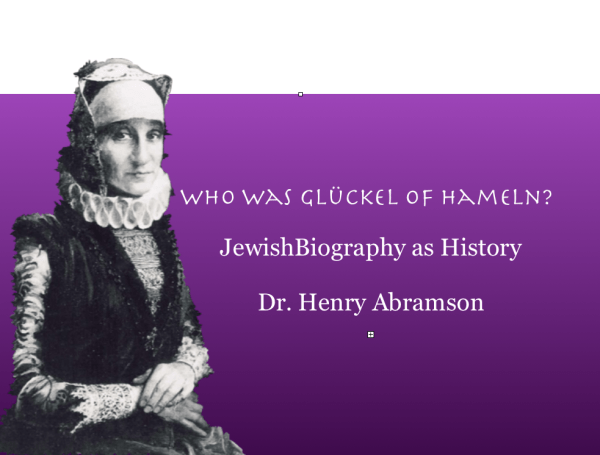
Gluckel of Hameln, a Jewish woman who lived in late 17th-century Germany, left a remarkable memoir describing her life. Part of the Jewish Biography as History series by Dr. Henry Abramson, more available at http://www.henryabramson.com.
The Jewish people experienced dramatic changes in the sixteenth century that reverberate to this day. This lecture discusses three aspects of this century in particular: 1) the demographic upheavals associated with the expulsions from Spain and Portugal as well as the Ashkenazic migration, 2) the impact of the disruptive technology of printing, and 3) the ramifications of the Safed circle.
Famed author of the Lecha Dodi hymn sung on the eve of the Jewish sabbath, Rabbi Alkabets was one of the founding members of the 16th-century school of Kabbalists based in Safed (Tsfat), Israel.
Next week’s lecture: Gluckel of Hameln!
Love Yiddish culture? Check out the new poster for the 2015 Kultur Festival in Boca Raton! I’m really proud to be doing a book reading (The Kabbalah of Forgiveness) there on March 6. Main event, as always, will be Maestro Aaron Kula’s phenomenal Klezmer Company Orchestra concert on March 1!
Early adopters of the newest disruptive technology, the Soncino family were the first Jewish printers in 15th century Europe. This lecture discusses some aspects of the early decades of Jewish printing, and meditates on the meaning of the current digital revolution for Jewish culture and society.
Planning to attend Limmud Miami this year?
I would love to see you at the session on The Kabbalah of Forgiveness! Register here.
Rabbi Shlomo ben Adret, known to his student by the acronym of his name Rashba, was one of the most brilliant Talmudists of medieval Spain. Student of Nachmanides (Ramban) and teacher to the Ritva, his writings are studied to the present day.
Here’s Dr. Abramson in print (because there are times and places where one just can’t enjoy a video). Check out the eBook versions as well.
What, exactly is Chanukah (or is it Hanukah, or Hannukkah)? This short video describes the historical origins of the holiday, notes the ironic nature of its observance in the American context, and has a couple of jokes besides.
Suggested Holiday Gifts (Maybe for people you don’t especially like).








 Henry Abramson