The Nuremberg Laws of 1935 (This Week in Jewish History) Dr. Henry Abramson

Nuremberg thumbnail

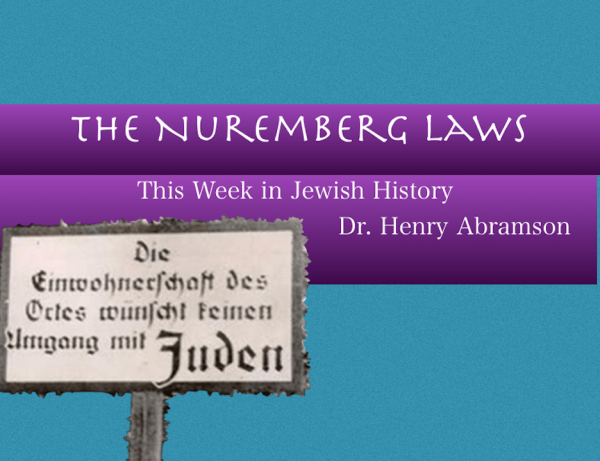
The Nuremberg Laws of 1935 defined, for the purposes of the Nazi regime, exactly who was considered a Jew. This was an essential element in the unfolding of the Holocaust, as the Nuremberg Laws allowed the Nazis to first identify, then exclude, and finally attempt to eliminate Jews from German society. Part of the “This Week in Jewish History” series by Dr. Henry Abramson. More videos available at http://www.henryabramson.com

Who Was Bar Kochba? Jewish Biography as History Lecture by Dr. Henry Abramson

BK thumbnail

“Akiva, grass will grow from your cheeks,” said the talmudic Rabbi Yochanan ben Torta, “and still the messiah will not have come.” A stinging rebuke for the most prominent supporter of Bar Kochba’s would-be messianic leadership of the Jewish people in his 2nd-century rebellion against the Roman oppressors. Who was Bar Kochba, and what did his rebellion signify for Jewish history?

Dr. Abramson in print:

kof cover DMA_Fotor The Sea of Talmud  Rambam Cover  rtt2  art of hatred coverPrayer for the Government cover

Who was Salome? Jewish Biography as History lecture by Dr. Henry Abramson

Salome thumbnail

Briefly but notoriously mentioned in both Josephus and the Gospels, Salome was the granddaughter of King Herod who is best known for a salacious performance that resulted in the execution of John the Baptist. Who was Salome, and does her bit part play a significant role in the representation of Jews and Judaism in medieval Christian thought? Part of the Jewish Biography as History series by Dr. Henry Abramson at http://www.jewishhistorylectures.org.

***********

Books by Henry Abramson

kof cover DMA_Fotor The Sea of Talmud

Rambam Cover

RTT Cover 2

Prayer for the Government cover

art of hatred cover

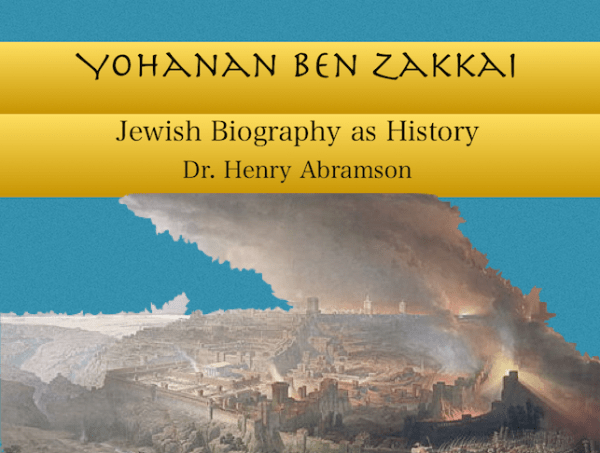
Who was Rabban Yohanan ben Zakkai? (Jewish Biography as History) Dr. Henry Abramson

real ybZ thumbnail

Rabban Yohanan ben Zakkai (d. c. 85 ce) was one of the most influential figures in ancient Jewish history. Emerging from the ruins of the destroyed Temple, Rabban Yohanan ben Zakkai led the Jewish people through the dangerous first years after the devastation of the last remnants of their state by the Romans. A disciple of Hillel, he was of the “national-realist” school that favored tactical surrender to the overwhelming power of the Roman Empire. In his most famous act, he arranged to fake his own death in order to escape his enemies among the Zealots to negotiate a peace treaty with Vespasian, who would later become Emperor. “Give me Yavneh and its scholars,” asked Rabban Yohanan ben Zakkai, setting in place the foundation for the existence of Judaism after the Temple could no longer serve as the center of Jewish religious life. Part of the Jewish Biography as History series available at http://www.jewishhistorylectures.com.

Medieval Antisemitism (Essential Lectures in Jewish History) Dr. Henry Abramson

Depiction of Host Desecration in Sternberg, Germany (1492). Diebold Schilling the Younger [Public domain], via Wikimedia Commons
Concise video lecture describing the four main expressions of antisemitic ideology in the medieval period.  Warning: images are disturbing.


Breaking the history of antisemitism into four major periods (Ancient Xenophobia, Early Christian Anti-Judaism, Medieval Jew-hatred, and Modern Antisemitism), Dr. Abramson focusses on the third period to look at the ideological basis for the false charges of ritual murder, blood libel, and desecration of the host, ending with a discussion of the Judensau image.

Jews in the Medieval Economy (Essential Lectures in Jewish History)

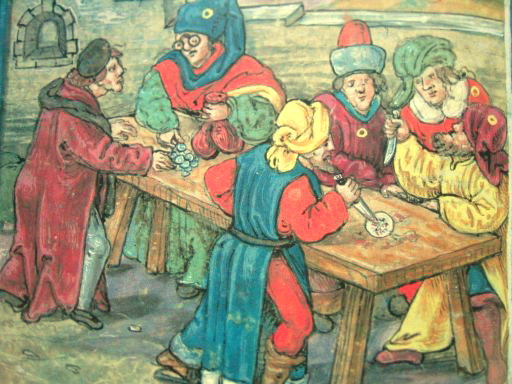
Jewish Man in Worms, Germany, 16th c. Source: Wikimedia Commons.

An introductory lecture on the role of Jews in the medieval economy. Part of the Essential Lectures in Jewish History series.

Free Download of The Kabbalah of Forgiveness (Expires October 19, 2014)

kof cover DMA_Fotor


Please visit https://www.smashwords.com/books/view/464044 and enter coupon code YT52E (Expires October 19, 2014).

Please click here for excepts and supporting videos.


Rabbi Samson Raphael Hirsch (This Week in Jewish History)

Rabbi Samson Raphael Hirsch via Wikimedia Commons

Rabbi Samson Raphael Hirsch (1808-1888) articulated a strategy to allow Jews their traditional observances while participating actively in the modern world.  Criticized from both the left and the right, his thought remains highly influential into the 21st century.

Rabbi Hayim of Volozhin (This Week in Jewish History)

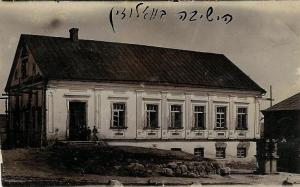
The Yeshiva of Volozhin via Wikimedia Commons

Founder of the famous Yeshiva of Volozhin, Rabbi Hayim ben Yitshad was one of the most influential proponents of traditional Talmudic study of the early 19th century.  The author of Nefesh haHayim, he articulated a cogent response to the growing Hasidic movement.

Nicholas Donin and the Disputation of 1240 (This Week in Jewish History)

1413-disputation (1)

In 1240 Nicholas Donin, a Jewish convert to Christianity, engaged in a public debate with his former teacher, Rabbi Yechiel of Paris. Donin charged that the Talmud was a noxious document that prevented the Jews from embracing Christianity, and brought a total of 35 distinct accusations against this ancient holy text. Ultimately, 24 carriage loads of Talmuds, representing 10,000 priceless manuscripts were burned in Paris on June 6, 1242.

Personal note to my subscribers: I was so impressed with the NCSY Learnathon that my son Alexander completed, that I decided to join on my own! Please visit http://learn.ncsy.org/learner/hmabramson/ to support this great organization that does so much for Jewish youth (and encourage me to study more Talmud)!

Create a website or blog at WordPress.com

Up ↑