Brief overview of the life and work of Abraham Zacuto, important Jewish Iberian astronomer and historian.
Now available: revised edition of The Kabbalah of Forgiveness.
Click here for more information.

Lectures in Jewish History and Thought. No hard questions, please.

Brief overview of the life and work of Abraham Zacuto, important Jewish Iberian astronomer and historian.
Now available: revised edition of The Kabbalah of Forgiveness.
Click here for more information.


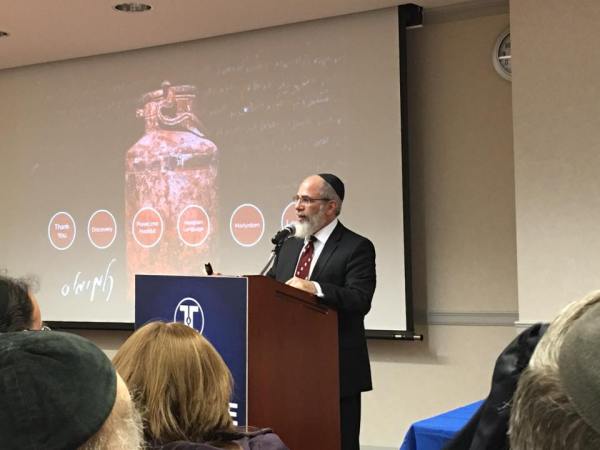
Aish Kodesh scholar Daniel Reiser holding a copy of my new book. Like Shakespeare holding a copy of one’s sonnets. Thank you!
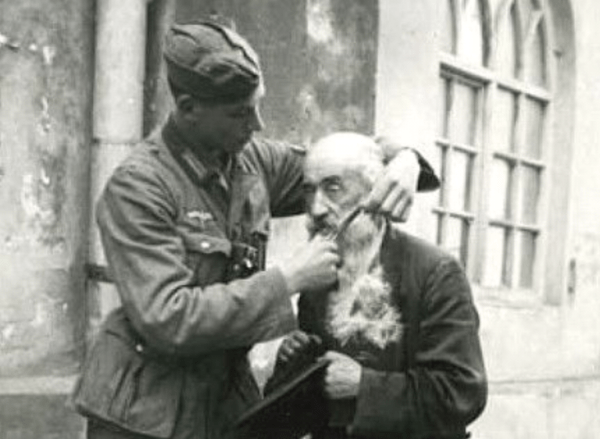
The Piaseczno Rebbe, Rabbi Kalonymus Kalmish Shapira, refused to dignify the Nazis by naming them in his wartime sermons in the Warsaw Ghetto. In a rare moment of transparency, perhaps motivated by anguish over the suffering of his Hasidim, the Rebbe briefly suspended his euphemistic terminology with a curt third-person reference in his drashah on Parashat Toledot (November 11, 1939): “they even cut off the beards of Jews.” This is the closest he will come to naming them in all of his book, Torah from the Years of Wrath, or as it is widely known, Aish Kodesh: The Holy Fire. The historical antecedent of the sermon was the Nazi practice of humiliating Warsaw Jews by forcibly shaving their beards, a brutality that occurred with regularity after the city formally capitulated and German soldiers entered on October 1. Rabbi Shimon Huberband provides personal testimony to this widespread phenomenon in the initial weeks of the occupation.
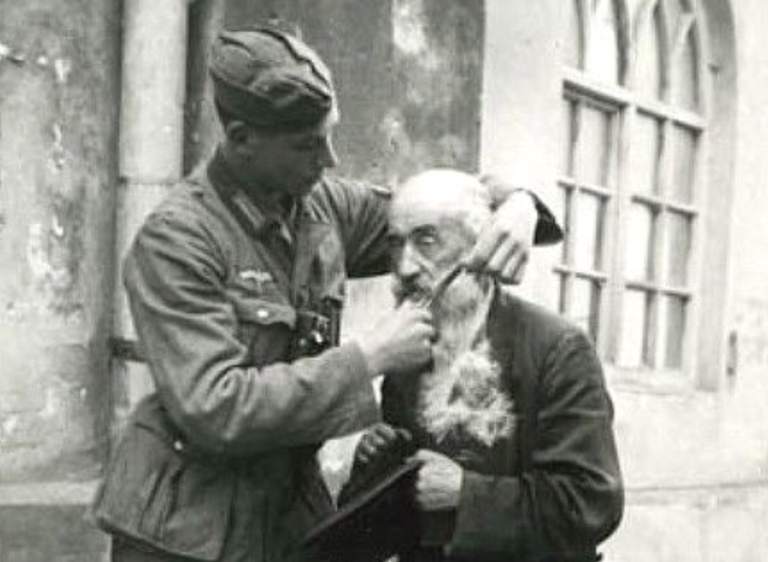
Two other Jews were seized along with us; one with a black beard, the other with a long yellowish beard. A moment later, they grabbed an elegantly dressed young lady and forced her to shear off my beard and Shtayer’s. The girl wept as she cut our hair, for the honor of the Jewish people which was being disgraced in public by the evil ones…These barbarities were done not only to grown men, but also to children with earlocks. In Praga, a group of German officers chanced upon the ten-year-old Avrom Igelnik, at the gate of 32 Brukowa Street. They took him away to their headquarters, where they set fire to his earlocks. The young boy was lucky to have been left alive.
The Rebbe’s sermon responded with a message that meditated on a verse in Isaiah (27:13):
And then they will come, those who are lost in the land of Assyria, and those who are dispersed in the land of Egypt. There are two distinct categories, the lost and the dispersed. The dispersed refers to one who is displaced to a distant locale, yet remains distinct and recognizable. This is in contradistinction to the lost—this person is lost, and is neither distinct nor recognizable. For when the hardships are presently so compounded that they even cut off the beards of Jews which make them outwardly unrecognizable—and due to unimaginable persecution and unbearable afflictions, they are no longer recognizable internally—such a person loses himself, he ceases to recognize himself. How did he feel a year ago, on the Sabbath, or on a weekday prior to prayers, or during prayers, etc.? Now he is trampled and crushed, such that he no longer senses if he is a Jew or not, or a human being or not, or an animal which has no capacity to feel. This is the nature of one who is lost, yet they will come, those who are lost.
One may imagine the impact of these words on his audience, which likely included individuals whose beards and side locks were shorn by the Nazis. Marshaling his keen psychological insight, the Rebbe empathized with the victims and affirmed the deep connection between the external markers of identity and one’s internal state: “he ceases to recognize himself.” The Rebbe concluded with a message of encouragement:
The Talmud states that the one who lost something seeks after his lost object. When he lost it, it was no longer perceptible nor recognizable, and thus the owner seeks to find it, to pick it up and bring it home. And is it not God who is the master of we who are lost? Are we not the lost possessions of God?…May the Owner of the lost return to find us…
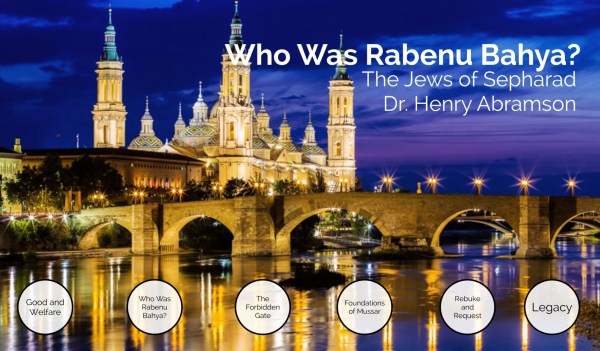
This was a huge amount of fun. If you are into Duties of the Heart, I think you will like this lecture! The video has a reference to Despacito by The Maccabeats, link provided below. Enjoy in good health!

I’m really happy that TorahAnytime.com is including my lectures, starting with The Jews of Sepharad series! Sign up for a free membership–there are some amazing speakers at TorahAnytime.com.
I was stopped on my way in to davening this morning by someone who told me about the incredible shiur that Rabbi Efrem Goldberg of Boca Raton Synagogue gave on the Aish Kodesh this week. Here’s the excerpt–Rabbi Goldberg captures the agony of the Rebbe after the loss of his family in his typically powerful manner. If you only learn one piece of Torah from the Aish Kodesh–this must be the one. Rabbi Goldberg also said some very kind things about my book, and I’m humbled by his praise. I’ve just included 10 minutes, but the entire shiur is really valuable: you can hear it all at YUTorah Online. Note also that the new critical edition he refers to is the work of Daniel Reiser, published under the title תורה משנות הזעם, two volumes.

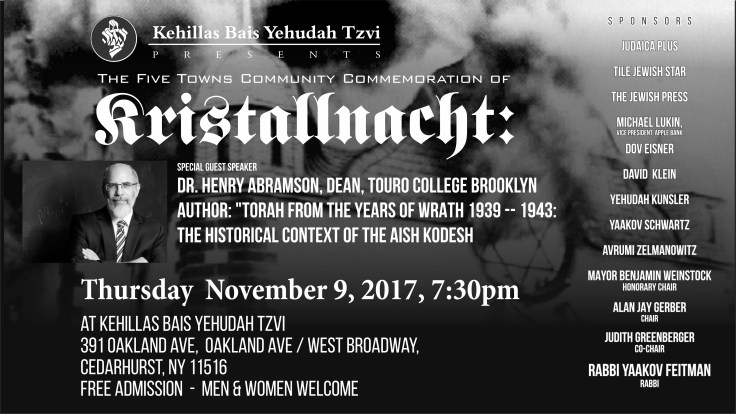
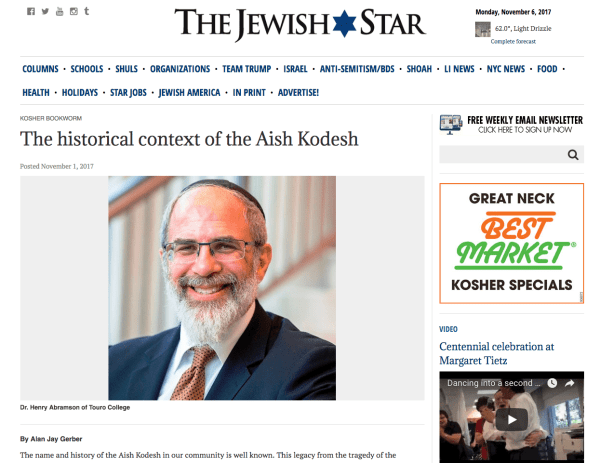

Please click here to read the review at The Jewish Star.
The name and history of the Aish Kodesh in our community is well known. This legacy from the tragedy of the Warsaw Ghetto of one of its towering leaders, Rebbi Kalonymus Kalmish Shapira, the Aish Kodesh, has been taught to us by the example of Rabbi Moshe Weinberger of Woodmere whose shul is dedicated, by name, to the Aish Kodesh.
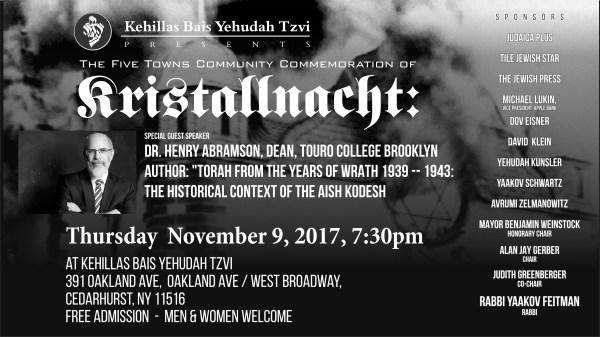
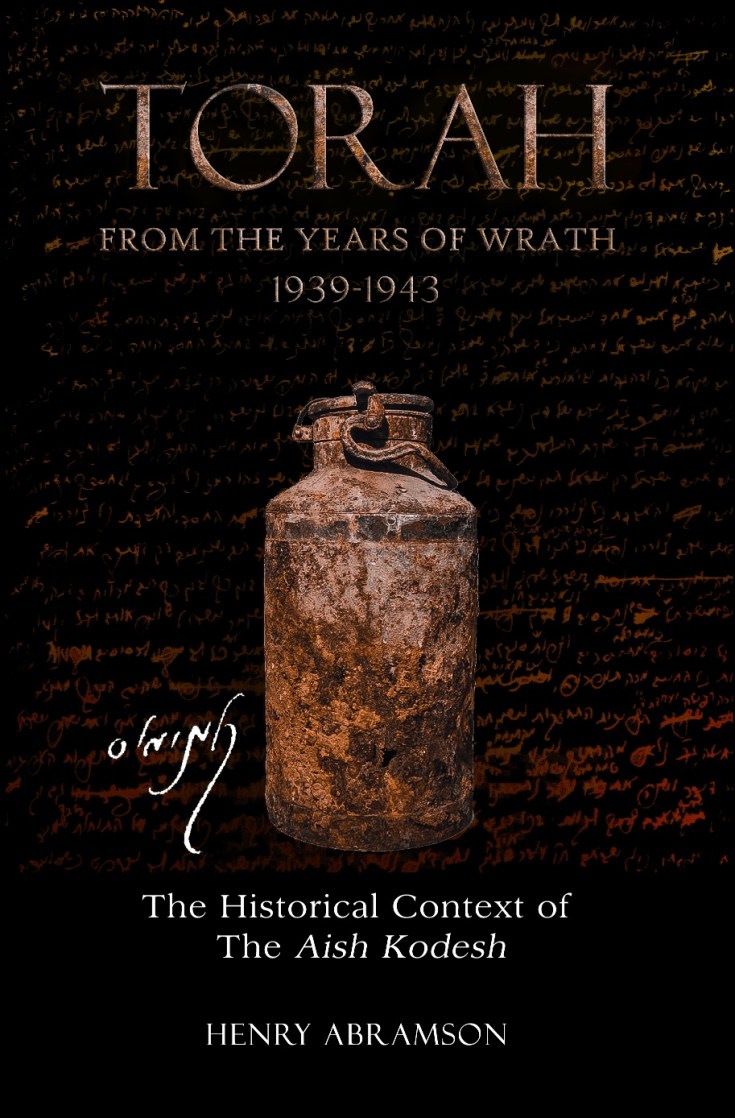
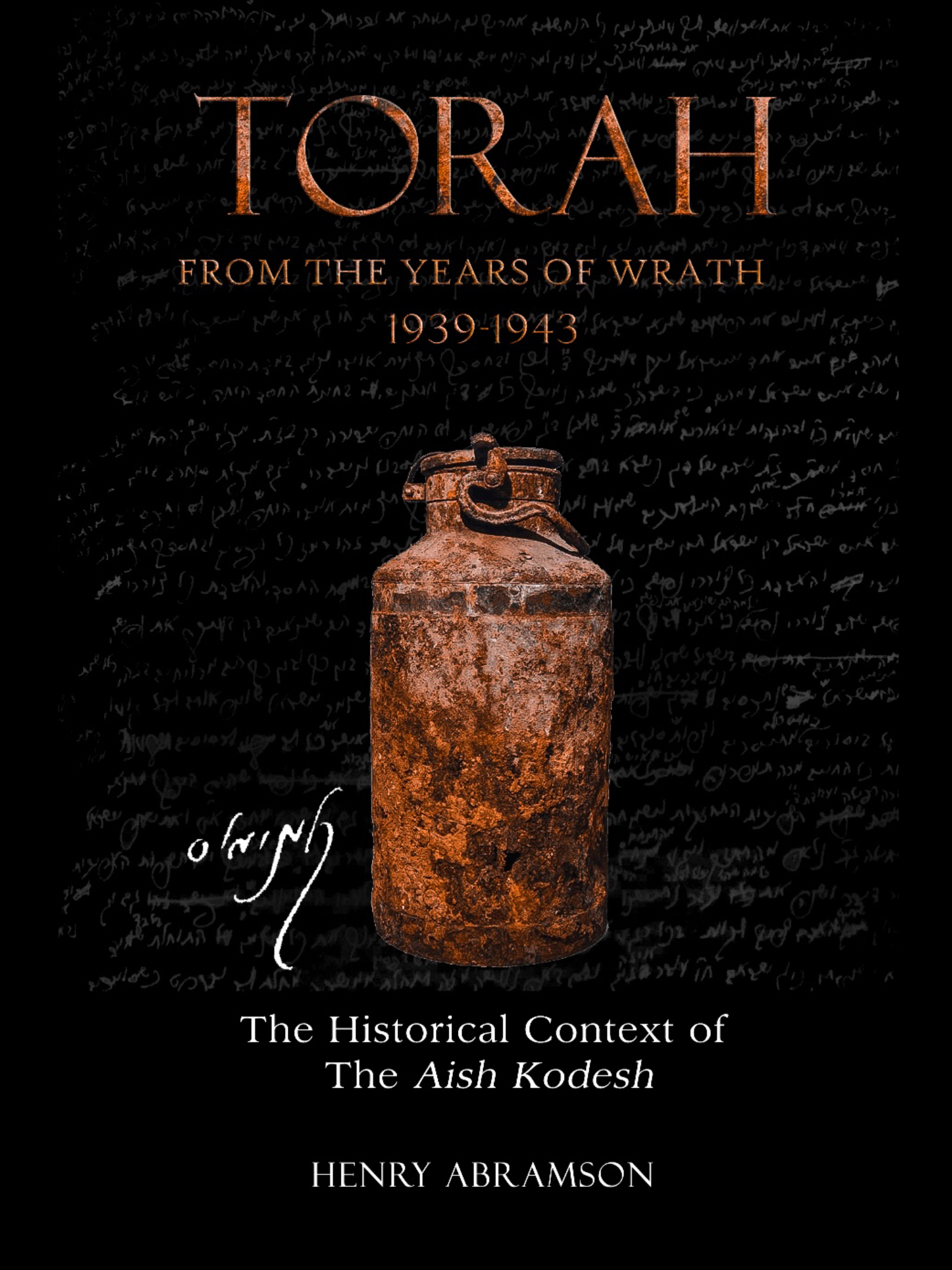
Recently a new book was published, authored by the distinguished scholar and educator, Dr. Henry Abramson, dean of the Brooklyn campus of Touro College, themed to the legacy of the Aish Kodesh, titled, “Torah From The Years Of Wrath 1939 – 1943: The Historical Context of The Aish Kodesh.”
This work receive the following approbation from Rabbi Weinberger:
“I am indebted to Professor Henry Abramson for his extraordinary study of Aish Kodesh, and his bringing to life the heart-wrenching, poetic world of the great tzaddik and martyr, Rebbi Kalonymus Kalmish Shapira of Piaseczna. May this work be a merit for him and his family and may we all be privileged to be uplifted by the teachings of one of our most inspired masters.”
The following guest review was written by Rabbi Pesach Sommer, a member of the Judaic Studies faculty at the Ramaz Middle School in Manhattan. A musmach of Rav Zalman Nechemia Goldberg, Rabbi Sommer is also much involved with project Makom, and is a writer, blogger, and an accomplished speaker. The following is his take on Dr. Abramson’s work:
“Without lifting up a gun or molotov cocktail, Rav Shapira committed some of the greatest acts of heroism of World War II.
“While experiencing much personal trauma and suffering, the rebbe managed to offer words of encouragement and hope to unknown scores of Jews, religious and irreligious, chassidim and misnagedim alike, who, like him, were trapped in the Warsaw Ghetto. Those who have read the rebbe’s words of Torah delivered on many Shabbas and holidays between the years 1939 and 1943, the written record of which miraculously survived after being buried in the ground before the ghetto was destroyed, have been inspired by his uplifting words delivered under the most trying of circumstances. Still, until recently, readers had an incomplete picture of his words.
“After being discovered in the rubble of the Warsaw Ghetto, the rebbe’s derashos were published by some of his surviving students in a work titled ‘Aish Kodesh.’ While they did their best to give over the rebbe’s words as accurately as possible, there were various typos and other errors that made it into the sefer. Recently, Dr. Daniel Reiser of the Herzog Academic College and the Tzefat Academic College published an incredible two volume critical edition of the rebbe’s derashos which is destined to be the one used by anyone interested in learning the rebbe’s wartime Torah.”
Further on in this narrative we are informed of the following: “While his divre Torah provide comfort and hope to those who are suffering, the reader is largely left unaware of the particular events which led the rebbe to say what he did each week.”
To fill this void, Dr. Abramson wrote his book to further teach us of the rebbe’s purpose and motives that brought about his holy teachings.
Rabbi Sommer continues: “After an opening chapter which provides biographical information about the rebbe from before the war, there are three chapters each of which concentrates on a year from the war, what the rebbe spoke about at that time, and which events led to the choice of topic. Through Abramson’s thorough scholarship and compelling writing, the reader’s eyes are opened as the divrei Torah are connected to the rumors which might have been going through the ghetto that week, a new policy which led to additional suffering, or the narrowing of the parameters of the Warsaw Ghetto.”
Further on we learn of the following: “The book concludes with a fifth chapter where he addresses something which has long been a point of contention among scholars. As one reads the rebbe’s words from during the war, one notices a shift in his outlook. While at the beginning of the war the rebbe seemed to see the suffering that he and his fellow Jews were experiencing as fitting within traditional explanations for earlier tragic eras, where teshuva is required, it is clear that at a certain point he recognized that the level of suffering was way beyond that which could be explained by seeing it as an extension of earlier tragedies. The rebbe no longer suggested that those who were listening to him could change things by returning to G-d. Instead, he tried to figure out how a believer should view this sui generis experience.
“While unfortunately certain academic scholars have used this change to suggest that the rebbe [G-d forbid] lost his faith, Abramson shows the absurdity of such a claim. He makes a conclusive case that while the rebbe struggled to make sense of the atrocities that the Jewish people were suffering, he remained what he had always been, a person with deep and enduring faith.”
Dr. Sommer concludes his essay:
“Dr. Abramson has written a book which is destined to lead to an increase of study of the rebbe’s Torah and thought in both the academic and Jewish world. His is a work which while maintaining high academic standards and containing ideas which will advance the field, is at once accessible to the non-scholar, and written in an engaging and compelling manner.
“Especially for the reader who is looking for a work which contains both Torah and Avodas HaShem, along with serious scholarship, I can not recommend this incredible book strongly enough.”
I cannot agree more with Rabbi Sommer’s gracious and heartfelt conclusion.



 Henry Abramson