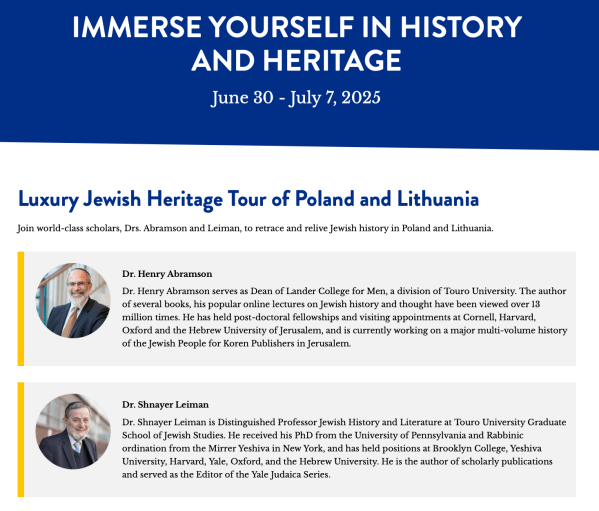
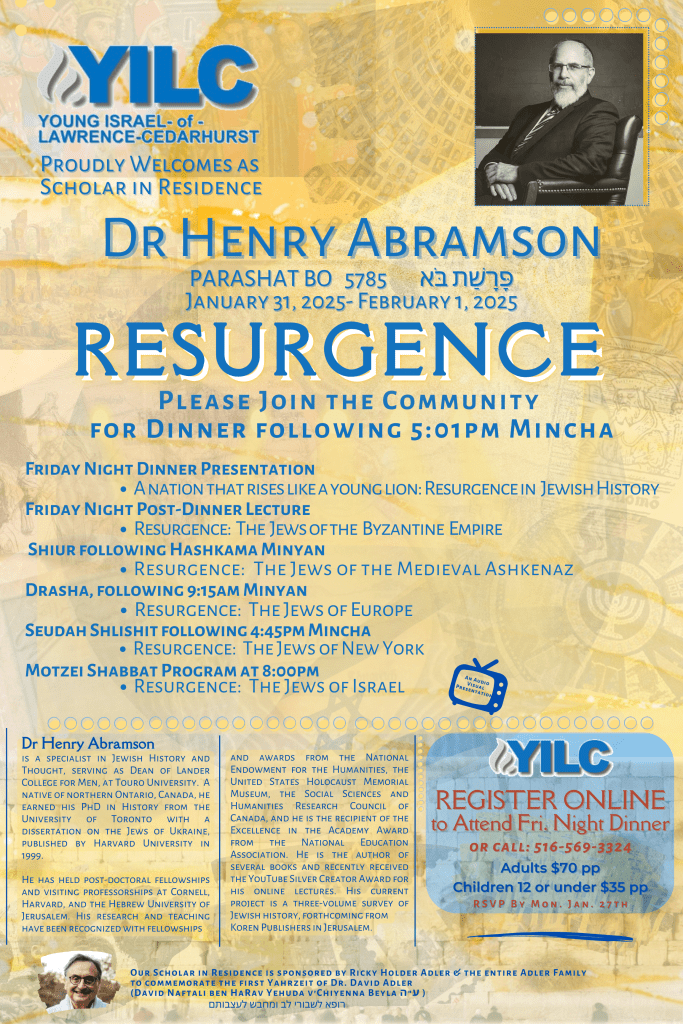
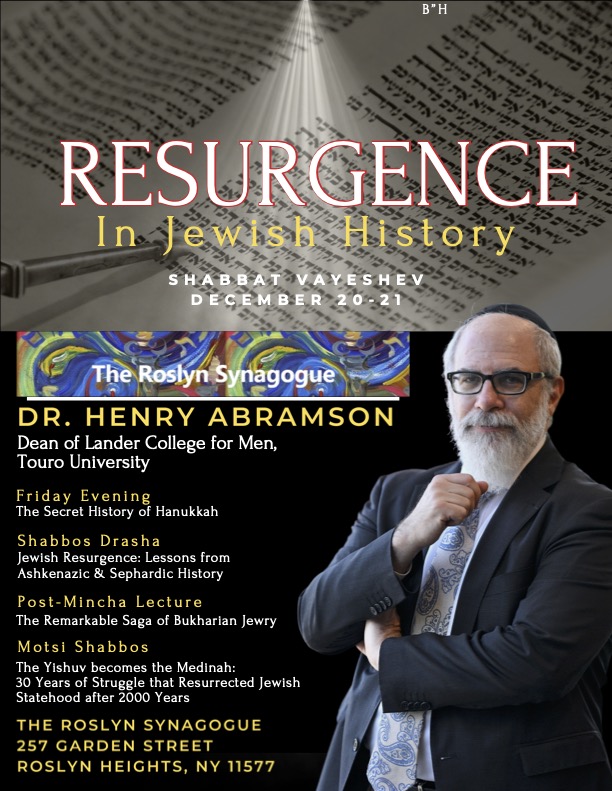
Really looking forward seeing my friends at YILC!

Lectures in Jewish History and Thought. No hard questions, please.


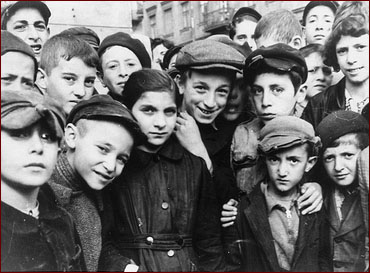
After several weeks without recording a drashah, perhaps related to the horrendous typhus outbreak of the late winter of 1941, the Rebbe delivered a series of powerful derashot for the Passover holiday. On the Seventh Day of Pesach he turned his attention to the subject of Torah learning. The memoirs of Chaim Kaplan, a former principal, describe…

Passover in the Warsaw Ghetto: Inspiration for the Second Seder Taken from Torah from the Years of Wrath (Aish Kodesh) אני מבקש ומתחנן לפני כל אחד מישראל שילמוד בספרי, ובטח זכות אבותי הקדושים זצוקלל״ה יעמוד לו ולכל ביתו בזה ובבא “I request and plead every person of Israel to study my works—surely the merit of…

Brief lecture on the life and work of Judah Touro, an important 19th-century American philanthropist for whom, together with his father Isaac, Touro College was named.

School principal Chaim Kaplan recorded the bleak mood in the Warsaw Ghetto on the eve of Passover of the Hebrew year 5701 (1941): Like the Egyptian Passover, the Passover of Germany will be celebrated for generations. The chaotic oppression of every day throughout this year of suffering will be reflected in the days of the…

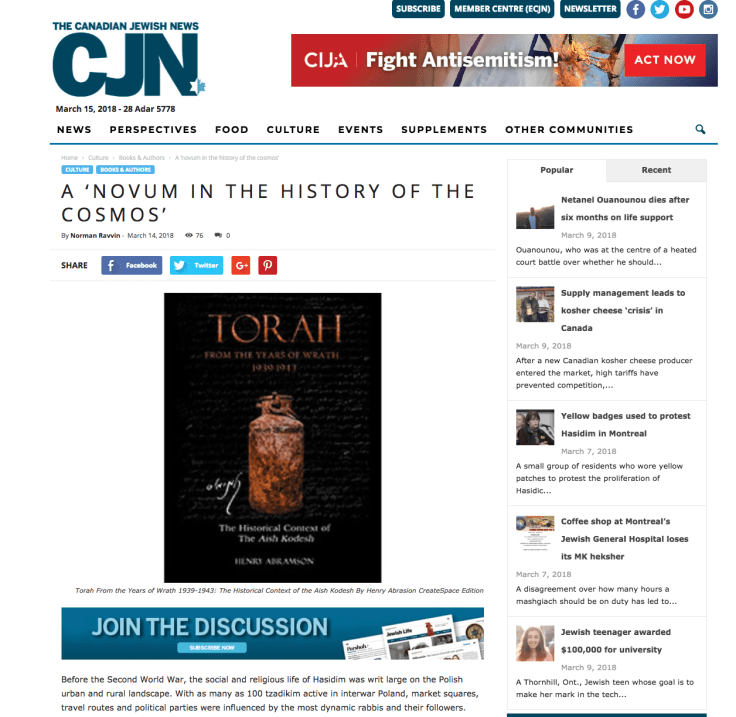
Really nice to see that readers in my native Canada are encountering the Piaseczno Rebbe: Here’s a new review by Dr. Norman Ravvin, appearing in the current Canadian Jewish News. Note to my dear readers: the book is in Judaica stores, on Amazon and Kindle, but my favorite (and the best value) is the beautiful…

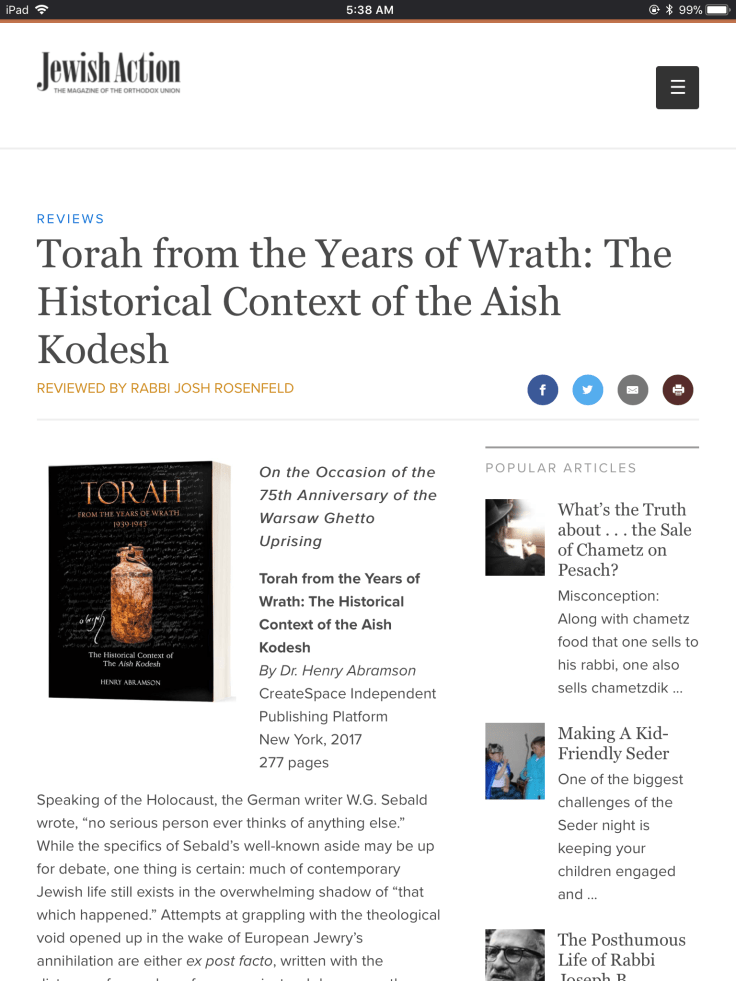
I’m grateful to Rabbi Josh Rosenfeld for his kind and thoughtful review of Torah from the Years of Wrath, which appeared in this month’s Jewish Action. Please click here to read his thoughts on the work of the Piaseczno Rebbe.

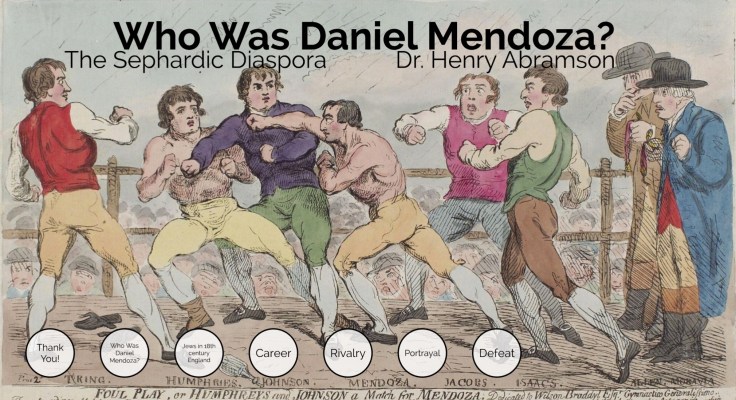
Brief lecture on the life and times of Daniel Mendoza, a Sephardic Jewish champion boxer of the 18th and early 19th century.

In early February 1940 the Nazis promulgated decrees that prohibited Jews from benefitting from general community charity services. Ration cards were distributed with racial distinctions: Jews received cards with a Star of David marked on them, while Poles and Germans received colored, otherwise unmarked cards. At this early date in the war, hunger did not…

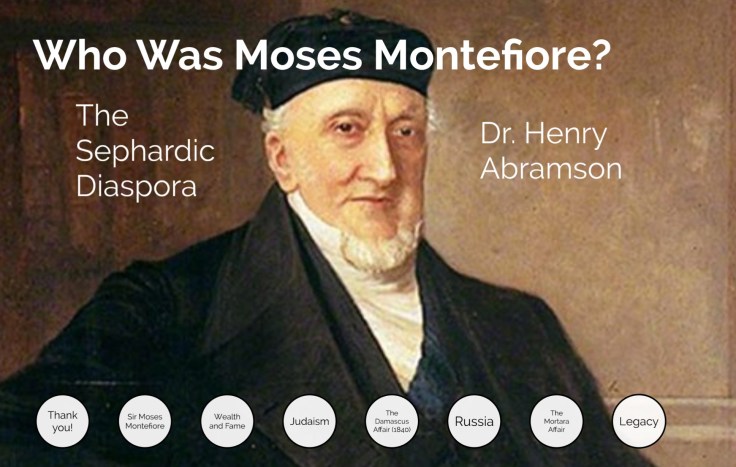
Brief presentation on the life and works of Sir Moses Montefiore, an important 19th century Sephardic English philanthropist. Part of the Sephardic Diaspora series.

“Faith is not an argument. It is a conversation, in which we listen, accept the premises of the interaction, make active choices and contributions, shift our direction as necessary based on the cues we hear, and most importantly, keep the conversation alive and active…Abramson’s work allows us to eavesdrop on one of the most powerful…

I am grateful for this thorough and kind review of the recent Ukrainian translation of “Ukrainians and Jews in Revolutionary Times” by Oleksandr Zinchenko, published in today’s Istorichna Pravda. If you don’t read Ukrainian (and refuse to read Google translate, which is close enough to the original to be seriously misleading), the revised English edition…

Brief presentation of the life and work of Rabbi Chaim Yosef David Azoulay, a fascinating Sephardic Rabbi of the 18th century. Part Three of The Sephardic Diaspora series.


This is a new experiment, suggested by Elya at TorahCafe.com: a weekly, 3-minute “This Week in Jewish History” mini-lecture. I’m trying it out, let me know what you think! Please click here for the refined, edited version from TorahCafe.com.

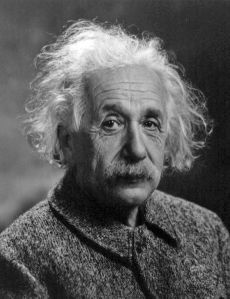
Here’s a new version of the Albert Einstein lecture, edited by the wonderful people at TorahCafe.com to include the PowerPoint. It’s basically the same, except without the lame jokes. Click on the icon below to watch the video.

This is a lecture I delivered at the University of Central Florida back in October 2004 (my hair was quite a bit darker and, well, there). Found the CD when I was cleaning out some old files. There’s a PPT that goes with this lecture, and I’m going to try to find a way to…

A presentation on the life and work of Rabbi Menachem Mendel Schneerson (1902-1994), the Seventh Rebbe of the Chabad-Lubavitch movement. A native of Nikolaev, Ukraine, and educated in Germany and France, his leadership transformed his Hasidic followers into an international movement that continues to shape the lives of Jews world wide. The lecture was held…

A presentation on the life and work of Betty Friedan, a prominent American Jewish feminist leader. The author of the landmark The Feminine Mystique (1963), she later became the Founder of the National Organization of Women, and an important political activist for women’s rights. The lecture was held at the Young Israel of Bal Harbour on May 29,…

A presentation on Albert Einstein (1879-1955), one of the best-known Jews of the twentieth century. Although he had a complicated relationship with Judaism, he maintained a distinct pride in his Jewish identity, and once said “A Jew who abandons his Judaism is like a snail that abandons its shell. It’s still a snail.” The lecture…

An excerpt from The Kabbalah of Forgiveness: A Reader’s Guide to Rabbi Moshe Cordovero’s The Palm Tree of Devorah, a new translation and commentary on the 16th-century classic of Kabbalistic musar, is now available online. Anticipated publication date is August 2013. The Palm Tree of Devorah first appeared in 1588 and became and instant classic.…

A presentation on the life and work of Stephen Samuel Wise (1874-1949), an important American communal leader. The lecture will take a broader focus, looking at the history of Jewish settlement in the United States during the 19th century and the major issues facing this immigrant community through the middle of the twentieth century. The…

A study of the life of Menachem Begin (1913-1992). A native of Poland, he was a proponent of Vladimir Jabotinsky’s Revisionist party that stood in dramatic contrast to the dominant left-wing tendency in the Zionist movement. A major figure in Israel’s struggle for statehood, and a founder of the Likud party, he was elected to…

This lecture presents a broad overview of the three main intellectual-religious trends present in 19th century Jewish Eastern Europe: the traditionalist Mitnagdim, the innovative Hasidim, and the modernizing Maskilim. Good as an overall introduction, although I go into more detail on all of these movements in other lectures on this website. Taped on April 21,…