Who Was Hillel Ba’al Shem?

A mysterious figure of the early 18th century whose work, recently discovered by Dr. Yohanan Petrovsky-Stern, sheds light on the world of popular culture from which Hasidism emerged.


Click here for the Prezi associated with this lecture.

This article originally appeared in the Five Towns Jewish Times on March 3, 2016.

By Dr. Henry Abramson

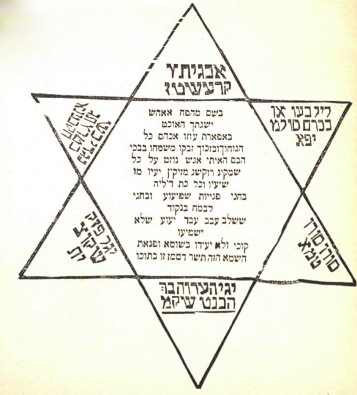
Working in the abandoned Judaica collection of the Kiev Vernadsky Library during the immediate post-Soviet period, a brilliant young Jewish historian named Yohanan Petrovsky-Shtern discovered a rare 300-year-old manuscript. Ignored by Communist scholars for a century, the well-thumbed, 760-page manuscript, bound in leather with a wooden cover and copper breastplate, was not catalogued in any of the collections of the library. Its unusual Ashkenazic script and numerous drawings of complex Kabbalistic symbols fascinated Petrovsky-Shtern, who was on a personal journey to rediscover his ancestral faith. What was this mysterious, one-of-a-kind book?

After nine years of extensive research that took him to archives around the world, Dr. Petrovsky-Shtern published the answer. Sefer HaCheshek was a rare, secret guide to practical Kabbalah, written when Rabbi Israel ben Eliezer, the founder of the Chassidic movement, was just beginning to deliver his revolutionary teachings. The author’s name itself sheds light on the significance of the text. Hillel styled himself as a Ba’al Shem, literally Master of the Name [of G‑d], a term used to describe itinerant amulet-makers who typically sold their services to simple Jews seeking Kabbalistic remedies for their problems. Shaman-like, these frequently unlearned and often unscrupulous individuals traveled from shtetl to shtetl, performing exorcisms, treating various ailments, and writing amulets for a wide variety of purposes: health, prosperity, marriage, children. Rabbi Israel ben Eliezer, by contrast, was known as the Ba’al Shem Tov, the “Good” Master of the Name, because his work was of an entirely different order.

The Sefer HaCheshek contains both extensive instruction in Kabbalistic healing and a surprising degree of autobiographical information. Dr. Petrovsky-Shtern, now a distinguished historian at Northwestern University in Chicago, argues convincingly that the manuscript was written as a type of curriculum vitae, as Hillel wished to end his peripatetic existence and secure a permanent position, preferably in Germany. Sefer HaCheshek was intended as a demonstration of his experience and expertise, having apprenticed to both medical doctors and reputable Kabbalists. Whether or not he received the position—an honor that was bestowed on his contemporary, the Ba’al Shem Tov, in the Ukrainian town of Medzhybizh—is unknown. Nevertheless, Hillel Ba’al Shem’s description of his prior experiences (especially a dramatic exorcism in Ostrah) illustrates the state of popular religious practice in pre-Beshtian Eastern Europe, and provides a vivid backdrop for the emergence of Chassidism.

Why did Chassidism flourish, and the populist, theurgic Kabbalah of Hillel and other ba’aleiShem decline? Dr. Petrovsky-Shtern provides a salient analysis by identifying what was absent in Sefer HaCheshek. Despite its encyclopedic coverage of remedies for every possible physical, psychological, romantic, and economic malady, Hillel Ba’al Shem delivers no message of universal human redemption. Unlike the Ba’al Shem Tov, whose teachings emphasized human potential and the value of community, Hillel relies on magical one-time fixes, not personal spiritual growth. To the crestfallen he offers no counsel; to the bereft, no benefit. The terminology employed in his work is similar—Hillel refers to Kabbalistic disciples as chassidim, for example—but the contrast between the numerous but forgotten Ba’alei Shem and the magnificent Chassidic world founded by the Ba’al Shem Tov could not be more profound.

Tanya: People of the Book

People Of The Book:

Classic Works Of The Jewish Tradition

By Dr. Henry Abramson

This article appeared in the February 25, 2016 edition of the Five Towns Jewish Times.

The appearance of Rabbi Schneur Zalman of Liadi’s Tanya at the turn of the 19th century represented a sea change in Eastern European Jewish history. With this work, the Chassidic revolution, which had been building momentum in western Ukraine and southern Poland, burst into a constituency that had until that point prided itself on its immunity to the Kabbalah-inspired populism of the Ba’al Shem Tov.

The publication of Tanya dramatically illustrated the profound intellectual foundations of Chassidic thought, placing it in direct competition with the traditional Talmudic community in Lithuania for the hearts and minds of spiritually sensitive Jews. The Lithuanian yeshiva community, centered around Rabbi Chaim of Volozhin, principal disciple of the recently deceased Vilna Gaon, could no longer dismiss the chassidim as superstitious, uneducated folk (or worse, as neo-Sabbatean heretics).

The Tanya placed Chassidism firmly within the Jewish literary tradition, articulating a fully documented path to holiness that had until then received little attention from more left-brained Talmudic thinkers.

The book itself was published in several stages, some posthumously, until it reached its current form in 1804. It begins with the modestly titled LekuteiAmarim (“Collected Statements”), which is a bold and psychologically gripping analysis of the human condition. Opening with the Talmudic passage that describes the angelic oath given to a person in utero (“be righteous and not wicked”), Tanya offers a remarkably original and persuasive description of the inner conflict of the soul as it encounters the challenges and temptations of the temporal world.

The title “Tanya,” literally “it is taught,” is taken from the opening line of this Talmudic citation. The remaining four sections of the work continue the discussion in several modalities, including a novel understanding of the meaning of repentance and deeper Kabbalistic insights on the nature of the soul. Overall, the work is deceptively complex, with sections that appear highly accessible while others hint to arcane, elusive depths.

The Tanya is known as the “Written Torah of Chassidism” because it represents the first work authored directly by a Chassidic master (previous works were collections of teachings published by various disciples). Rabbi Schneur Zalman is recognized as the first Rebbe of the Chabad movement, but the influence of his work reaches into every Chassidic dynasty and is regarded with great respect by non-Chassidic thinkers as well.

Tanya proved itself highly popular in the yeshiva world, much to the chagrin of traditional authorities, who could barely keep Talmudic students away from its intoxicating introduction of Kabbalistic concepts to pragmatic elements of the Jewish condition. In response, Rabbi Chaim of Volozhin composed his master work, Nefesh HaChaim (1824), a Lithuanian-style primer in Kabbalah that provided an alternative to students attracted to the rapidly expanding Chassidic movement.

For its part, Chabad embraced Tanya by instituting a daily study regimen to promote yearly completion of the entire work. Tanya remains a brilliant gem in the treasure of Jewish spirituality.

Dr. Henry Abramson is a specialist in Jewish History and Thought. He serves as dean at the Avenue J Campus of Touro’s Lander Colleges and may be reached at abramson@touro.edu.

March 2016 Lectures: Jews of the 18th Century

Jewish History @ Avenue J

A Community Project of the Lander College of Arts and Sciences

1602 Avenue J

Monday Nights, 7-8pm

Free and Open to the Community

Lectures by Dean Henry Abramson

No hard questions, please.

March 7: R. Pinhas Hurwitz

Author of the influential Sefer Ha-Brit, the work of Rabbi Hurwitz represented the growing influence of modern science in Jewish thought.

March 14. R. Moshe Hagiz

An aggressive opponent of Sabbateanism, Rabbi Hagiz was a staunch defender of Jewish tradition.

March 21. R. Jacob Emden 

Known equally for his Talmudic brilliance and polemic nature, Rabbi Emden’s life illustrates the trials and tribulations of Jewish communal leadership. 

March 28. R. David Sinzheim 

Appointed to Napoleon’s controversial Grand Sanhedrin, Rabbi Sinzheim articulated a modus vivendi for Jews in the political awakenings of the late 18th century. 

Photo: the amazing Yaakov Naumi/Flash 90.

Screen Shot 2015-07-28 at 1.17.28 PM

Who Was Sarah, Wife of Shabbetai Tsvi?

Orphaned by the Eastern European pogroms of 1648-49, the volatile Sarah became the spouse of the infamous messianic pretender. Her life, filled with controversy, illustrates the egalitarian elements in Shabbetai Tsvi’s antinomian message.


Here is a link to the Prezi.

Sarra Copia Sulem’s Manifesto

Sarra Copia Sulam’s Manifesto

People of the Book: Great Works of the Jewish Tradition

Dr. Henry Abramson

This article appeared in the February 17, 2016 edition of the Five Towns Jewish Times. 

An unlikely literary duel in Venice took an unexpected turn in 1621 with the appearance of a slim volume entitled “The Manifesto of Sarra Copia Sulam the Jewess, Who Therein Refutes and Reproves Signor Baldassare Bonifacio’s False Accusation that She Denies the Immortality of the Soul.” In concise, even blunt language, the young socialite took arms against a Catholic priest and philosopher who had written a direct attack on her religious beliefs under the title “On the Immortality of the Soul: A Discourse by Baldassare Bonifaccio for Signora Sarra Copia.” This was no mere pamphlet:  charging a Jew with nonbelief in a central article of faith could draw the unwanted attention of the Inquisition, with deadly results. Bonifaccio, however, had no idea who he was dealing with. Young Sarra’s direct and unequivocal response was the first example of a Jewish woman defending her faith in print in early modern Europe.

The roots of the confrontation went back several years, when Sulam began a correspondence with the respected Genoese author Ansaldo Ceba. Deeply impressed with his epic poem on the life of Queen Esther, Sulam gushed that she even slept with the poem on her pillow, such that it might be the first thing she sees upon waking. Ceba, some thirty years her senior and now retired to a monastery, was flattered by her exuberant praise, and resolved to persuade her to convert to Christianity. In a flurry of letters that extended over several years, Ceba directed every literary device to this goal, without success. In a final act of attempted proselytism months before his death, he published all his letters to Sulam in a single volume. Her letters, unfortunately, were not included.

Awareness of Ceba’s pet project to convert this perspicacious young Jewess was well known in Venetian literary circles, motivating a Priest (later Bishop) Baldassare Bonifacio to force her baptism through more aggressive means, thinking that his public attack on her personal Judaism might pressure her to accept Christianity. When news of the publication reached Sulam, she wrote her impassioned defense in two short days and rushed it into print before Bonifacio’s broadside could have any impact: the narrative shifted from Sulam’s intransigence to her brilliant “smack-down” of a meddling interloper. Brilliantly, she dedicated the Manifesto to her late father, pointedly asking Bonifacio how she could do so if she truly believed that the soul of her father was no more? She had no compunction against defending herself with an aggressive counter-attack.

Sulam’s Manifesto did not break new ground philosophically, but it stands alone as an unique statement of a Jewish woman’s voice in early 17th century Venice. Taking advantage of the relatively new technology of printing, Sarra Copia Sulam fearlessly defended her faith from senior Church officials, leaving her mark in Jewish literary history.


NO CLASS THIS MONDAY! PRESIDENTS’ DAY

.
Photo: Yaakov Naumi/Flash 90

Feb 22. Sarah, wife of Shabbetai Tsvi
Orphaned by the Eastern European pogroms of 1649-49, the volatile Sarah became the spouse of the infamous messianic pretender.

Feb 29. Hillel Ba’al Shem
A mysterious figure of the late 17th and early 18th centuries whose recently discovered work sheds light on the world of popular culture from which Hasidism emerged.


JEWISH HISTORY @ AVENUE J
A COMMUNITY PROJECT OF THE LANDER COLLEGE OF ARTS AND SCIENCES

1602 Avenue J
Monday Nights, 7-8pm
Free and Open to the Community
Lectures by Dean Henry Abramson
No hard questions, please.


The Tzemach David

Abramson-Ganz
Note the goose emerging from the Star of David on the tombstone of David Gans (1541-1613)

The Tzemach David

People Of The Book:  Classic Works Of The Jewish Tradition

(This article originally appeared in the Five Towns Jewish Times on February 11, 2016.)

David Gans (1541–1613) was a scientist and a rabbi in an age when the dual pursuit of these intellectual passions was a life-threatening occupation. He studied Torah under Rabbi Moshe Isserles in Cracow and the Maharal of Prague, and his expertise in astronomy was so formidable that he collaborated with Johannes Kepler and Tycho Brahe.

Rabbi Gans made a signal contribution to this field by translating the Alphonsine tables from Hebrew into German. Originally compiled in 1252 by a commission of Jewish and Muslim scholars for King Alphonso X, the Wise of Spain, these navigational charts were essential to the seafaring nation, and Jewish astronomers had been updating them for centuries in Hebrew. (Columbus relied on the version prepared by Joseph Vecinho, one of many Jewish contributions to the discovery of the New World.)

Despite the obvious advantages of the emerging scientific wisdom of the era, the Catholic Church reacted with a terrifying fanaticism, burning Converso Jews and Christian scientists alike for suggesting that the earth revolved around the sun. Even the supposedly more moderate Protestant Church arrested Kepler’s aged mother and tried her as a witch.

The work of David Gans, by contrast, illustrates the scope of academic freedom in the Jewish world. Following Maimonides, the bulk of Jewish thinkers favored the establishment Ptolemaic vision of a flat earth surrounded on all sides by water, with a heavenly parade of celestial orbs circling this stable center. Scattered early references to the spherical shape of the world, however, were increasingly confirmed by the age of exploration, including the remarkably prescient passage in the Zohar III 10a: “The earth is round as a globe . . . Revolutions make it daytime in one half and night in the other . . . There are places where it is perpetually light and places where it is perpetually dark.” Gans did not completely accept all the implications of the new Copernican, heliocentric model, but he engaged fully in the intellectual commerce of the late 16th and early 17th centuries with a refreshing open-mindedness tempered by traditional learning.

His most important contribution to Jewish studies is the highly original Tzemach David (“Shoot of David,” 1592). As fascinated by history as he was by science, he composed a one-volume history of the world, divided into two parts. The first explored the history of the Jews from Adam to the late 16th century, relying heavily on the limited historical studies produced till then, such as the ancient work of Josephus and the medieval Hebrew version, Yosippon. The second and larger section is a survey of world history, using secular calendars. Interestingly, he defends his work as appropriate Sabbath reading, relying on the ruling of his early master the Rema in Orach Chaim 307:1.

By modern standards, Tzemach David is more of a chronicle than a history, with the events presented simply in linear, chronological format with limited interpretive content. The bifurcation of Jewish and secular history is reflective of a Jewish Weltanschauung common even today: Jews move in history, but are not of history, a view that modern historians consider as retrograde as Ptolemaic astronomy. Nevertheless, Tzemach David is a pioneering work, especially valuable for the study of Ashkenazic Jewish history.

David Gans is also known for his popularization of the six-pointed Star of David, a symbol first associated with the Jews of Prague some 100 years prior. (The legends that the Magen David decorated the shields of King David’s troops have no literary basis.) Gans saw in the star, with its repeating symmetries of two overlapping equilateral triangles, a symbol for the mathematical perfection of G‑d’s universe. His gravestone in Prague is thus proudly adorned with a Magen David, surmounted by a line drawing of a goose: his family name in Hebrew was Avuz, translated into German as Gans (goose).

This article originally appeared in the Five Towns Jewish Times on February 11, 2016.

Who Was Sarra Copia Sulem?

When Sarra, a bright young poetry lover of 17th century Venice, wrote to a senior literary figure, she thought she was merely expressing her admiration for his literary work.  In the end, she was forced to defend publicly her refusal to leave Judaism.

Click here for the Prezi. 

Sarra Copia Sulam’s Manifesto

People of the Book: Great Works of the Jewish Tradition

Dr. Henry Abramson

This article appeared in the February 17, 2016 edition of the Five Towns Jewish Times. 

An unlikely literary duel in Venice took an unexpected turn in 1621 with the appearance of a slim volume entitled “The Manifesto of Sarra Copia Sulam the Jewess, Who Therein Refutes and Reproves Signor Baldassare Bonifacio’s False Accusation that She Denies the Immortality of the Soul.” In concise, even blunt language, the young socialite took arms against a Catholic priest and philosopher who had written a direct attack on her religious beliefs under the title “On the Immortality of the Soul: A Discourse by Baldassare Bonifaccio for Signora Sarra Copia.” This was no mere pamphlet:  charging a Jew with nonbelief in a central article of faith could draw the unwanted attention of the Inquisition, with deadly results. Bonifaccio, however, had no idea who he was dealing with. Young Sarra’s direct and unequivocal response was the first example of a Jewish woman defending her faith in print in early modern Europe.

The roots of the confrontation went back several years, when Sulam began a correspondence with the respected Genoese author Ansaldo Ceba. Deeply impressed with his epic poem on the life of Queen Esther, Sulam gushed that she even slept with the poem on her pillow, such that it might be the first thing she sees upon waking. Ceba, some thirty years her senior and now retired to a monastery, was flattered by her exuberant praise, and resolved to persuade her to convert to Christianity. In a flurry of letters that extended over several years, Ceba directed every literary device to this goal, without success. In a final act of attempted proselytism months before his death, he published all his letters to Sulam in a single volume. Her letters, unfortunately, were not included.

Awareness of Ceba’s pet project to convert this perspicacious young Jewess was well known in Venetian literary circles, motivating a Priest (later Bishop) Baldassare Bonifacio to force her baptism through more aggressive means, thinking that his public attack on her personal Judaism might pressure her to accept Christianity. When news of the publication reached Sulam, she wrote her impassioned defense in two short days and rushed it into print before Bonifacio’s broadside could have any impact: the narrative shifted from Sulam’s intransigence to her brilliant “smack-down” of a meddling interloper. Brilliantly, she dedicated the Manifesto to her late father, pointedly asking Bonifacio how she could do so if she truly believed that the soul of her father was no more? She had no compunction against defending herself with an aggressive counter-attack.

Sulam’s Manifesto did not break new ground philosophically, but it stands alone as an unique statement of a Jewish woman’s voice in early 17th century Venice. Taking advantage of the relatively new technology of printing, Sarra Copia Sulam fearlessly defended her faith from senior Church officials, leaving her mark in Jewish literary history.

Encyclopedia of Jewish Medical Ethics

People Of The Book: Classic Works Of The Jewish Tradition

By Dr. Henry Abramson

Few books demonstrate the enduring value of halachah as Dr. Avraham Steinberg’s monumental Encyclopedia of Jewish Medical Ethics. We live in an age when the most elemental aspects of the human condition are subject to unprecedented manipulation, with everything from the moment of conception to the last embers of consciousness open to revision and consideration. The headlong pace of scientific discovery threatens to overwhelm our basic humanity, radically redefining concepts like “alive,” “male and female,” and “parenthood.” Dr. Steinberg’s magnum opus, the first of its kind, restores a center of gravity to our medical universe and affords health practitioners firm ground for the innumerable moral calculations occasioned by modern medicine.

The six-volume Hebrew-language original was completed in 1989 with approbation from leading halachic authorities. Dr. Steinberg, a physician with extensive rabbinic training and military experience, surveyed the vast scope of medical challenges considered by Jewish law since ancient times and rendered them in alphabetical format, facilitating rapid consultation for doctors seeking immediate guidance on life-and-death issues. The Encyclopedia earned immediate acclaim for its erudition, comprehensive approach, and scholarly objectivity. The volumes were ably translated into a fluid English by Dr. Fred Rosner, a well-known and prolific author in the field, making Jewish thought accessible to a wider audience of non-Jewish bioethicists. This is especially significant, as Dr. Steinberg points out: “Judaism is unique among modern ethical systems in that it constitutes a continuum of recorded deliberations and decisions dating back several millennia. It combines deontological principals with casuistic analysis of an enormous variety of cases.” The Encyclopedia earned the author the prestigious Israel Prize for its contributions to scholarly literature.

The book is written for intelligent non-specialists. Each entry begins with relevant definitions, followed by a historical introduction to debate on the issue (often taking an impressively broad cross-cultural approach), and the scientific background. This is followed by a survey of the relevant Jewish texts, and a detailed analysis of specific applications, heavily reliant on modern responsa literature. Some entries include a discussion of the implications of secular law. The first entry of the Encyclopedia is “Abortion and Miscarriage,” for example, and over the course of 29 double-column pages Dr. Steinberg impressively relates the halachic material cataloging and documenting the approach of rabbis since the first appearance of the issue in the book of Exodus, the implications of the various abortifacient methods and situational variables, and also placing Jewish thought within the non-Jewish works, including modern American law. The reader is left with a concise, comprehensive yet comprehensible understanding of the major approaches of the Jewish legal tradition to this complex issue.

Understandably, a book of this nature is doomed to at least partial obsolescence almost as soon as it appears in print because medical technology evolves so rapidly. The book contains remarkably little discussion of pre-implantation genetic screening, for example, and elective gender reassignment deserves greater attention. Nevertheless, it remains a remarkable feat of scholarship, and may be considered cover-to-cover reading by anyone interested in Jewish medical ethics.

Henry Abramson is a specialist in Jewish history and thought, serving as dean at the Avenue J campus of Touro College. He may be reached at henry.abramson@touro.edu.

This article originally appeared in the Five Towns Jewish Times, February 4, 2016.

Who Was Rabbi David Gans?

David Gans (1541-1613) was a Rabbinic scholar, historian, and astronomer.  A student of Rabbi Moshe Isserles and the Maharal of Prague, he collaborated actively with Tycho Brahe and Johannes Kepler and left behind important scholarly works.


Click here for the Prezi.


Create a website or blog at WordPress.com

Up ↑