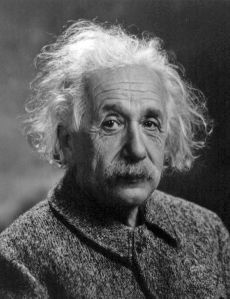
A presentation on Albert Einstein (1879-1955), one of the best-known Jews of the twentieth century. Although he had a complicated relationship with Judaism, he maintained a distinct pride in his Jewish identity, and once said “A Jew who abandons his Judaism is like a snail that abandons its shell. It’s still a snail.” The lecture was delivered at the Young Israel of Bal Harbour on May 22, 2013.
Here’s the improved version, edited by TorahCafe with the missing powerpoint. Thank you Torahcafe.com! Please click on the icon below:
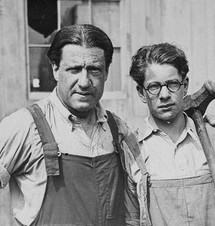
Stephen S. Wise and son (1918). Source: Wikipedia Commons.
A presentation on the life and work of Stephen Samuel Wise (1874-1949), an important American communal leader. The lecture will take a broader focus, looking at the history of Jewish settlement in the United States during the 19th century and the major issues facing this immigrant community through the middle of the twentieth century. The lecture was held at Young Israel of Bal Harbour.
Notes from the Presentation:
Stephen Samuel Wise
Henry Abramson
Touro College South
Young Israel of Bal harbour
Stephen Silver Wise
Born Budapest 1874
Reform Rabbi
Major Jewish Activist
American Zionist
Controversial leadership during Holocaust
Died 1949
Haredi to Neolog
Long line of Rabbis
Grandfather Joseph Hirsch Weisz ultra-Orthodox
Father Aaron also ultra-Orthodox, immigrates to USA and becomes founding member of Jewish Theological Seminary
Stephen Samuel Wise prominent Reform leader, founder of Jewish Institute of Religion (later merges with Hebrew Union College)
The Denominational Spectrum
Immigration to the USA
Father Aaron Rabbi, social liberal
Attempts to unionize workers in father-in-law’s porcelain factory
Father-in-law buys him one-way ticket to New York
German vs Eastern European immigration
Earliest Jewish immigrants: Sefardic Jews
German Jews mid-19th century
Massive wave of Eastern European Jewry after 1881
Education
Ordination 1893 (Adolph Jellinek of Vienna)
Columbia PhD, 1901
Dissertation: translation of Shlomo ibn Gabriol
American mid-century model of “Scholar-Rabbi”
Family
Married Louise Waterman, 1900, took position at Temple in Portland, Oregon
Disciple of Felix Adler’s Ethical Culture movement
Translator, author, social activist
Son author, art specialist (wrote biography of mother)
Daughter author, judge, advisor to Eleanor Roosevelt
The Free pulpit
1906 turned down offer to lead Congregation Emanu-el over issue of a “free pulpit”
Returns to Oregon but comes back to NYC one year later, founds The Free Synagogue
Free pulpit, free seats
American Liberalism
Co-founder of National Association for the Advancement of Colored People (NAACP, 1909)
American Civil Liberties Union (ACLU, 1920)
Promoted labor causes, attacked corruption
forced resignation of New York mayor James Walker (1932)
Founded and led American Jewish Congress (more activist than American Jewish Committee)
American Zionism
Classical Reform position on Zionism
Founded New York Federation of Zionist Societies (1897)
Worked closely with Herzl
American secretary in World Zionist Congress in Basle (1898)
Involved in drafting text of the Balfour declaration
Ethnic Voting Patterns, 2008
Jewish Denominational Voting Patterns (2008)
International Politics
Close to President Wilson
Represented Zionism at Versailles Peace Conference
Writings
Multiple volumes of memoirs, speeches, sermons
Leadership During the Holocaust
Controversy
How much pressure to put on Roosevelt, State Department?
Advocated strong anti-Nazi policy since 1930s, but criticized for tepid response during war
The Riegner Telegram
August 1942
Telegram addressed to Wise, but intercepted at State Department
Confirmed existence of the “Final Solution”
Wise received it from British parliament
Reaction
Met with Roosevelt in 1943
30 minutes, mainly Roosevelt talking
Should Wise have invoked his fiery rhetoric and public persona?
A study of the life of Menachem Begin (1913-1992). A native of Poland, he was a proponent of Vladimir Jabotinsky’s Revisionist party that stood in dramatic contrast to the dominant left-wing tendency in the Zionist movement. A major figure in Israel’s struggle for statehood, and a founder of the Likud party, he was elected to the office of Prime Minister in 1977. Despite his hawkish ideology, he was the first Israeli leader to sign a peace treaty with an Arab country. Lecture was recorded on Wednesday, May 1 at the Young Israel of Bal Harbour.
Golda Meir (1949), Photograph courtesy T. Brauner and Wikipedia Commons
A presentation of the life of Golda Meir (1898-1978), spanning her immigration to Israel in 1921 through the end of her term as the fourth Prime Minister of Israel in 1974. The lecture will discuss the foundations of the Yishuv, the pre-state Jewish community, and touch on the major social and military conflicts that Israel endured during the first three decades of its existence. The lecture was held at Young Israel of Bal Harbour.
Evgenia Ginzburg (1904-1977) was a Jewish woman who endured the horrors of the Stalinist Gulag. Charged and convicted of anti-Soviet activity in 1937, she was sent to the infamous work camps of Siberia for nearly two decades until her case was reviewed two years after Stalin’s death. She was ultimately rehabilitated, and published her memoirs of the ordeal. Her life story is illustrative of the tenuous situation of Jews in the Soviet Union during the Stalinist period.
Here’s the improved TorahCafe version. Please click on the icon below:
An examination of the life and work of Emanuel Ringelblum (1900-1944), the heroic Polish scholar who organized the underground Oneg Shabbat society in the Warsaw Ghetto. Ringelblum recognized the extreme and unprecedented nature of the Nazi onslaught early in the war, and brought together a group of highly dedicated volunteers who recorded every aspect of Jewish life in the ghetto, including a functioning underground medical school, theaters, newspapers and the like. Betrayed to the Germans, he died a martyr’s death, but not before he buried the Oneg Shabbat archives in milk cans. They were unearthed after the war, and constitute a major source for the study of the Holocaust.
Here’s the improved TorahCafe version. Please click on the icon below:
Solomon Mikhoels (1890-1948) was one of the most prominent actors and directors in early Soviet Russia. His career coincides with the brief flourishing of Yiddish culture under the policy of korenizatsiia, or “indiginization,” when the Communist authorities sought to develop folk culture as a means of developing loyalty to the new regime and its ideology. Performing in Shakespeare and Sholom Aleichem with equal grace, Mikhoels was a hero to Jews throughout the Soviet Union until Stalin brought the liberal policy to an abrupt end.
Shimon Dubnow (1860-1941), a noted historian and activist whose theories of Jewish survival in the diaspora were extremely influential in the shaping Jewish identity in the modern world, from the future of Russian Jewry to the establishment of the modern Federation movement in the United States. Dubnow’s scholarship was inextricably intertwined with the effort to establish equal rights for Jews in the Tsarist Empire during a period of phenomenal change. Martyred at the hands of the Nazis, his last words were “shrayb–un farshrayb” (write..and record), a Yiddish phrase that has motivated generations of Jewish historians.
Here’s a link to the improved TorahCafe version. Click on the link below:
Moses Mendelssohn was a hugely influential thinker in 18th-century Germany. An unusually gifted intellect, he became the primary spokesperson for the emancipation of Jews in the 18th century, and his cause was championed by many non-Jewish liberals of the era. Heralded as the founder of the Reform movement even though Mendelssohn himself maintained an observant lifestyle, his activity spawned a wholesale abandonment of traditional Judaism. Within a century of his death, his strategy of acculturation to the modern era was widely accepted by most Jewish thinkers in western Europe, but not a single one of Mendelssohn’s descendants remained Jewish.
Please click here to view the version of this lecture edited by torahcafe.com.
Nathan of Hanover is best known for his moving chronicle of the Khmel’nyts’kyi (Chmielnicki) Rebellion. Entitled Yeven Metsulah (“The Abyss of Despair”), it records with remarkable fairness the social, political, economic and religious background of the mid-17th century Ukrainian movement against the Poles, along with the horrible pogroms perpetrated in the context of that violent era. His analysis of the overall demographic impact of the attacks has been challenged by modern scholarship, but Hanover’s powerful treatment of the martyrdom of Ukrainian Jewry made a powerful impact on Jewish memory for centuries.
Here’s a link to the improved TorahCafe version. Please click on the icon below:





 Henry Abramson
