Monday March 3: Please join me for this public lecture!
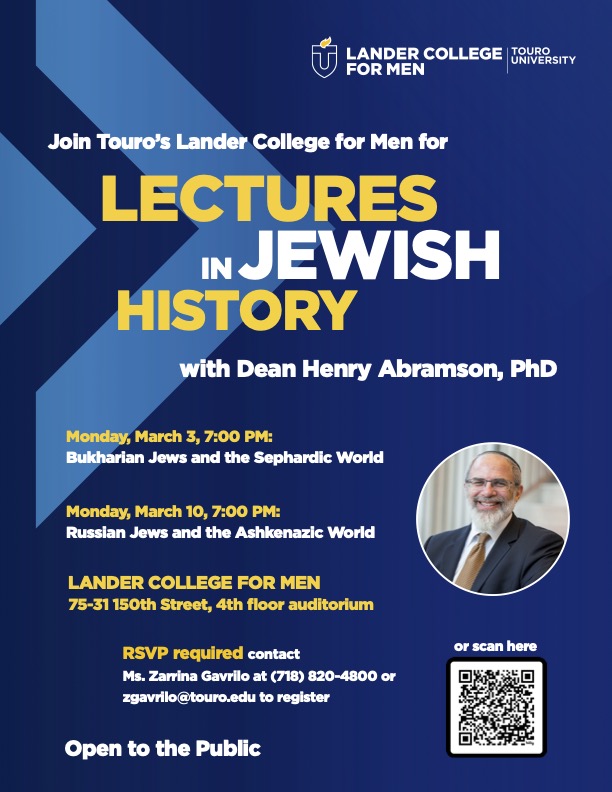
Lectures in Jewish History and Thought. No hard questions, please.

Contact their offices for details:


With Dr. Sharon Liberman Mintz, Judaica curator for Southeby’s, at a private viewing of this amazing 14th century Spanish Bible.






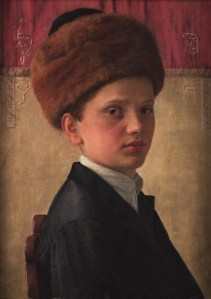

Reeling from the humiliating defeat of the Crimean War, the Russian Empire decides its policy of forcibly conscripting Jewish boys into military service is counterproductive, and finally abandons the cruel decades-old policy of taking underage children into thirty-one years of military training and service.
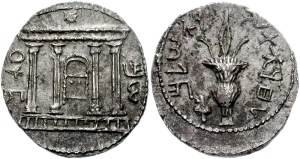
To view the Prezi associated with this lecture, please click here. Excerpt from “The Jewish Diaspora: A Brief History” Henry Abramson 3. The Roman-Jewish Wars Our sources for the Roman-Jewish wars of the first and second centuries are more substantial than those of earlier periods, primarily because the importance of developments in this tiny…
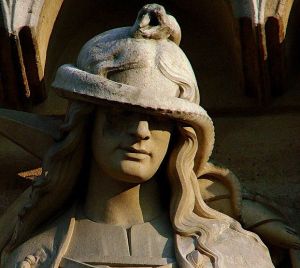
Born in turbulent times, Christianity emerged from its intensely Jewish roots to become the official religion of the Roman Empire within a remarkably brief period of time. As a daughter religion to Judaism, however, dissent between the two faiths slowly dominated the discourse as Christianity became less of a Jewish movement, and more of a…

The summer of 1321 was plagued with rumors that Jews had entered into a conspiracy with lepers (some versions also included Muslims) to poison the wells of Europe, resulting in mass hysteria and mob violence. King Philip V was eventually able to quell the movement, but it resurfaced twenty years later in a much more…

In August of 1778, the non-Jewish writer Gotthold Ephraim Lessing wrote to his brother of a new literary project designed to further tolerance of Jews in German society. The result was Nathan the Wise, a sensation that was initially banned by the Church and heavily criticized by antisemites of the day.
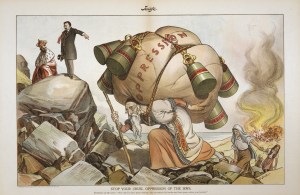
Officially banned in 1479, no Jews lived in the Russian Empire until Tsarina Catherine II conquered a major portion of Polish territory, instantly inheriting the largest single concentration of Jews in the world. Under her rule the Pale of Settlement was established, determining the region where Jews were allowed to reside, however tenuously, until the…

To view the Prezi associated with this lecture, please click here. Excerpt from “The Jewish Diaspora: A Brief History” Henry Abramson 2. Jews and Judaism in the Year Zero Two Jews, three opinions. The year zero was not nearly as auspicious or significant for Jews as it would later be for Christians. Jews observe a…

Instructions: please watch the lecture, review the reading below, and kindly take the anonymous poll. Thank you! To view the Prezi associated with this lecture, please click here. Excerpt from The Jewish Diaspora: A Brief History Henry Abramson 1. What is Jewish History? “They tried to kill us, we survived, let’s eat.” So runs the…
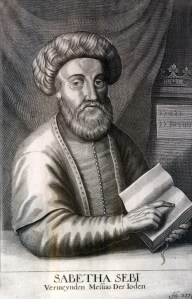
Devastated and demoralized after the violence of the Khmelnytsky rebellion, the Jews of Europe were astounded to hear that a young Kabbalist named Shabbetai Tsvi had proclaimed himself the long-awaited Messiah.
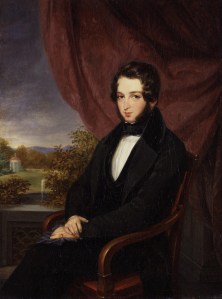
In 1847, the citizens of London elected its first Jew, Lionel de Rothschild, to the House of Commons. Rothschild, however, refused to take the Christian oath required of all members, and resigned without taking his seat in Parliament. He was immediately reelected a second and even a third time until the Jews’ Disabilities Act was…

Beloved for his children’s stories, Henryk Goldszmidt wrote under the pen name Janusz Korczak. A lifelong advocate for children’s rights, he ran an orphanage in Warsaw that was world-famous for his innovative pedagogic techniques. Imprisoned in the Warsaw ghetto during the Nazi occupation, he continued to serve in this capacity until the terrible order…

 Henry Abramson