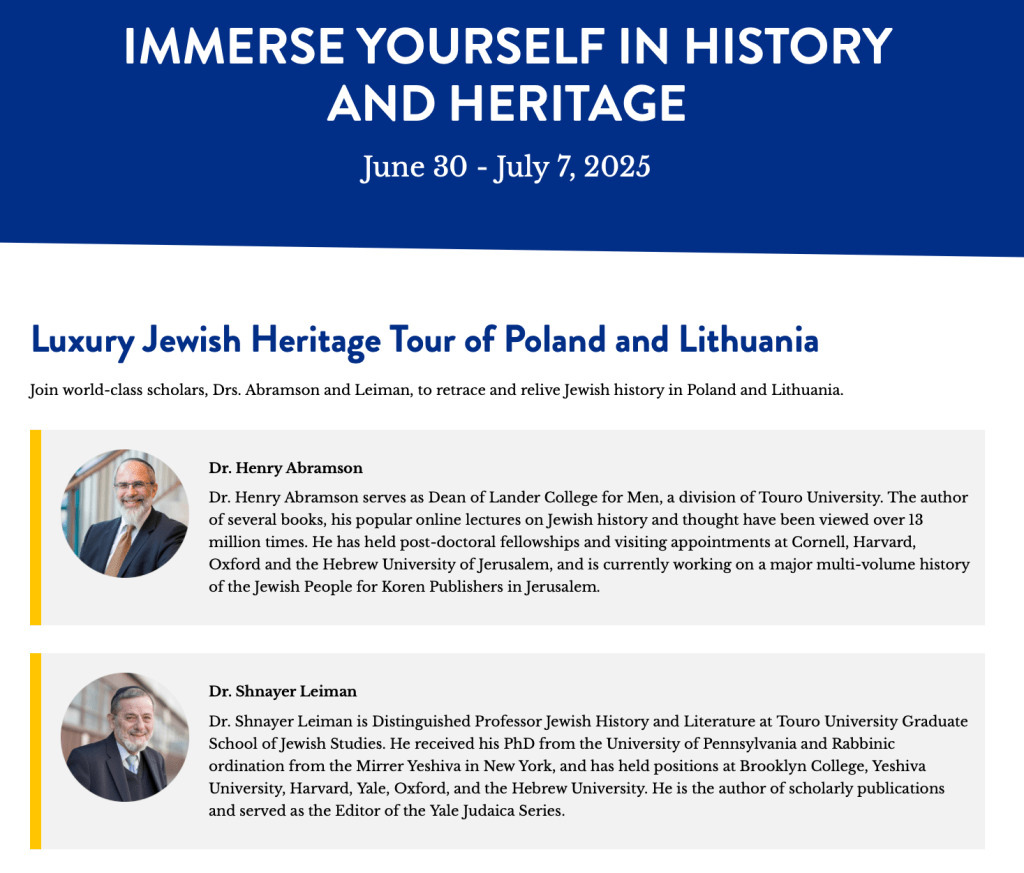
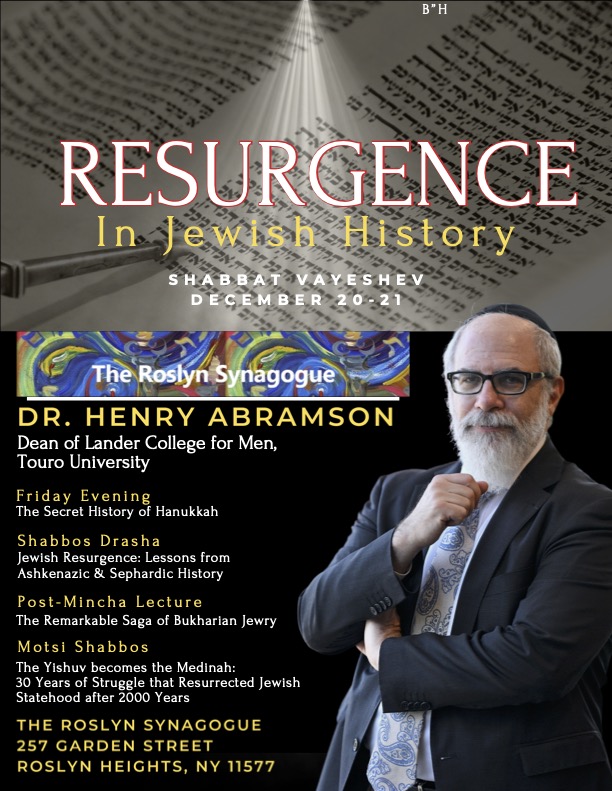
Really looking forward to meeting this community!

Lectures in Jewish History and Thought. No hard questions, please.


This brief lecture inaugurates a new series: Essential Lectures in Jewish History, brief overviews of major themes and periods, designed as introductions to more detailed treatments in the Jewish Biography as History s series. Enjoy in good health! Lectures by Dr. Henry Abramson. To view the Prezi associated with this lecture, please click here.
My son Alexander shows up in official Miami Marathon video at 0:38 seconds (red bandana) http://youtu.be/gxJRzYzQfoQ Please sponsor him at http://www.teamfriendship.org/Alexander to help kids with disabilities!

Hello everyone: my son Alexander is once again training to run the ING Miami Marathon to raise funds for Friendship Circle, a non-profit organization that helps children, teens and adults with special needs. Alexander is an avid runner with a long history of running for charitable causes: in 2010 he ran his first half-marathon (at……

Emerging from the sixteenth-century Safed Circle of Jewish mystics, Rabbi Isaac Luria (the Arizal) was a pivotal figure in the history of Kabbalah. His influence on later Jewish movements, in particular Hasidism, is still felt to this day. Part of the Jewish Biography as History lecture series by Dr. Henry Abramson.

David Reubeni was one of the most colorful messianic figures of Jewish history. A little person with a shady background, he was received with dignity by Popes and Kings in the fifteenth century, regaling them with tales of the Jews of the east and promising them great military victories should they enlist his service. He……

Nahmanides (Rabbi Moshe ben Nahman, or Ramban) was one of the most important thinkers of Jewish history. Brilliantly creative and intellectually courageous, his commentary on the Torah is widely studied eight centuries after his passing. Part of the Jewish Biography as History series by Dr. Henry Abramson.

American-born Henrietta Szold was an extremely influential Zionist leader and organizer, founder of Hadassah, the Women’s Zionist Organization of America. To view the Prezi associated with this video, click here.

Nicholas Donin was an erstwhile Talmudic scholar who converted to Christianity and made a career of denouncing the Talmud. His charges, brought before the Pope, resulted in a massive destruction of priceless Jewish manuscripts in Paris, 1242. Part of the Jewish Biography as History lecture series by Dr. Henry Abramson.

Rabenu Gershom, Me’or Ha-Golah (Our Teacher Gershom, Light of the Exile) was one of the most influential Jewish legislators of the High Middle Ages, affecting a wide variety of Jewish practices including monogamy, divorce law, and the right to privacy. Part of the Jewish Biography as History lecture series by Dr. Henry Abramson.

Yocheved was the daughter of one of Judaism’s greatest scholars: Rabbi Shlomo Yitzhaki, better known as Rashi. A fascinating woman in her own right, this lecture will survey some of the references to Yocheved (and her illustrious sisters) and what light this sheds on the history of medieval Jewish women.


Wrongly accused of espionage, Captain Alfred Dreyfus was sentenced to Devil’s Island on the basis of remarkably tenuous evidence. May critics, including the famous writer Emile Zola, argued that Dreyfus was unfairly charged simply because he was a Jew in the French army. As evidence mounted that another officer was guilty, the Dreyfus Affair exposed……

Captured by the Romans, Josephus was a Jewish general who ultimately served as a military advisor to General Titus. Josephus recorded his first-hand observations of the destruction of the Temple, and went on to a brilliant literary career in Rome, describing Jews and Judaism to a wider audience. Who was Josephus–traitor to his people or……

Rembrandt is well-known for his depictions of Jewish subjects, both as contemporary portraits and as models for Christian biblical characters.

Photo: Aryeh Abramson looks out over Iroquois Falls, Ontario, Canada, where he spent the Sukkot vacation visiting his grandparents. Captured by the Roman General (and later Emperor) Vespasian while defending the Galilee, Josephus ultimately turned against his coreligionists and served as an advisor to the forces besieging Jerusalem during the first Roman-Jewish War. His first-hand……

Moses Maimonides (1135-1204) was one of the greatest minds the Jewish people ever produced: philosopher, jurist, physician, and an extremely prolific writer who left us classics like The Guide for the Perplexed and the Mishneh Torah. For several years I have been in the habit of reviewing his Laws of Repentance in the weeks leading up to the……

Pope Gregory I (“the Great”) was one of the most influential Church leaders of the medieval period. His policy on the treatment of Jews in Christian Europe, known by the Latin phrase “Sicut Judaeis,” instituted an official if ambivalent position that lasted from the sixth century to the beginnings of the modern era.

Reeling from the humiliating defeat of the Crimean War, the Russian Empire decides its policy of forcibly conscripting Jewish boys into military service is counterproductive, and finally abandons the cruel decades-old policy of taking underage children into thirty-one years of military training and service.

To view the Prezi associated with this lecture, please click here. Excerpt from “The Jewish Diaspora: A Brief History” Henry Abramson 3. The Roman-Jewish Wars Our sources for the Roman-Jewish wars of the first and second centuries are more substantial than those of earlier periods, primarily because the importance of developments in this tiny……

Born in turbulent times, Christianity emerged from its intensely Jewish roots to become the official religion of the Roman Empire within a remarkably brief period of time. As a daughter religion to Judaism, however, dissent between the two faiths slowly dominated the discourse as Christianity became less of a Jewish movement, and more of a……

The summer of 1321 was plagued with rumors that Jews had entered into a conspiracy with lepers (some versions also included Muslims) to poison the wells of Europe, resulting in mass hysteria and mob violence. King Philip V was eventually able to quell the movement, but it resurfaced twenty years later in a much more……

In August of 1778, the non-Jewish writer Gotthold Ephraim Lessing wrote to his brother of a new literary project designed to further tolerance of Jews in German society. The result was Nathan the Wise, a sensation that was initially banned by the Church and heavily criticized by antisemites of the day.