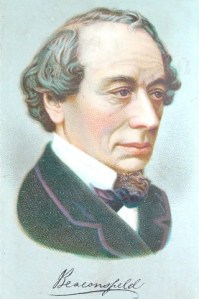
Baptized at age 12 as the result of his father’s dispute with a synagogue, Benjamin Disraeli (1804-1881) rose to prominence as a novelist and politician, serving several times as England’s Prime Minister. Colorful and flamboyant, Disraeli dismissed his antisemitic critics by emphasizing, rather than downplaying, his Jewish origins.
The discovery of the mutilated body of a young boy in Kiev led to the false arrest of a Jewish laborer named Mendel Beilis. Ignoring the argument of investigating officers, the Russian government under Tsar Nicholas II pressed ahead with the prosecution of Beilis, arguing that the boy was murdered as part of a Passover-related Jewish plot. After two years’ imprisonment, Beilis was freed by a Ukrainian Jewry that could not be persuaded to agree with the Russian prosecutor. Part of the This Week in Jewish History series by Dr. Henry Abramson.
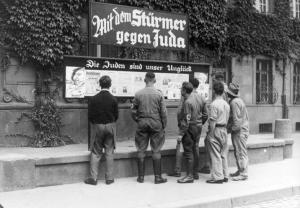
Germans read Streicher’s propaganda. Sign reads “With The Sturmer Against the Jews.” Source: Bundesarchiv via Wikimedia Commons.
In October of 1946, ten Nazi defendants were hung on gallows erected by the International Military Tribunal. One of the most notorious, the propagandist Julius Streicher, uttered the phrase “Purimfest 1946” moments before his death, unconsciously echoing a mysterious passage in the Biblical book of Esther itself. Fascinating footnote in Jewish History!
Blessed with a fine mind but an obstreperous personality, Salomon Maimon was one of the most erudite rebels against Judaism in the 18th century, leaving a powerful memoir that betrayed some of the stress points in traditional society.
Obliterating Haman’s Name, early 18th century. Public domain: Jewish Encyclopedia via Wikimedia Commons
Murder on Purim? That’s the charge of Socrates Scholasticus, whose lone account of an alleged Purim celebration that got out of hand in the year 415 has become part of the historical record, for good or ill. Although the validity of the accusation is highly questionable, the incident at Inmestar had a larger impact centuries later as the myth of ritual murder gained popularity in medieval Europe.
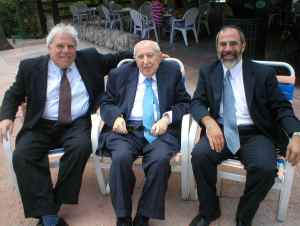
Dr. Bernard Lander (1915-2010) was one of the most influential Jewish educators of the 20th and 21st century. Scholar and social activist, he founded Touro College in 1971, which now serves almost 19,000 students world wide. This short video was prepared to commemorate the recent anniversary of his passing.
Author of the Tanya, a hugely influential 18th-century work of Jewish spirituality, Rabbi Scheur Zalman of LIadi is considered the founder of the Chabad (Lubavitch) movement.
The appearance of Rabbi Schneur Zalman of Liadi’s Tanya at the turn of the 19th century represented a sea change in Eastern European Jewish history. With this work, the Chassidic revolution, which had been building momentum in western Ukraine and southern Poland, burst into a constituency that had until that point prided itself on its immunity to the Kabbalah-inspired populism of the Ba’al Shem Tov.
The publication of Tanya dramatically illustrated the profound intellectual foundations of Chassidic thought, placing it in direct competition with the traditional Talmudic community in Lithuania for the hearts and minds of spiritually sensitive Jews. The Lithuanian yeshiva community, centered around Rabbi Chaim of Volozhin, principal disciple of the recently deceased Vilna Gaon, could no longer dismiss the chassidim as superstitious, uneducated folk (or worse, as neo-Sabbatean heretics).
The Tanya placed Chassidism firmly within the Jewish literary tradition, articulating a fully documented path to holiness that had until then received little attention from more left-brained Talmudic thinkers.
The book itself was published in several stages, some posthumously, until it reached its current form in 1804. It begins with the modestly titled LekuteiAmarim (“Collected Statements”), which is a bold and psychologically gripping analysis of the human condition. Opening with the Talmudic passage that describes the angelic oath given to a person in utero (“be righteous and not wicked”), Tanya offers a remarkably original and persuasive description of the inner conflict of the soul as it encounters the challenges and temptations of the temporal world.
The title “Tanya,” literally “it is taught,” is taken from the opening line of this Talmudic citation. The remaining four sections of the work continue the discussion in several modalities, including a novel understanding of the meaning of repentance and deeper Kabbalistic insights on the nature of the soul. Overall, the work is deceptively complex, with sections that appear highly accessible while others hint to arcane, elusive depths.
The Tanya is known as the “Written Torah of Chassidism” because it represents the first work authored directly by a Chassidic master (previous works were collections of teachings published by various disciples). Rabbi Schneur Zalman is recognized as the first Rebbe of the Chabad movement, but the influence of his work reaches into every Chassidic dynasty and is regarded with great respect by non-Chassidic thinkers as well.
Tanya proved itself highly popular in the yeshiva world, much to the chagrin of traditional authorities, who could barely keep Talmudic students away from its intoxicating introduction of Kabbalistic concepts to pragmatic elements of the Jewish condition. In response, Rabbi Chaim of Volozhin composed his master work, Nefesh HaChaim (1824), a Lithuanian-style primer in Kabbalah that provided an alternative to students attracted to the rapidly expanding Chassidic movement.
For its part, Chabad embraced Tanya by instituting a daily study regimen to promote yearly completion of the entire work. Tanya remains a brilliant gem in the treasure of Jewish spirituality.







 Henry Abramson