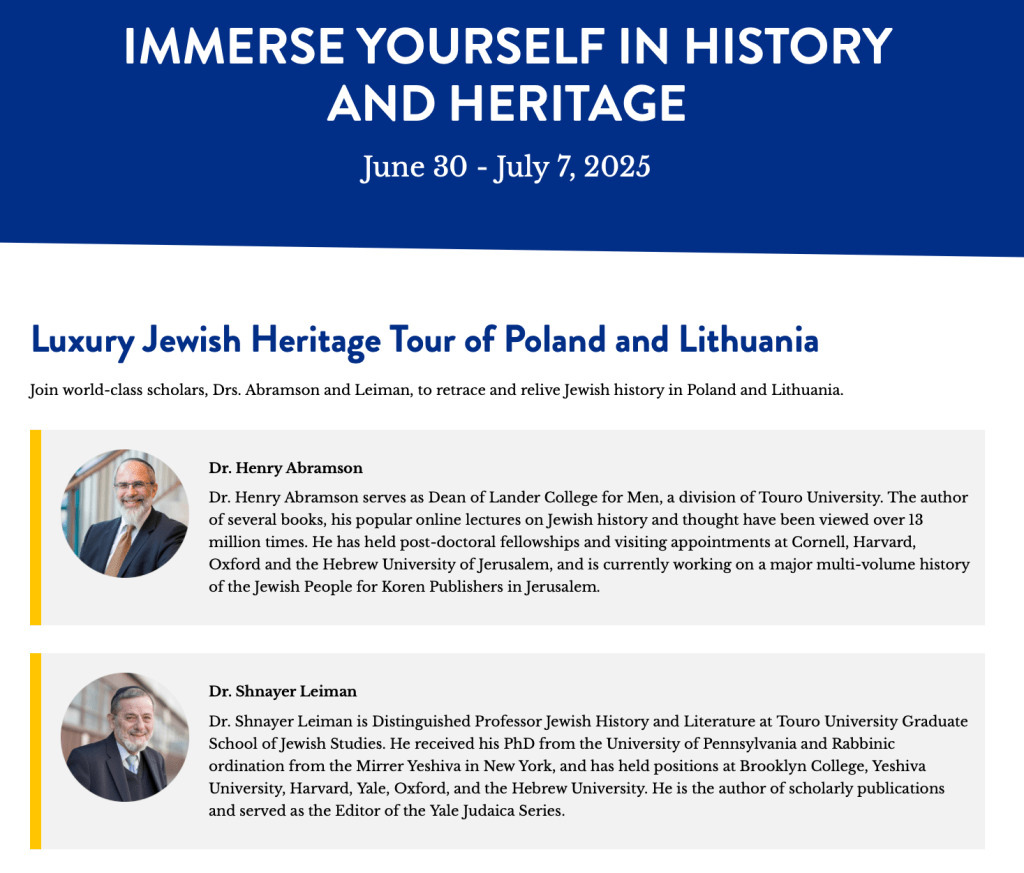
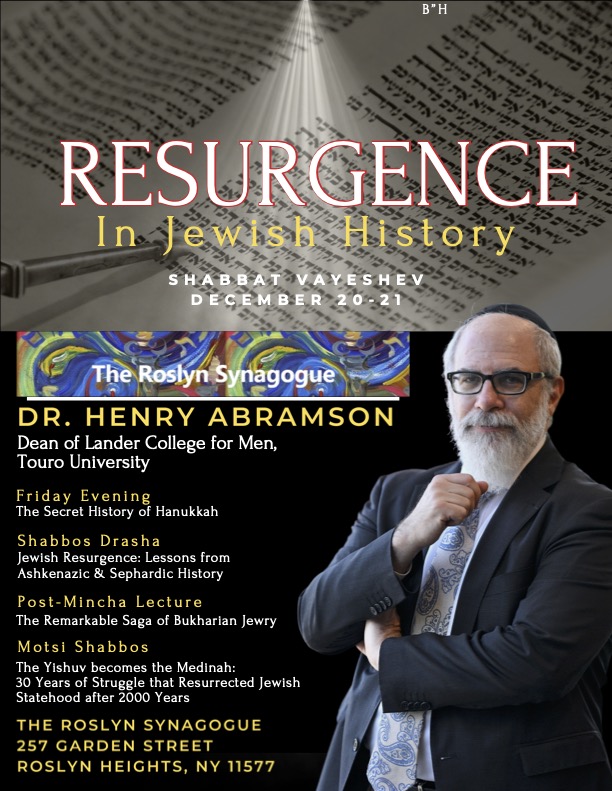
Really looking forward to meeting this community!

Lectures in Jewish History and Thought. No hard questions, please.


Blessed with a fine mind but an obstreperous personality, Salomon Maimon was one of the most erudite rebels against Judaism in the 18th century, leaving a powerful memoir that betrayed some of the stress points in traditional society.

The Haskalah was a major intellectual-political movement of the 18th and 19th centuries. Seeking political emancipation and intellectual freedom, it challenged the hegemony of the traditionalist authorities, leading to widespread assimilation on one hand but exceptionally creative solutions to modernity on the other. Part of the Essential Lectures in Jewish History series. To view the……

Rabbi Eliyahu ben Shlomo, the 18th century Talmudic scholar better known as The Vilna Gaon, is revered as the father of traditional Lithuanian Judaism. Part of the Jewish Biography as History series by Dr. Henry Abramson.

Dr. Bernard Lander (1915-2010) was one of the most influential Jewish educators of the 20th and 21st century. Scholar and social activist, he founded Touro College in 1971, which now serves almost 19,000 students world wide. This short video was prepared to commemorate the recent anniversary of his passing.

Author of the Tanya, a hugely influential 18th-century work of Jewish spirituality, Rabbi Scheur Zalman of LIadi is considered the founder of the Chabad (Lubavitch) movement. People Of The Book: Classic Works Of The Jewish Tradition By Dr. Henry Abramson This article appeared in the February 25, 2016 edition of the Five Towns Jewish……

A brief overview of the settlement and activity of the Jewish people in the Polish-Lithuanian Commonwealth. Part of the Essential Lectures in Jewish History series by Dr. Henry Abramson. To view the Prezi associated with this lecture, please click here.

Bilhah Abigaill Levy Franks lived in New York City in the early decades of the eighteenth century. Her correspondence with Naftali, her eldest son, reveals much about the inner life of a Jewish woman in colonial America. Part of the Jewish Biography as History series by Dr. Henry Abramson.

Forced debates between Jews and Christians were a feature of medieval Jewish life, often with dire consequences.

Posing as a would-be convert to Judaism, Johann Andreas Eisenmenger studied Rabbinic literature for 19 years before publishing a massive two-volume denunciation of the Talmud called “Judaism Revealed” in 1711. His defamation of Jews and Judaism has been the foundation of much antisemitic diatribe for the last three centuries. Part of the Jewish Biography as……

Sarah bas Tovim was one of the most prolific authors of tekhines, prayers composed specifically for Jewish women in Eastern Europe. Her work illustrates the deeply spiritual lives of simple women, and sheds significant light on the social history of the shtetl. Part of the Jewish Biography as History series by Dr. Henry Abramson.


I’m really thrilled to be cruising the Douro River this summer with Kosher Riverboat Cruises, lecturing on the history of Spanish and Portuguese Jewry (my wife plans to come along, which means I really have to bring my A-game). I just learned that there’s only 18 cabins left, so if you’re interested, please click the……

Conference presentation at the “The 100th Anniversary of the Ukrainian Revolution and the Proclamation of Ukraine’s Independence,” held at the Ukrainian Institute, New York, Sunday, January 21. My talk was inspired by a thought-provoking article in the Forward by Avital Chizik-Goldschmidt. A fascinating panel, which included Anna Procyk of CUNY, Serhy Yekelchyk of University of……

On Parashat Beshalah (January 20, 1940), a young rebel escaped from the notorious Pawiak Prison, located not far from the Piaseczno Bet Midrash. Andrzej Kott, the 21-year old leader of the military wing of a resistance movement called the Polish People’s Independence Action, was a child of assimilated Jewish parents who had converted to Christianity….…

The recent translation of the work of Rabbi Shimon Gershon Rosenberg (Rav Shagar, 1949-2007) promises to elevate his distinctive thought to a broader audience of readers (Faith Shattered and Restored: Judaism in the Postmodern Age), many of whom will resonate with Dr. Yitzchak Mandelbaum’s comment on his discovery of Rav Shagar: “I knew I had……

The Rebbe’s entry for Parashat Bo (January 13, 1940) is unusual. Recorded in the scribe’s careful hand, with minimal annotation, it has two bold diagonal lines drawn through the center of the text, indicating that the Rebbe rejected it altogether. A brief and uncharacteristic first-person comment is appended: “more of what we said I do……

Really nice to meet with Jésica Neuah of Editorial Perspectivas to work on the tentative cover and book design of the Spanish edition of The Kabbalah of Forgiveness! Great to work with her and the whole team. G-d willing the book will be released in the summer of this year.

I had chills listening to Rabbi Shlomo Katz review the Rebbe’s words on this week’s parashah. I am grateful for his kind words of praise for my recent book on the historical context of the Aish Kodesh, but to tell the truth, I hardly recognized my own words from the masterful treatment they received from……

Chaim Kaplan recorded the mood in the Warsaw Ghetto in January 1942: The cold is so intense that my fingers are often too numb to hold a pen. There is no coal for heating and electricity is sporadic or nonexistent. In the oppressive dark and unbearable cold your mind stops functioning. Yet even in such……

Five months into the Nazi occupation, the Jews of Warsaw struggled to keep up with the barrage of administrative decrees inflicted upon them by the Germans. When the Rebbe spoke on Parashat Vaera, which fell on January 6, 1940, the worst was still far off. The Nazis had replaced the leadership of the Jewish Council……

The winter of 5702 brutalized the Jews of the Warsaw ghetto with unforgiving cold. Chaim Kaplan, a school principal whose journal Scroll of Agony survived the war, recounts in his typically blunt prose how the physical privations of January 1942 affected the spiritual life of Ghetto inhabitants: Gone is the spirit of Jewish brotherhood. The……

The Sephardic Diaspora Spring 2018 Lecture Series Monday Nights @ 7:00 pm Main Auditorium, Touro College, 1602 Avenue J Brooklyn NY 11230 (718) 535-9333 Free and Open to the Public No hard questions, please. Image: Eleanora of Toledo, student of Benvenida Abravanel February 5: Who Was Benvenida Abravanel? February 12 :Who Was Samuel Usque? (No Class Feb……

On December 27, 1941, the Piaseczno Rebbe delivered his last recorded drashah on Parashat Vayigash in the Warsaw Ghetto. The previous month was especially brutal: an especially cold winter, combined with a severe coal shortage, exacerbated the typhus epidemic, and each morning a detail of the chevra kadisha patrolled the streets to collect the bodies……