Famed author of the Lecha Dodi hymn sung on the eve of the Jewish sabbath, Rabbi Alkabets was one of the founding members of the 16th-century school of Kabbalists based in Safed (Tsfat), Israel.
Next week’s lecture: Gluckel of Hameln!
Love Yiddish culture? Check out the new poster for the 2015 Kultur Festival in Boca Raton! I’m really proud to be doing a book reading (The Kabbalah of Forgiveness) there on March 6. Main event, as always, will be Maestro Aaron Kula’s phenomenal Klezmer Company Orchestra concert on March 1!
Early adopters of the newest disruptive technology, the Soncino family were the first Jewish printers in 15th century Europe. This lecture discusses some aspects of the early decades of Jewish printing, and meditates on the meaning of the current digital revolution for Jewish culture and society.
Planning to attend Limmud Miami this year?
I would love to see you at the session on The Kabbalah of Forgiveness! Register here.
Rabbi Shlomo ben Adret, known to his student by the acronym of his name Rashba, was one of the most brilliant Talmudists of medieval Spain. Student of Nachmanides (Ramban) and teacher to the Ritva, his writings are studied to the present day.
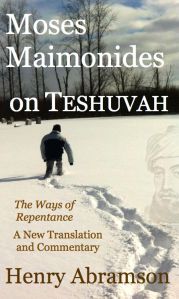
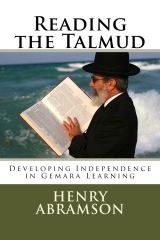
Here’s Dr. Abramson in print (because there are times and places where one just can’t enjoy a video). Check out the eBook versions as well.
Preserved in a medieval anthology of women poets, Qasmunah’s unique voice stands out as one of the few surviving voices of the Jewish Golden Age in Spain.
Recent Publications by Dr. Abramson (better in print than on video anyway):
What, exactly is Chanukah (or is it Hanukah, or Hannukkah)? This short video describes the historical origins of the holiday, notes the ironic nature of its observance in the American context, and has a couple of jokes besides.
Suggested Holiday Gifts (Maybe for people you don’t especially like).
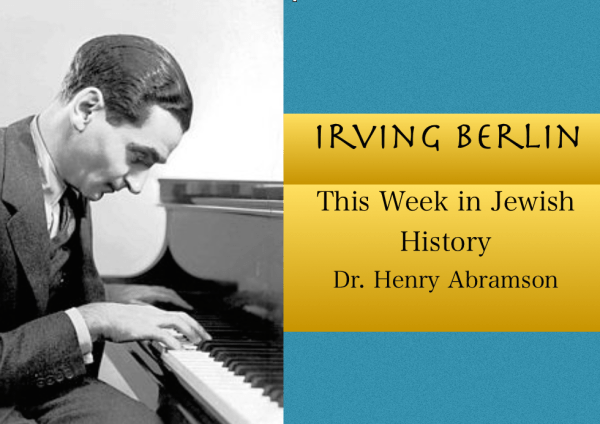
At this time of year it’s impossible to escape the ubiquitous holiday music that assults us whenever we turn on the radio or walk through a shopping mall. Few listeners are aware, however, that the syrupy, commercialized versions of holiday cheer have their origins in the musical genius of a Jewish immigrant from Siberia, the phenomenal Irving Berlin. Whatever we may think of the 21st century interpretations of his work, it is undeniable that Berlin had the amazing ability to express the core values of American culture in a way that transcended religious ideology.
Here’s some additional useful comments from Dr. Carl Singer:
His actions were acknowledged with such accolades as the Army’s Medal of Merit from President Truman in 1945; a Congressional Gold Medal for “God Bless America” and other patriotic songs from President Eisenhower in 1954; and the Freedom Medal from President Ford in 1977. In 2002, the U.S. Army at Fort Belvoir, Virginia, named the Army Entertainment Division (AED) World Headquarters “The Irving Berlin Center” in his honor. Also that year he was commemorated on a U.S. postage stamp.
I believe there was a slight error towards the end of the presentation: “CongressionalMedal of Honor” — is likely a misnomer. To the best of my knowledge there is no such medal.
There is the Congressional Gold Medal. The “Medal of Honor” (no “Congressional“) is the nation’s highest military award.
Reputed to be the wealthiest man in 11th century England–wealthier even than the King–Aaron of Lincoln was a hugely successful moneylender whose achievements included the financing of many cathedrals. His story, while exceptional in terms of scope, is nevertheless instructive of the Jewish experience in the medieval economy as a whole.
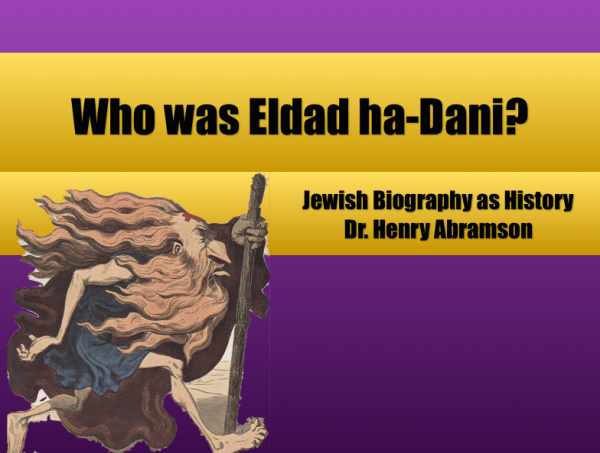
Claiming descent from the long-lost Ten Tribes of Israel, Eldad was a ninth-century traveler with a fantastic story: beyond the “River Kush” lay an intact civilization of Jews who enjoyed political sovereignty, in preparation for their eventual return to the Land of Israel in messianic times. Surviving shipwreck, cannibals and attack from fire-worshipping pagans, Eldad’s story of the mystical river Sambatyon and the Jews who lived there captivated the Jewish mind for centuries, and had a lasting impact on the development of Christian thought as well. But was he for real?
Dr. Abramson is way better in print (and taller, too):
Emerging from a cave after twelve years of isolated Torah study, Rabbi Shimon Yohai went on to become one of ancient Israel’s most celebrated Kabbalists and leaders of the Jewish people.
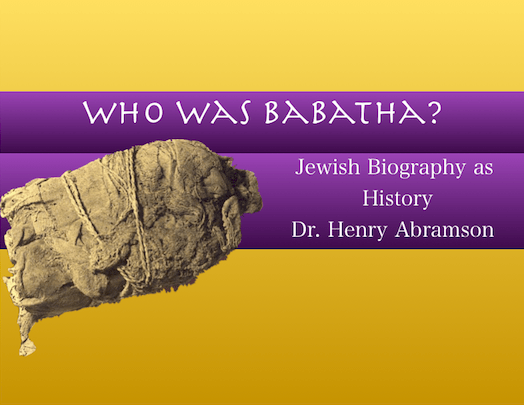
Rolling her precious documents and carefully wrapping them in a leather pouch tied with twine, Babatha buried her entire legal history in the floor of the cave she shared with Bar Kochba’s rebels. They would remain entombed in that desolate refuge for 1800 years until their discovery by archaeologist Yigael Yadin, and then the life of an otherwise forgotten 2nd-century woman suddenly came to light: her marriages, custody battles for her son, property disputes, and much more. The Babatha archive constitutes an amazing source of information for the history of Jewish women in ancient Israel.
















 Henry Abramson